


The Four Venue Models, Side by Side
There is no single best wedding venue in Istanbul, but there is usually a best venue model for a given wedding. A Bosphorus hotel suits larger international guest lists that need rooms, weather cover and a multi-day programme in one place. A waterfront yalı or mansion suits couples who want the whole property to themselves and a setting directly on the water, and who accept that guests will sleep elsewhere. A palace or historic property suits ceremonial weddings where the building itself carries the occasion, and where heritage rules will shape what can be built. A rooftop or terrace suits smaller city-facing celebrations with a skyline rather than a shoreline.
Most couples begin with a shortlist of individual properties. It is more productive to start with the model, because the model determines the shape of the day: how many people you can seat comfortably, whether guests sleep on site, how long you can play music, what your suppliers can build, and what happens if the weather turns. Once the model is settled, the shortlist narrows quickly and comparisons become like-for-like. The Ramarossi guide to weddings in Istanbul covers the destination as a whole; this article deals only with the choice between venue types.
| Bosphorus hotel | Waterfront yalı or mansion | Palace or historic property | Rooftop or terrace | |
|---|---|---|---|---|
| Typical scale | Largest headroom, ballroom plus outdoor space | Medium, bounded by the site footprint | Varies, often limited to specific rooms | Smallest, reduced further by production |
| Guests sleep on site | Usually yes | Usually no | Only where the property is also a hotel | Often yes, at smaller scale |
| Exclusive use | Normally requires a full buyout | Commonly whole-property hire | Varies, some sites keep public access | Terrace only, hotel below stays open |
| Relationship to the water | At the water or elevated above it | Directly on the shoreline, own quay | Waterside or inland, depending on the site | Skyline view, water often distant |
| Weather backup | Usually an indoor room of similar size | Often smaller than the outdoor space | Limited by protected interiors | Usually a different space on a lower floor |
| Production freedom | High, within house supplier rules | Constrained by heritage and access | Most constrained | Constrained by lift and roof loading |
| Multi-day suitability | Strongest | Workable with transfers | Workable with transfers | Best as one element of a programme |
The table describes the models in general terms. Individual properties vary widely within each one. Every restriction, minimum, buyout condition, heritage rule, security rule, sound limit and supplier policy discussed below is property-specific, and must be confirmed with the individual venue in writing rather than assumed from the category.
Guest Numbers and Usable Capacity
Published capacity figures describe a room, not a wedding. A stated banquet number generally assumes round tables at standard spacing with no stage, no dance floor, no band riser, no lounge area, no long feasting tables and no ceremony seating in the same space. Once those elements are added, usable capacity falls, sometimes substantially.
Bosphorus hotels carry the most headroom, because a ballroom and an outdoor terrace or garden can be used in sequence. The important detail is that the terrace figure and the ballroom figure are rarely the same. If you need a wet-weather plan that holds your whole group, the smaller of the two is your real ceiling.
A yalı or waterfront mansion is bounded by its footprint. The quay, the garden and the interior rooms were built as a residence, so circulation, service routes and kitchen access all compete with guest space. These venues reward realistic guest numbers and punish optimistic ones.
Historic properties often occupy a generous site, but usable event space may be limited to particular rooms and terraces while other areas stay closed. A large building does not mean a large wedding.
Rooftops lose capacity to production faster than any other model, because the bar, the band and the service route all take space from the same surface. They are best treated as venues for smaller celebrations, a subject Ramarossi covers in more detail in its guide to planning an intimate wedding in Istanbul.
Rather than accepting a capacity number, ask each venue for a seating plan drawn to your actual guest count with your stage, dance floor and bar marked, and ask whether that number changes if the ceremony is held in the same space.
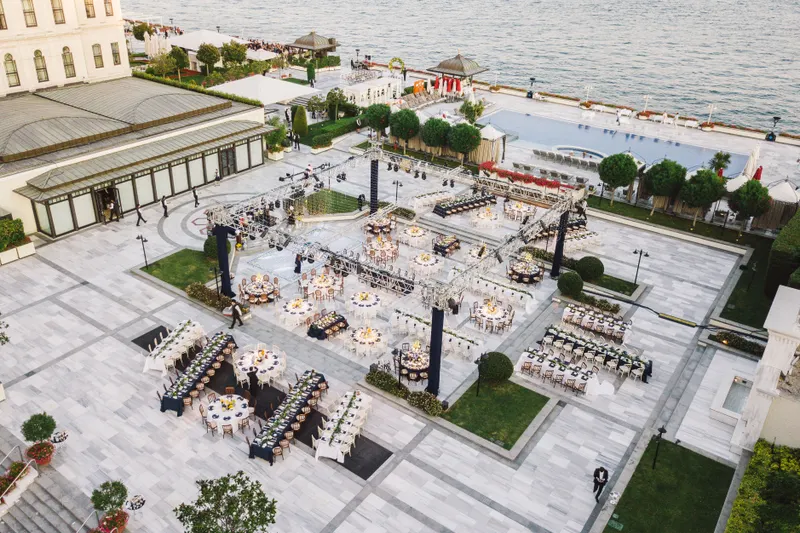
Privacy, Exclusivity and What a Buyout Covers
Exclusivity is a contractual term, not an impression formed on a site visit. The four models start from very different positions.
A Bosphorus hotel is a working hotel. Resident guests use the lobby, the terraces and the restaurants unless you take the property in full. A second event may run in another room on the same day. Where exclusive use is offered, ask precisely what it covers: the whole property, one wing, or one space.
A yalı or mansion is usually hired as a whole, which is the main reason couples choose it. Even so, some waterfront sites can run more than one event at the same time, and sound from a neighbouring celebration carries across an open garden. Ask the question directly.
Historic properties vary most. Some are private venues. Others are visitor sites where access begins only after public opening hours end, which compresses your setup and your timeline.
A rooftop generally sits on top of a working hotel or restaurant that continues trading below. The terrace may be exclusively yours while the lift, lobby and entrance are not.
Where Your Guests Sleep
For a destination wedding, the accommodation question usually decides the transport question, so it belongs early in venue selection rather than after it.
Hotels are strongest here by a clear margin. Guests sleep where they celebrate, which removes late night transfers, simplifies the arrival day, and matters a great deal for older relatives, guests with limited mobility and families with small children. It also makes an unhurried morning and a next-day brunch straightforward.
Yalı and historic venues rarely offer accommodation. Guests are housed in hotels elsewhere in the city and moved in both directions, which means coach contracting, a published transfer schedule and a plan for guests who want to leave early or stay late.
One hybrid is worth noting. Where a historic palace building operates as a hotel, you get the architecture of a palace and the logistics of a hotel in the same place. Ramarossi covers one such property in its article on wedding organisation at Çırağan Palace Hotel in Istanbul.
Ceremony and Reception Flow
A wedding day usually has three movements: ceremony, drinks reception, then dinner and dancing. The venue model decides whether those happen across three settings or in one.
Hotels handle this most cleanly. A garden or terrace ceremony flows into drinks in an adjoining space and then into a ballroom, with each space prepared in advance and no reset required in front of guests.
Waterfront venues often use the quay for the ceremony, the garden for drinks and either an interior room or a covered structure for dinner. Where the same space must serve twice, the critical question is where guests physically stand during the changeover and for how long. That interval is the most common weak point in an otherwise well-planned day.
Historic sites tend to have fixed layouts and protected rooms, and movement between spaces may be routed rather than free. Rooftops frequently ask one surface to do all three jobs, which means guests must be entertained elsewhere while the space is turned around.
Ceremony type also shapes the answer. Many international couples complete the legal marriage at home and hold a symbolic or religious ceremony in Istanbul; others plan a religious ceremony at a separate site, as in Ramarossi’s guide to planning a nikah ceremony at the Blue Mosque. Legal and civil requirements are a separate subject from venue choice and should be checked against current official guidance for your nationalities.
Bosphorus Access, Views and Arrival by Water
The phrase Bosphorus view covers a wide range. A venue may sit at the water’s edge, stand elevated above it, or look across the rooftops to a distant band of the strait. All three photograph well. They do not feel the same to a guest.
Yalı venues are on the shoreline by definition, usually with their own quay. Hotels split between waterside properties and elevated ones. Historic properties may be waterside or inland, and several of the best-known sites in the old city look over the Golden Horn or the Sea of Marmara rather than the Bosphorus. Rooftops sell the skyline first and the water second.
Arrival by boat is attractive and workable, but it depends on the venue having a usable landing, on sea conditions on the day, and on the permissions held by the boat operator. Confirm with the venue whether landing is possible on your date and what the alternative is if conditions do not allow it. Celebrations held on the water rather than beside it are a different proposition again, covered in Ramarossi’s article on a wedding ceremony on a yacht in Istanbul.
If the view is the reason you chose Istanbul, check the direction of the light at your ceremony hour. A west-facing terrace and an east-facing quay produce very different photographs at the same time of day.
Guest Transport and Istanbul Traffic
Istanbul traffic is not a background detail in wedding planning. It sets the timings of the day. TomTom’s Traffic Index for the 2025 calendar year put the average time to drive ten kilometres inside the Istanbul city area at just under 23 minutes, rising to around 33 minutes in the evening peak. Guest movements towards a wedding typically fall inside that evening peak.
The practical consequence is that distance in kilometres tells you very little. A venue fifteen kilometres from the guest hotel can be a twenty-minute journey or an hour, depending on the hour and the direction. Cross-Bosphorus movements add a further variable, because the bridges and the tunnel are the pinch points and the queue for them is where transfer plans usually fail.
Arrival airports pull in different directions too. Istanbul Airport (IST) sits at Arnavutköy on the European side, while Sabiha Gökçen (SAW) sits at Pendik on the Asian side, and guests booking independently will arrive at both. Publish that difference to your guest list early.
By model, hotels remove the problem entirely for guests staying on site. Yalı and historic venues generate the most coach movement, because everyone arrives and leaves together. Rooftop venues in central districts can have the poorest vehicle access despite being central, because narrow streets often mean no coach drop-off at the door. Where a venue has a quay, a boat transfer can be both quicker and more pleasant than a coach, but it needs a dry-weather and a wet-weather version.
Supplier Access, Load-In and Setup
Whether a design is possible matters less than whether it can be built in the window the venue allows.
Hotels have loading bays, service lifts and in-house technical teams, which makes complex builds straightforward. In exchange, they commonly restrict which suppliers may work on site, and audio-visual and catering are often held in house.
Waterfront properties are approached along shore roads with limited parking and restricted delivery windows. Some items travel by hand from the road, and some venues receive deliveries by water. This affects the scale of furniture, staging and floral installations that can realistically arrive.
Historic sites usually give the shortest and most controlled access, sometimes only on the day itself and only after visitor hours, with equipment lists submitted in advance. Rooftops depend on a single service lift shared with a working hotel, so every item has to be sized to that lift, which is a real constraint rather than a formality.
Ask for the load-in start time, the strike deadline, the access route, lift dimensions and whether an overnight build is permitted. Give those answers to your suppliers before you approve a design.
Heritage Rules, Security and Permissions
Many Istanbul wedding venues are protected buildings. Under Turkey’s Law No. 2863 on the Conservation of Cultural and Natural Property, immovable cultural property is registered by regional conservation councils, and physical intervention in registered property requires their approval. The Bosphorus shoreline carries an additional regime under Law No. 2960, which applies tighter planning control along the strait than general planning legislation.
These laws govern construction and physical alteration rather than a single evening’s event, but they shape what venues will permit. Fixings into stone or historic timber, rigging loads, heavy anchoring on a quay, open flame, and any structure that stands for more than a day are commonly restricted at protected properties. What is permitted at a given property is a matter for that property, and should be confirmed with the venue in writing before a design is approved.
Security requirements follow the same pattern. Some sites require advance guest lists, vehicle screening, restricted access to certain rooms or limits on professional equipment. These affect your invitation timeline as well as your production plan, so they belong in the first conversation rather than the last.
One point of confusion is worth clearing up. The imperial palaces most visitors know, including Dolmabahçe, Beylerbeyi and Topkapı, are operated as museums by the Directorate of National Palaces under the Presidency. Availability for a private celebration should never be assumed from the fact that a building is called a palace. The properties that host weddings are generally restored imperial-era buildings and mansions in commercial operation, some of which run as hotels.
Sound Limits and Finishing Times
Finishing time is the single most common source of late disappointment in destination wedding planning, because couples tend to discover it after the venue is booked.
Turkey’s Environmental Noise Control Regulation was published in the Official Gazette on 30 November 2022. In announcing it, the Ministry of Environment, Urbanisation and Climate Change set out that open-air events are to be held between 10.00 and 01.00, that fireworks require prior permission from the local civil authority with the time and place notified, and that the operating hours of premises broadcasting music may be reset by the provincial local environment board taking account of season, local conditions and noise mapping. Premises broadcasting music are required to hold a music broadcast permit granted on the basis of an acoustic report.
Two things follow. First, limits are set locally and can be revised, so a venue’s answer for this year is not automatically its answer for next year. Second, a venue’s own contractual limit may be tighter than the regulatory framework, particularly where neighbours are close. Sound travels a long way over water, and residential buildings sit close to most waterfront venues on both banks.
In general terms, an enclosed hotel ballroom runs latest, an outdoor terrace at the same hotel stops earlier, and yalı and rooftop venues face the tightest outdoor limits. Historic sites may add conservation-driven restrictions of their own. In every case the exact times are property-specific and must be confirmed with the venue in writing.
Ask what time amplified music must stop outdoors and indoors, whether a decibel limit applies and how it is measured, whether the venue holds a current music broadcast permit, and what happens if a complaint is made during your event. Then build the run sheet backwards from that time rather than forwards from the ceremony.
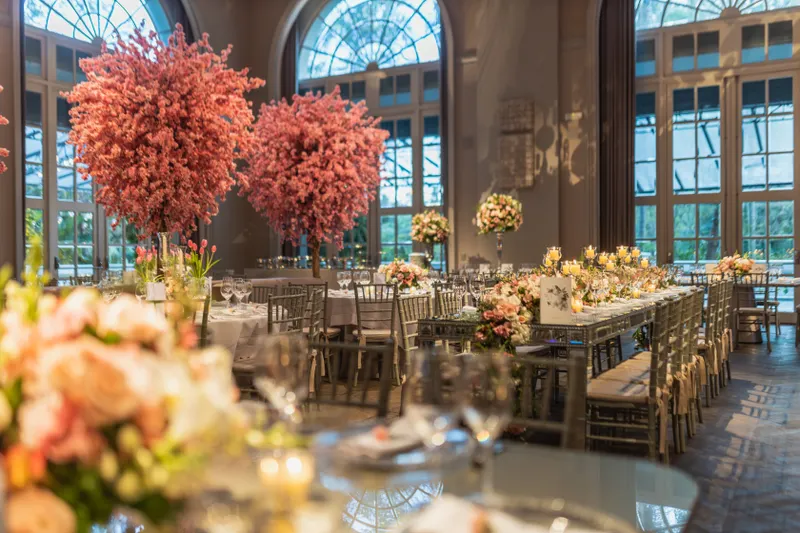
Catering and Beverage Flexibility
Hotels cook in house. For large numbers, complex dietary requirements and consistent service ratios that is an advantage. External caterers are usually not permitted, so a specialist Persian, Indian, Lebanese or kosher menu depends on the hotel’s willingness to work with a specialist supplier under its own supervision. Ask that question before you fall in love with the ballroom.
Whole-property venues vary. Some cater in house, some hold an approved caterer list, and some allow an external kitchen for a fee. For culturally specific weddings this is often the decisive question, and it can outweigh every aesthetic consideration.
Rooftops have the smallest kitchens, which usually means a simplified menu or a plated service designed around limited pass capacity.
Beverage arrangements change what any quotation represents. Some couples plan a fully non-alcoholic celebration, others local service only, others imported labels or a bar charged on consumption. Never assume a package includes a particular beverage arrangement, and never compare two venues’ figures until you have confirmed both are quoted on the same beverage basis. Ramarossi’s separate guidance on wedding costs in Istanbul covers how these structures behave in practice.
Weather Backup: Rain, Wind and Shade
Most of Istanbul’s rainfall arrives in the colder half of the year and the summer months are comparatively dry, but dry spells are punctuated by sudden heavy showers and thunderstorms. An outdoor plan needs a backup in any month of the year.
Wind deserves more attention than it usually gets. The strait channels air along its length, and the prevailing northeasterly, known locally as poyraz, is a regular feature rather than an occasional one. Wind affects tall florals, hanging installations, drapes, candles, lightweight chairs, aisle runners, speaker stability, veils and hair, and it can move a ceremony indoors on a day that looks calm from a hotel window.
Hotels usually offer the cleanest backup, an indoor room of comparable size, though you should confirm it is contractually held for you rather than available in principle and sellable to another booking. At yalı venues the covered space may be smaller than the garden, and a marquee may not be permitted on a protected site. Historic properties may have protected interiors with limited capacity. Rooftops are the most exposed, and the backup is typically a different space on a lower floor with a different character altogether.
Ask what the backup is, what it holds, whether it is contractually reserved, who makes the call, by what deadline, and what it costs to switch.
Photography Across the Four Models
Hotels give a photographer variety, controlled interiors and properly lit spaces after dark, at the cost of shared public areas where uninvolved guests appear in the frame. Yalı venues are strongest at golden hour on the water, and their compact footprint keeps every location within a short walk, which saves time on a tight schedule.
Historic properties produce the strongest architectural images and carry the most restrictions, commonly on tripods, professional lighting, access to particular rooms and drone use. Rooftops offer skyline and sunset with the least space for large group photographs, and they become difficult quickly once the light goes.
Confirm drone permission separately at every venue, and agree a portrait window inside the schedule. Istanbul traffic makes an off-site portrait session expensive in time, and time taken from the reception is rarely recovered.
Multi-Day Celebrations
Many international and multicultural weddings in Istanbul run across two to four days, with a welcome event, a cultural or religious ceremony, the main celebration and a farewell gathering.
Hotels are the strongest fit, because several spaces, guest accommodation, one operations team and one contract sit in the same place. Yalı and historic venues are normally hired per event, so a multi-day programme means several venues, several contracts and a transport plan for each movement. That is entirely workable, and often worth it, but it should be a decision rather than a discovery.
Rooftops work best as one element of a longer programme, typically a welcome evening or a closing gathering, rather than as the centre of it.
Where the programme includes a specific cultural element, the practical questions become setup time between events, catering specialisation and sound limits on consecutive nights. Persian, Lebanese, Indian, Pakistani, Jewish and Turkish celebrations each carry their own sequence and their own production requirements, and they are not interchangeable. Confirm with the venue what each element involves before assuming a single site can host all of them.
Which Model Suits Which Wedding
A Bosphorus hotel suits a large international guest list, a multi-day programme, guests travelling with children or older relatives, and couples who want the weather question closed rather than managed. It is the lowest-friction option and generally the least distinctive, though the strongest properties close much of that gap.
A waterfront yalı or mansion suits couples for whom the setting is the point, who want the property to themselves, and who are prepared to accept a firm capacity ceiling, an earlier finish and a transport plan. It rewards a guest list that has been kept deliberately in check.
A palace or historic property suits ceremonial weddings with a strong sense of occasion, cultural celebrations where the setting carries meaning, and couples willing to design within heritage limits rather than against them. Expect the least production freedom and the most preparation.
A rooftop or terrace suits smaller, city-facing celebrations, shorter planning timelines and couples who prefer Istanbul’s skyline to its shoreline. It is the most exposed to weather and usually the most constrained on finishing time.
The models also differ in how they are priced, which matters as much as the headline figure. Hotels commonly work from a per-person catering rate with a minimum spend, contracted separately from guest rooms. Whole-property venues more often combine a hire fee with catering. Historic sites may add access, supervision or security charges. Rooftops frequently apply a minimum spend rather than a hire fee. None of these structures is inherently cheaper than another; the structure determines which of your decisions moves the total.
What to Confirm With Any Istanbul Venue in Writing
Venue conversations move quickly and memories differ. Before signing anything, get written answers to the following.
- Confirmed guest capacity for your exact layout, including stage, dance floor and bar positions.
- Whether any other event may take place on the property on your date, and where.
- Whether any part of the property stays open to the public or to resident guests.
- Exact time amplified music must stop outdoors, and indoors, and how that limit is measured.
- Whether the venue holds a current music broadcast permit.
- Load-in start time, strike deadline, access route, lift dimensions and overnight build permission.
- Whether external caterers, external production and external entertainment are permitted, and on what terms.
- The beverage basis of any quotation, including whether alcohol is served and how it is charged.
- The wet-weather space, its capacity, whether it is contractually held, and the decision deadline.
- Heritage restrictions on fixings, rigging, anchoring, open flame and temporary structures.
- Security requirements, including advance guest lists, vehicle screening and restricted areas.
- Drone, tripod and professional lighting permissions for photography and video.
- Minimum spend, hire fee, buyout condition and what each one covers.
- Coach access, drop-off point and parking capacity for your transfer plan.
A written answer to each of these turns a shortlist into a decision, and it protects you at the point months later when a detail is questioned.
Frequently Asked Questions
Which Istanbul venue type works best for a large international guest list?
A Bosphorus hotel, in most cases. It combines the largest usable capacity with guest accommodation on site, an indoor wet-weather space of comparable size, and the ability to host several events across a few days under one contract. Waterfront and historic venues can host substantial weddings, but capacity is bounded by the site and guests will need housing and transport elsewhere.
What is the difference between a yalı and a palace venue?
A yalı is a waterfront mansion on the Bosphorus shoreline, historically a residence, usually hired as a whole property with its own quay and garden. A palace or historic venue is a larger institutional or imperial-era building, which may or may not be on the water, and where usable space is often limited to particular rooms. Yalı venues tend to feel private and intimate; historic properties tend to feel ceremonial and carry more restrictions.
Will an outdoor wedding in Istanbul have to finish earlier?
Often, yes. Turkey’s environmental noise framework sets a window for open-air events and allows provincial authorities to adjust operating hours for premises broadcasting music, and individual venues frequently apply tighter limits where neighbours are close. Enclosed spaces generally run later than terraces and gardens. The exact time is property-specific and must be confirmed with the venue in writing before you plan the evening.
Can we bring our own caterer, band or production company?
It depends entirely on the venue. Hotels usually cater in house and often restrict audio-visual work to their own team or approved partners. Whole-property venues range from fully in house to open with a kitchen fee. If a specialist caterer or a particular band is essential to your celebration, treat it as a screening question at the shortlist stage rather than a detail to negotiate later.
Do we need a waterfront venue to get a Bosphorus view?
No, but you should decide which relationship to the water you actually want. Waterside venues put guests at the level of the strait, with boat traffic passing close by. Elevated venues give a wider panorama with more distance. Rooftops in central districts may look over the old city or the Golden Horn rather than the Bosphorus itself. All three are legitimate choices; they are simply not the same photograph or the same evening.
Choosing between these four models is easier with someone who has worked in all of them and knows which questions each property answers reluctantly. If you are weighing venue types for a wedding in Istanbul, Ramarossi is happy to talk through your guest numbers, dates and the kind of day you have in mind, and to explain how planning support in Istanbul works alongside the venue you choose.