

Istanbul Wedding Guest Transport: Coaches, Boats and Traffic Buffers
In Istanbul, the vehicle is the last transport decision, not the first. Guest transport holds together when the venue, the hotels, the pickup points and the return journey are planned as one system, with buffers that protect the moments the wedding depends on.
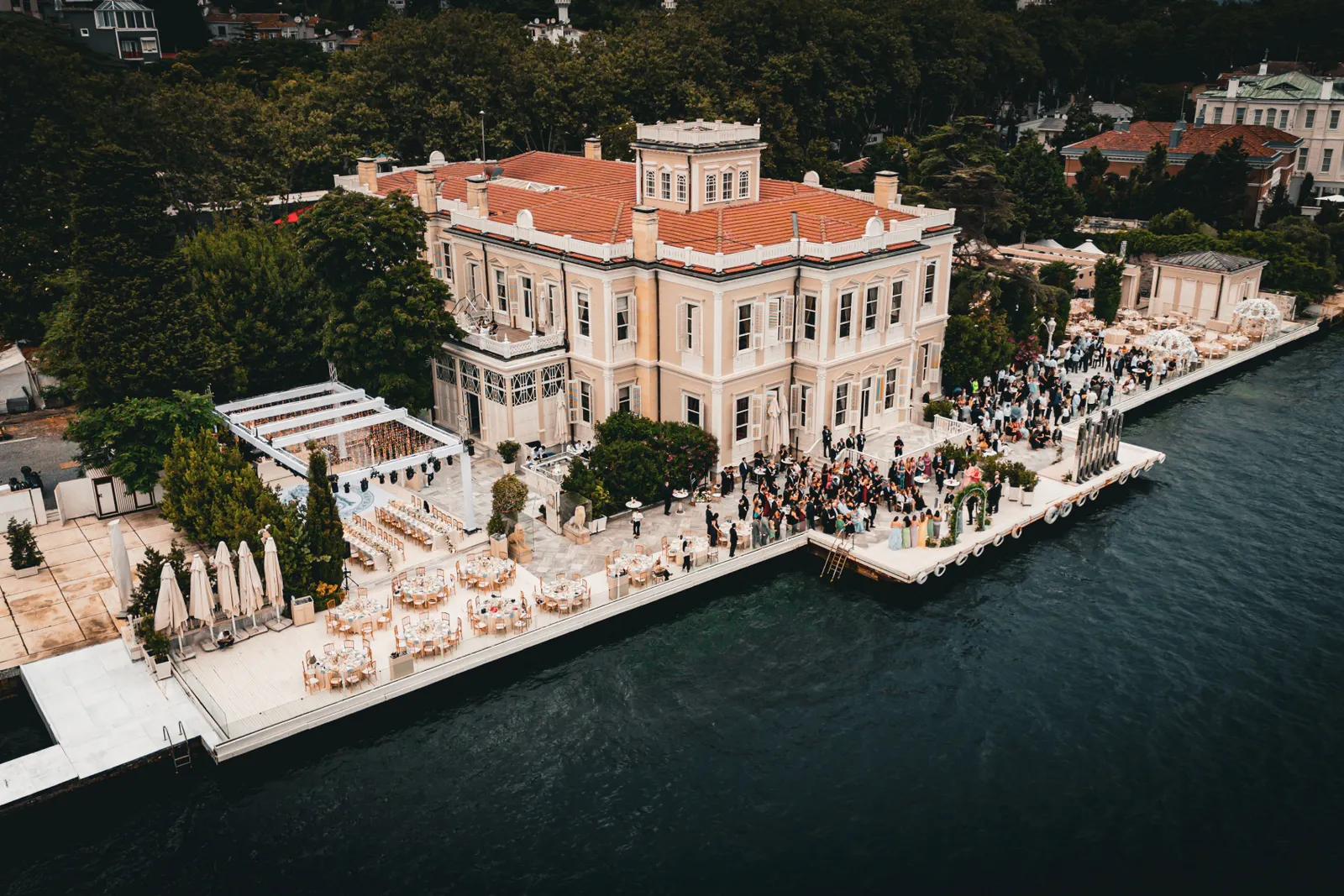
Istanbul wedding guest transport is less about choosing between a coach and a boat than about knowing exactly where every guest starts, where every vehicle can stop and which point in the programme cannot slip. A single coach can work well when guests share one practical pickup point and the venue can take a large vehicle. Several minibuses give more control when guests are spread across hotels or need to leave at different times. A Bosphorus boat transfer can suit a waterfront venue, but only once the boarding point, the landing and a road fallback are confirmed. Whichever system you choose, build it around fixed points in the day, with buffers that absorb traffic, not travel times read from a map.
For the wider picture, see our guide to planning a wedding in Istanbul. This article focuses on one question: how guests physically move between hotels and venue on the day.
Start with Exact Addresses, Not District Names
A district name tells you very little about transport. Two hotels that look close on a map can still produce an awkward sequential pickup once one-way streets, hotel entrances and places where a vehicle can actually stop are taken into account. A large coach may fit the guest count and still be the wrong vehicle for the final approach to the venue.
The first planning document is therefore not a vehicle quote. It is a sheet listing every guest property by exact address, how many guests are there, any mobility needs, and where a vehicle can stop. The venue needs the same detail: where vehicles set down, whether they can wait, and how far guests then walk. Anything that affects the plan should be confirmed in writing by the venue or the transport provider.
Once that information exists, work through the decisions in this order:
- The wedding venue and its confirmed vehicle access.
- Where guests are staying, and how they are spread across properties.
- The exact pickup points at each property.
- Set-down, waiting and walking conditions at the venue.
- Guest count and guest profile, including older guests, children and mobility needs.
- The fixed points in the event schedule.
- The return requirements, including early and late departures.
Only then does the choice between one coach, several coaches, minibuses, smaller vehicles, a boat transfer or a road and boat combination become clear. Choose the vehicle first and you risk a coach that cannot reach the door.
Coach, Minibus or Smaller Vehicles?
None of these is better in the abstract. The right fleet depends on the pattern of hotels, the venue approach and how many departure times you need.
When a Coach Works Well
A coach suits a large group leaving from one practical pickup point, such as a single guest hotel or an agreed meeting point, travelling to a venue that has confirmed it can receive a vehicle of that size and give it somewhere to set down. The advantages: fewer vehicles, one driver to brief, one manifest to check, and guests who arrive together.
The weaknesses: a coach is the least flexible option where access is restricted, and it moves at the pace of its last passenger: one delayed group in a hotel lobby holds back everyone already on board. A single coach also gives you a single return time unless you add vehicles later in the evening.
When Minibuses Give You More Flexibility
Several minibuses let you divide guests by hotel or by group, send vehicles in parallel rather than in sequence, and run staggered return departures. A smaller vehicle may also manage approaches that a coach cannot, but that should never be assumed: the provider should confirm that the specific vehicle can reach and stop at each specific point.
The price is coordination: more drivers, manifests, dispatch points and instructions to keep consistent. Without a clear structure, a minibus plan can create more confusion than one well-organised coach.
Smaller vehicles have a specific role alongside either option: the couple, close family, and guests who need step-free access or a shorter walk. A mixed fleet, such as a coach for the main group with a smaller vehicle for guests with particular needs, can be more practical than forcing everyone into one solution.
One Pickup Point or Hotel-by-Hotel Collection?
Door-to-door collection sounds like the considerate option, and sometimes it is, but it is not automatically the best guest experience. Each extra stop on a route adds boarding time, a further point of communication, more waiting for guests already on board and another chance of delay. On a sequential route, the first guests collected spend longest in the vehicle.
There are three basic structures. Sequential pickups use one vehicle calling at several properties in turn. Parallel departures send a separate vehicle from each property at once, removing the chain of delays but adding vehicles. A shared meeting point simplifies operations but asks guests to get themselves there.
A shared meeting point is not universally better. It can be unsuitable for older guests, families with young children, guests with mobility limitations, guests in formal footwear, or where the walk involves steep streets or exposure to heat or rain. A practical answer is a hybrid: the main group meets at one property, while a separate vehicle collects the guests for whom that walk is not reasonable.
Traffic Buffers: Protect the Schedule, Do Not Guess a Travel Time
Road travel time in Istanbul can vary materially by time of day, day of the week and route, so distance in kilometres is not a planning tool for a wedding. For citywide context, TomTom’s Traffic Index recorded an average of 22 minutes 54 seconds to drive 10 km in Istanbul across all days and hours of 2025. That is an annual average for the city as a whole. It says nothing reliable about your route at your time, and it should not be turned into a wedding transfer estimate.
The useful question is which point in the day must be protected. A buffer should protect a decision point: the moment the programme cannot start properly without the guests, such as the ceremony start, a timed boat departure or a fixed service time agreed with the venue. Work backwards from that moment. Decide when guests need to be in place, ask the transport provider to assess the actual route for the same weekday and time of day, and then add margin on top of that assessment rather than treating it as a promise.
On the day, agree who decides what happens if a vehicle is running late, make sure the transport lead and the venue can reach each other directly, and give guests a departure time rather than a journey time. Choosing the ceremony time itself is a separate decision; transport’s job is to protect whichever time you choose. Where the celebration runs across several days, our guide to a multi-day wedding in Istanbul covers how to sequence events so the weekend is not dominated by transfers.
Crossing the Bosphorus: Plan the Route, Not Just the Distance
When guests stay on one side of the city and the venue is on the other, every road journey has to pass through one of a limited number of fixed crossings: the Bosphorus bridges and a road tunnel. That makes the crossing, not the distance, the variable that matters.
Vehicle type also changes the options. The Eurasia Tunnel is designed for light vehicles only, and the operator states that vehicles above its permitted dimensions cannot use it. A full-size coach should therefore not be assumed to be a tunnel option. Whether a particular minibus or smaller vehicle is eligible depends on the vehicle classification, so confirm the crossing with the transport provider for the actual vehicle being used.
Where guests are split across both sides, sending separate vehicles from each side can be cleaner than one vehicle crossing twice to collect everyone. For the wider choice of where to base the celebration, see our guide to the European Side vs Asian Side for an Istanbul wedding.
When a Boat Transfer Works for Wedding Guests
For the right venue, a boat transfer can replace a difficult road leg with a calmer arrival. It is not automatically faster or better than a coach, and it works only when several conditions are met together:
- There is a useful boarding point within practical reach of the guest hotels.
- The venue has a landing the vessel can use, or there is a practical pier nearby with a short onward connection.
- The operator confirms the vessel and its permitted passenger capacity for the specific trip.
- Boarding and disembarking are workable for your guests, including steps, gangways and footwear.
- The sailing fits the event schedule, including time to board and land.
- The road legs before and after the water leg are planned as carefully as the boat itself.
In practice, a water route can be a chain rather than a single journey: hotel or meeting point, then a road vehicle, then a pier, then the boat, then the venue. Every handover adds a point where guests wait, where timing can slip and where a group can become separated. Count the handovers before deciding that the boat simplifies the day.
Weather is the other deciding factor. Şehir Hatları, Istanbul’s public ferry operator, states that its scheduled sea services may be delayed or cancelled for mandatory reasons such as weather conditions or unexpected technical failures. A private charter is a different arrangement: its operating decision rests with the charter operator under its own operating conditions rather than with the public-ferry timetable. In either case, a wedding transport plan that depends on a boat needs a confirmed road fallback. Agree who makes the go/no-go decision, when that decision will be made and how guests will be moved if the water leg cannot operate.
Use of a venue’s landing is also property-specific. Confirm with both the venue and the boat operator, in writing, that the specific vessel can use that landing at the time you need it.
Airport Transfers and Wedding-Day Transport Are Different Plans
Airport arrivals and wedding-day transport are related but separate systems. Arrivals are spread across days, flights and possibly two airports, and they end once guests have checked in. The wedding-day plan is then built from where guests are actually staying, not from where they landed. For the arrival side, see our guide to Istanbul Airport vs Sabiha Gökçen for wedding guests.
Guest Communication: Keep Instructions Simple
A transport plan fails if guests are unsure where to stand. Each guest needs a few clear facts: their exact pickup point, their departure time, how to identify their vehicle, a single contact number for the day, and their return options. Send the information close to the wedding and keep one version of it, so guests are not comparing different messages.
Behind the instructions sits the manifest: names for every vehicle and departure, with a named person checking guests on board. Agree in advance what happens if a guest misses a departure: the vehicle leaves on time, and the late guest is directed to a pre-agreed alternative rather than holding everyone else.
Plan the Return Journey Before the Wedding Day
The outward transfer is only half the job, because guests do not all want to leave at the same time. A return plan can involve three waves: an early return for older guests, families with children and anyone with an early flight; a main return at the end of the main programme; and, where there is an after-party, a later return for guests who stay on.
In Ramarossi’s operational experience of Turkish wedding-venue practice, the main wedding and reception programme is normally structured to finish at approximately 00:00, and any continuation after that is treated as an after-party. An after-party may continue later, commonly to around 02:00, only where the specific venue and event space are permitted and contractually able to operate at that time. These are not universal statutory finishing times. Confirm the main finishing time, any after-party finishing time and the space used in writing with the venue, then set return departures around those confirmed times.
The return route may also differ from the outbound one: night traffic behaves differently, and a boat that worked on arrival may not be available for a late return. Confirm with the provider where vehicles will wait and how they will be called forward, so the end of the evening does not become a queue at the door.
Coach, Minibus and Boat Transport at a Glance
A large group leaves from one practical pickup point
Fewer vehicles and a single manifest
Large-vehicle access and set-down at the venue
Guests are spread across hotels or need several return times
Flexible routing and staggered departures
Number of vehicles, drivers and dispatch points
The venue has a usable landing and guests can board near their hotels
Can replace a difficult road leg with a water route
Landing use, boarding conditions and the weather decision
No single mode serves both hotels and venue well
Uses each mode where it works
Every handover, plus a road fallback for the water leg
| Transport model | Works best when | Main advantage | Main point to confirm |
|---|---|---|---|
| Coach | A large group leaves from one practical pickup point | Fewer vehicles and a single manifest | Large-vehicle access and set-down at the venue |
| Minibuses | Guests are spread across hotels or need several return times | Flexible routing and staggered departures | Number of vehicles, drivers and dispatch points |
| Boat transfer | The venue has a usable landing and guests can board near their hotels | Can replace a difficult road leg with a water route | Landing use, boarding conditions and the weather decision |
| Mixed road and boat | No single mode serves both hotels and venue well | Uses each mode where it works | Every handover, plus a road fallback for the water leg |
Questions to Confirm Before Booking Istanbul Wedding Transport
- What are the exact addresses of every guest hotel or rental, and how many guests are at each?
- Where exactly can a vehicle stop at each pickup point, and for how long?
- Which vehicle sizes can reach the venue’s set-down point, and has the venue confirmed this in writing?
- Can vehicles wait at or near the venue during the event, and if not, where will they wait and how will they be recalled?
- How far is the walk from set-down to the event space, and does it involve steps, slopes or uneven surfaces?
- Which guests need step-free access, a shorter walk or a separate vehicle?
- Does any route cross the Bosphorus, and which crossing can each vehicle use?
- Has the provider assessed the route for the actual weekday and time of travel?
- For a boat leg, where do guests board, how do they get on and off, and is use of the venue’s landing confirmed in writing?
- Who decides whether the boat sails, by what time, and what is the road fallback?
- Is there a manifest for every vehicle, and who checks names at departure?
- What happens if a guest misses their departure?
- How many return departures are planned, at what times, from where, and do they match the venue’s confirmed finishing times?
- Who is the single transport contact on the day, and how do guests and the venue reach them?
How Ramarossi Coordinates Istanbul Wedding Guest Transport
Transport works when it is planned together with the venue, the accommodation and the wedding timeline, which is why Ramarossi treats it as part of planning the whole wedding rather than as a separate booking. Within the agreed planning scope, that can include mapping accommodation against the venue, designing the pickup structure, obtaining options from transport and boat providers, confirming access with the venue, preparing manifests and guest instructions, coordinating road and boat handovers, planning return waves, and aligning every movement with the event schedule.
Ramarossi coordinates independent providers and does not operate vehicles or boats. Because journey times depend on conditions on the day, the plan rests on buffers and confirmed arrangements rather than promised durations.
Plan Guest Transport Around the Whole Istanbul Wedding
Share your guest count, dates, venue shortlist and where your guests are likely to stay, and Ramarossi can help you shape a transport plan that fits the venue, the accommodation and the programme as part of planning the wider wedding.
Frequently Asked Questions
Should we use one coach for all our wedding guests in Istanbul?
One coach can work when a large group leaves from one practical pickup point and the venue has confirmed it can receive a vehicle of that size. If guests are spread across hotels, need different return times or cannot all manage a shared meeting point, a combination of vehicles is likely to work better.
Are minibuses better than a coach in central Istanbul?
Not automatically. Minibuses suit separate hotels and staggered departures, and may manage approaches a coach cannot, but they add vehicles, drivers and coordination. The transport provider should confirm that a specific vehicle can reach and stop at a specific address.
Can guests arrive at a Bosphorus wedding venue by boat?
Sometimes. It depends on whether the venue has a landing the vessel can use, or a practical pier nearby, whether boarding suits your guests, and whether the venue and operator confirm the arrangement in writing. A boat leg also needs an agreed weather decision process and a road fallback.
How much traffic buffer should we allow for Istanbul wedding transport?
There is no universal figure. Ask the transport provider to assess the actual route for the same weekday and time of travel, then add margin to protect the fixed point the guests must reach, such as the ceremony start. Routes that cross the Bosphorus or include handovers between vehicles and boats need more protection, not less.
Is one shared pickup point better than collecting guests from each hotel?
A shared meeting point simplifies operations; hotel-by-hotel collection is easier for guests but adds stops and delay risk. A hybrid, with a main meeting point and a separate vehicle for guests who should not walk, can balance both.
Do we need more than one return time?
It is worth planning more than one if your guest list includes older guests, families with children, guests with early flights or guests staying for an after-party. Set return departures around the finishing times confirmed in writing with the venue rather than around assumptions.
Can Ramarossi coordinate guest transport for our Istanbul wedding?
Yes, as part of planning the wedding within the agreed scope. Ramarossi coordinates the pickup structure, transport and boat providers, manifests, guest instructions and return waves, and integrates them with the venue and the timeline. Ramarossi does not operate vehicles or boats itself.