


A villa can be an excellent wedding venue in Fethiye. It can also be a beautiful holiday house that cannot practically hold a wedding, and the difference may not show in the photographs.
A villa may be designed primarily as accommodation rather than as an event venue. A wedding can ask the same property to accommodate supplier deliveries, catering production, amplified sound where planned, guest movement, setup and dismantling. Whether it can support those requirements depends on the individual property.
Three questions help determine whether the property fits the wedding you are planning, and they should be investigated before you commit. Is the property genuinely private for the hours you need it? Can your suppliers physically get in, work and get out? And can food and drink actually be produced and served there at wedding scale? This article works through each of them, and through the checks Ramarossi makes on a couple’s behalf when assessing a property for weddings in Fethiye.
A Villa Is a Property Before It Is a Venue
A hotel or purpose-built event venue may operate under licences, certificates and permissions relevant to its business, but those documents do not by themselves answer every wedding-use question. A private or residential villa should be assessed separately rather than assumed to operate on the same basis.
That does not mean a villa cannot host a wedding. It means that the property’s practical suitability and operating position need to be established for that individual property rather than assumed from the word villa. Two points are worth understanding before you speak to a property.
Letting a Residence and Running an Event Are Separate Matters
Under Law No. 7464 on the Rental of Residences for Tourism Purposes, published in the Official Gazette on 2 November 2023 (No. 32357), a residence rented for tourism purposes for 100 days or less in a single letting requires a tourism-rental permit before the tourism rental contract is made. That permit concerns the letting of the residence. It should not be treated as proof that the property is authorised or practically suitable for a wedding.
Music and Event Permissions Are Property-Specific
Turkey’s Environmental Noise Control Regulation (Çevresel Gürültü Kontrol Yönetmeliği), published in the Official Gazette on 30 November 2022 (No. 32029), places music broadcast permission for qualifying music-broadcasting businesses with the relevant provincial directorate, following an acoustic report. Whether a particular property holds that kind of permission, and on what terms, is specific to that property and its business status.
A private or residential villa should not be assumed to hold the same permissions as a licensed hotel or event business. Equally, it should not be assumed to sit outside all noise, event and local requirements. The position is specific to the property and its location, so the property should confirm its relevant operating status and permissions in writing.
Ramarossi plans weddings. It does not act as a legal adviser or a licensing authority. Where the legal or licensing position of a particular property matters to your decision, ask the property to confirm its status in writing, and take independent legal advice if the answer is unclear.
Privacy: What Exclusive Use Actually Covers
Privacy is one of the main reasons a couple may consider a villa, but the word private does not tell you exactly what the booking includes.
Who Remains on the Property
Exclusive use can mean the whole property and everyone in it, or only the parts of it you have hired. Ask directly who will still be present on the wedding day: owners, a resident manager, housekeeping, gardeners, pool technicians, security, or a caretaker living in an annexe. None of those is necessarily a problem, and some of them are useful. The problem is discovering them on the day.
Ask whether the property is a single dwelling or one unit within a shared development, and whether any part of the site is excluded from your hire. Storage areas, staff quarters, a locked wing, an owner’s apartment or a second terrace can all sit outside the agreement, and each one changes what can be done with the layout.
Neighbours, Sightlines and the Approach
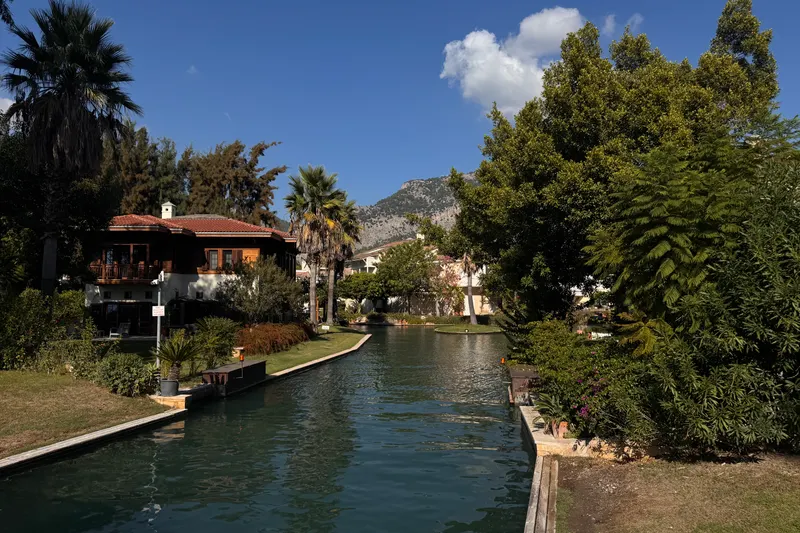
Privacy inside a boundary wall is not the same as privacy from above or from next door. Parts of the Fethiye area are built on slopes, which is much of their appeal and also means neighbouring properties can look down onto terraces and pool areas.
On a site visit, and ideally at the time of day your ceremony would take place, check what overlooks the ceremony space, whether the access lane passes through the view, whether neighbouring properties are holiday lets with their own evening activity, and whether the entrance is shared. If a lane or driveway serves several properties, ask what that means for guests arriving and for a supplier vehicle standing there for several hours.
Privacy Across the Stay, Not Only the Event
Do not assume that exclusivity negotiated for the wedding applies to the whole booking. Setup may require access before the wedding day, and dismantling or collection may continue after the event depending on the production and the property’s access terms.
Confirm separately which dates and hours the property is exclusively yours, when suppliers may first enter, whether anyone else occupies the property immediately before or after your wedding day, and whether changeover cleaning is scheduled in a way that collides with your setup.
Access: Whether Suppliers and Guests Can Physically Use the Property
Access is where an attractive property can quietly become an expensive one, because anything that cannot be driven to the door has to be carried, and anything that has to be carried costs time and staff.
The Final Approach
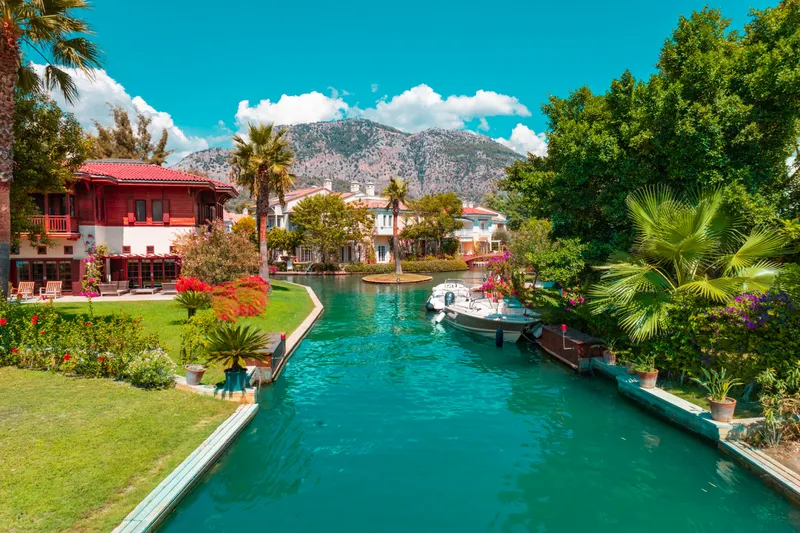
The relevant measurement is not the distance from the airport. It is the last few hundred metres. Ask about the width of the final approach lane, whether there are gradients or tight turns, and what the largest vehicle is that has previously reached the property. Catering vans, refrigerated vehicles, furniture lorries and generator trailers have different requirements, and a lane a car handles comfortably may not take a van with a wide turning circle.
Where coaches are relevant to your guest plan, ask specifically whether a coach can reach the property, whether there is a turning point nearby, and where guests would be set down. Do not infer coach access from the fact that a minibus manages.
Parking, Carrying Distances and Ground Conditions
Ask where supplier vehicles stand during the event, and whether they can remain on site or must leave and return for collection. Ask where guest cars and taxis go.
Then have the route walked: gate to kitchen, gate to ceremony space, kitchen to dining area. Note steps, gravel, grass, slopes, narrow gateways and anything a wheeled trolley cannot cross. The same walk answers a second question, which is whether guests with limited mobility, or guests in evening shoes, can move around the property comfortably after dark.
Setup, Collection and Service Access
Confirm the hours during which suppliers may load in, and whether there are constraints on early morning or late evening vehicle movements, particularly in residential lanes. Confirm when equipment must be collected. A property may require everything to be removed the same night or may allow next-day collection, and that answer can change both the hire arrangements and the dismantling plan.
Ask about service and emergency access as well. If the only way in is one narrow lane, it is worth establishing in advance what happens if it is blocked.
Catering: A Domestic Kitchen Is Not a Wedding Kitchen
This is an area where a villa wedding may require additional infrastructure rather than assumption, and it is worth more of your attention than the setting.
A villa kitchen is designed to cook for the people staying in the house. Depending on the guest count and service style, wedding catering may require a large number of covers to be prepared and served within a narrow window, with canapés before, a cake later, staff meals somewhere in between, and washing-up throughout. Bridging that gap may require additional equipment and temporary service infrastructure, and that has to be planned and has to be physically possible on the site.
Whether External Catering Is Permitted at All
Start here, because the answer governs everything that follows. Ask whether the property permits external caterers, whether it requires a nominated supplier, whether it operates its own catering, and whether any charge applies to bringing in an outside caterer.
Ask the same questions separately about drinks. Do not assume that a property allowing an external caterer also allows you to supply your own beverages, or the reverse. If the property maintains a supplier list, ask whether it is a requirement or a recommendation.
Where the Food Is Actually Prepared
Then establish the physical reality. Will preparation happen in the house kitchen, in a temporary kitchen set up outdoors, or across both? If a temporary kitchen is needed, ask where it can be sited, whether that area is screened from guests, whether the ground is level and serviceable, and whether the property permits it at all.
Ask about the staging area, meaning the space between preparation and service where plates are assembled and held. Where a property has a kitchen and a dining terrace with no usable staging area between them, service can become slower and maintaining food temperature and presentation can become more difficult.
Power, Water, Refrigeration and Waste
Four practical areas are particularly worth checking on a residential site: power, water, refrigeration and waste.
Electrical capacity. Ask what the property’s supply is and what else will be drawing on it during the evening: air conditioning, pool pumps, lighting, sound and now catering equipment. Ask whether a generator may be brought in, where it can be placed so that its noise does not sit alongside the dining area, and whether the property permits one.
Water. Ask whether the property runs on mains supply, a tank, or both, and what the arrangement is if a tank runs low during a long event.
Refrigeration. Ask what refrigerated storage exists, and where additional units could be sited and powered. In summer this is not a detail.
Waste. Ask where kitchen and event waste is held during the evening, where it goes afterwards, and who removes it. Do not assume the property’s normal waste arrangement can absorb event waste; confirm how waste will be stored and removed.
The Route From Kitchen to Table
Finally, walk the service route. Staff will cross it repeatedly, in the dark, carrying trays. Steps, a pool edge, a gravel path, a change of level or a single doorway everyone has to share will each show up in the pace of service.
Ask where washing-up happens, whether there is space and hot water for it, and whether it can be done out of earshot of the dining area. Ask what glassware, crockery, cutlery and linen the property holds for event use and in what quantity, since domestic quantities and event quantities are different things. Anything the property does not hold has to be supplied or hired from elsewhere, delivered, managed during the event and removed afterwards, which brings you back to access.
The Secondary Checks That Still Decide the Evening
These matter less than privacy, access and catering, but they are worth settling before you commit rather than after.
- Usable layout. Where does the ceremony sit, where do guests go afterwards, where does dinner happen and where does dancing happen? A property can have enough total space and still have no single area that holds everyone at once.
- Toilets. Count what is available for guest use and note where it is. Bathrooms reached through bedrooms do not work well for event use.
- Lighting. Terraces, steps, paths and parking areas that are pleasant in daylight can be difficult after dark without lighting brought in for the purpose.
- Wet weather and wind. Ask what covered space exists, whether it seats your full guest count, and whether marquees or temporary structures are permitted, where they could be pitched, and whether the ground takes fixings.
- A pool may sit at the centre of the layout and is also open water at an evening event where children may be present. Ask what covering, lighting or barrier arrangements the property allows.
Music and Finishing Times at a Private Villa
Where amplified music matters to you, treat it as a property-specific question and settle it early rather than late.
In Turkish wedding-venue practice, the main wedding and reception programme is normally structured to finish at approximately 00:00. Any continuation after that is treated as an after-party. An after-party may continue later, commonly to around 02:00 in Ramarossi’s operational experience, but only where the specific property and the specific space are permitted and contractually able to operate at that time. If outdoor amplified music is permitted after 00:00, an after-party may continue outdoors within that permission; otherwise it may be able to continue in an authorised indoor or enclosed space. These are venue-practice and property-specific arrangements rather than universal statutory finishing times.
At a private or residential villa the question carries an additional layer, because such a property should not be assumed to hold the permissions a licensed hotel or event business holds. Ask the property to confirm in writing the finishing time for the main wedding and reception, the finishing time for amplified music outdoors, whether an after-party is possible and in which specific space, until when, any volume limit, sound limiter or other operational condition, and what happens when each permitted period ends.
What Ramarossi Does on a Villa Wedding
Ramarossi is a full wedding planning company, so on a villa wedding in the Fethiye area we coordinate these moving parts as part of the planning process rather than leaving the couple to manage each property and supplier question separately.
In practice that covers identifying properties that suit your guest number, your dates and the kind of day you want; putting the practical wedding-use questions to those properties and recording the answers; planning catering and service with the caterer against what the site can actually support; planning access, load-in, setup and collection; designing the layout and production; coordinating suppliers and the running order; handling guest logistics where they touch the event; building a practical wet-weather alternative around the options the property has confirmed; and running the wedding day itself, so that you are not the person managing a delayed van.
What remains with the property is the property’s own commercial terms, permissions, capacity and availability. Ramarossi does not own or operate villas, does not grant permissions, does not provide legal advice or contract review, and does not guarantee that a particular property will be available or will agree to a particular arrangement. Those answers come from the property, in writing.
Common Questions About Villa Weddings in Fethiye
Can any private villa in Fethiye host a wedding?
No, and the answer cannot be given at destination level. It depends on the individual property: its operating status and permissions, whether the owner permits events at all, and whether the site can physically support catering, suppliers and a guest count. Two neighbouring villas can give different answers. The property itself has to confirm its position in writing.
Is a villa wedding cheaper than a hotel wedding?
Not automatically. A hotel may already have event infrastructure such as professional kitchen facilities, staff, power, furniture, toilets, backup spaces and accommodation available on site, although what is included or available depends on the individual hotel. A villa may require more of those elements to be brought in or arranged separately. A villa may offer a different degree of privacy and control, but that depends on the property and the terms being offered, and a hotel may also provide exclusive-use arrangements. The saving is not a given and depends on how much infrastructure the property already has.
Do we need to hire the villa for longer than the wedding day?
Possibly. Setup and dismantling may require access outside the wedding-day event hours, and how much extra time is needed depends on the scale of the production and on what the property allows in terms of access before and collection after. Establish the required dates with the property before you fix your own travel.
Can we bring our own caterer to a Fethiye villa?
That is entirely a matter for the individual property. A property may permit an external caterer, require a nominated supplier, operate its own catering or apply a charge for an outside supplier. Ask before the property becomes your preferred option rather than afterwards.
Planning a Villa Wedding in Fethiye
If you already have a Fethiye villa in mind, or you would like help finding one that fits your guest number and your dates, Ramarossi can take it from there: assessing the property against the requirements above, planning catering, access, layout and production around what the site can support, coordinating suppliers, and running the wedding through to the day itself.
Tell us your approximate guest count, your dates and the kind of celebration you have in mind, and we can assess how well the property fits your wedding plan, coordinate the practical questions with it, and identify unresolved points before you commit.