


Fethiye wedding venues fall into four practical models, and they suit different celebrations. A beach venue works best for ceremony-led weddings where the setting carries the day, and it generally carries the strongest evening constraints of the four, though the exact finishing time is specific to the property and its location. A private villa gives the strongest exclusivity and the most natural multi-day rhythm, but carries the heaviest production and accommodation load. A hotel or resort handles the largest and most logistically complex weddings because rooms, kitchen, power and indoor backup already exist, at the cost of exclusivity and catering freedom. A garden or private outdoor property gives the most design and catering flexibility, and asks you to build almost everything from nothing.
The choice is rarely settled by photographs. It is settled by three questions: how many people are coming, where they will sleep, and how much of the day you need to control. Everything else follows from those answers.
This comparison assumes you have already decided on the destination. If you are still at an earlier stage, our overview of planning a wedding in Fethiye covers the destination itself. What follows is narrower: how the four venue models behave in practice once you start asking difficult questions.
What actually separates Fethiye wedding venues
The four models are not four aesthetics. They are four different answers to the same set of structural questions: who else is on site during your celebration, where your guests sleep, what infrastructure already exists, and what the property is licensed and physically able to do after dark.
Fethiye also sits inside a specific planning context that shapes what exists. Fethiye and Göcek were declared a Special Environmental Protection Area by government decision in 1988, covering an area of roughly 805 square kilometres, and the zone is administered under a dedicated conservation-weighted environmental plan by the Ministry’s General Directorate for the Protection of Natural Assets. Development within the zone is controlled rather than open.
For couples, that matters in a practical way. Permissions carry more weight here than in destinations built around purpose-built event venues, structures and installations may be restricted, and a property’s ability to host an event is a question of its own licence rather than a regional norm. Confirm what a specific property may do in writing before you commit to it.
Beach venues
What a beach wedding in Fethiye actually means
The lagoon at Ölüdeniz sits inside Ölüdeniz Nature Park, a protected public area with an entrance fee, parking charges and set opening hours. It is a location people visit, not a property you can book to yourself. In practice, a beach wedding in the Fethiye area means a licensed beach club, a hotel beach, or a waterfront property with a defined area of sand and terrace that it is entitled to use for events.
That distinction is worth making early, because a great deal of beach wedding imagery from this coast is photographed in places that cannot host a reception.
Capacity, privacy and what your guests share
Usable capacity on sand is almost always lower than a site’s headline figure. Level ground, a ceremony aisle, a dance floor, a bar and a service route all compete for the same area, and sand will not take heavy structures without decking. Ask for the usable event area rather than the site’s total capacity, and ask where the dance floor and bar would physically sit.
Exclusivity is the second question. Many beach areas are semi-public or overlooked by public beach, and full exclusivity, where it is available at all, is usually a chargeable buy-out with a defined start time. Ask whether exclusivity is total or partial, when it begins, and what happens to day visitors already on the sand.
Sea turtle nesting rules and what they mean for evening events
This is the single most overlooked constraint on a Fethiye beach wedding. Fethiye-Çalış is one of Türkiye’s designated sea turtle nesting beaches under the Directorate General of Nature Conservation and National Parks Circular 2009/10 on the protection of sea turtles. The nesting and hatchling period runs from around May to the end of September.
The circular sets protection and use conditions rather than a single clock time. Those conditions include controls on night-time access to designated nesting beaches, keeping motor vehicles and animals off the sand during the breeding season, and screening lighting so that it is not visible from the beach.
Specific hours come from provincial guidance rather than from the circular itself. Guidance issued to businesses in the Fethiye area states that premises located on sea turtle nesting beaches must arrange sound and lighting so that neither can be heard nor seen from the beach between 15 May and 15 September, between 20:00 and 05:00. Compliance is inspected locally and breaches carry administrative fines under environmental law. For a wedding, that is the provision that matters most, because it reaches both the lighting design and the sound, not only access to the sand.
The circular works through mapped protection zones defined by coordinates, so whether a particular property falls inside a protected zone, and what it may do after dark, is property-specific rather than a general rule you can apply to the whole coastline. Do not assume that an evening beach reception with lighting and amplified sound is available. Ask the venue to confirm its current position in writing, and to state which authority it has confirmed it with, and expect the answer to differ between a hotel beach outside the designated zone and a stretch of Çalış sand inside it.
Supplier setup and load-in
Sand is the practical problem. Chairs, dance floors, bars and heels all need decking or matting. Power is frequently generator-based and needs screening for both noise and appearance. Wind loading means any structure has to be properly weighted or anchored rather than simply placed.
Load-in windows are often tied to public beach use, which can compress setup into a short period on the day. Ask when suppliers can access the site, whether vehicles can reach the sand at all, and how far equipment must be carried.
Private villas
Capacity is set by the property, not by a floor plan
A villa’s wedding capacity has very little to do with how many bedrooms it has. It is set by flat usable outdoor ground, the width of the access road, parking, and whether there is anywhere to put a service area out of sight. A villa that sleeps a large family may still be uncomfortable for a seated dinner at any scale.
Ask for the flat usable outdoor area in square metres, ask whether the ceremony and reception can take place in different parts of the grounds, and walk the route a guest would take between them. Sloping terraces and steps that look attractive in photographs become a problem when people are moving between spaces in the dark.
Privacy, and the neighbours nobody mentions
On exclusivity, the villa is the strongest of the four models. Nobody else is on site, the day belongs to you, and the atmosphere is genuinely different from a hotel function space.
The complication is external rather than internal. Villas in the Fethiye area frequently sit within residential clusters, and neighbours are the most common source of sound complaints and early finishes. Ask whether the property has hosted events before, whether there have been complaints, and how close the nearest occupied houses are.
Accommodation and the guests who are not staying with you
A villa sleeps your immediate circle. Everyone else needs accommodation elsewhere and transport in both directions, late at night, on roads that are often narrow. Settle the sleeping arrangement before you close the guest list, not after.
Supplier setup and what the property does not have
Villas rarely have a commercial kitchen, a service entrance, guest toilets at event scale, or the electrical supply an event needs. Catering is normally brought in complete, along with a marquee or shade structure, generator, lighting, furniture, staff facilities and waste management.
Access is the constraint that catches people out. Hillside and valley roads may not take a full-size lorry, which pushes suppliers into smaller vehicles and more trips, and that shows up in both cost and setup time.
Confirm one thing before anything else: whether the property’s licence, tenancy agreement or management company permits events at all. Some private rentals do not, and finding out late is expensive.
Hotels and resorts
The infrastructure argument
A hotel arrives with a working kitchen, adequate power, guest toilets, service routes, trained staff, indoor space and bedrooms. Compared with the other three models, there are far fewer unknowns, and far fewer things you have to buy in.
For a wedding where guests are flying in from several countries and you are not able to visit repeatedly, that reduction in unknowns is worth a great deal.
Capacity and accommodation as one decision
This is the model that handles the largest guest numbers, and the only one that solves capacity and accommodation together. That combination is the reason most large destination weddings end up here.
Ask about the commercial structure attached to the rooms: whether a room block is required, what the minimum stay is, when unsold rooms are released, and whether the wedding is contingent on a minimum number of room nights. Ask how board arrangements interact with the wedding meal, since many properties in the region operate on inclusive board and the answer affects what your guests actually eat that day.
Privacy and sharing the property
This is where the hotel is weakest. Unless you buy out a venue area or the property itself, you are sharing it. Ask directly whether the ceremony area is accessible to other guests, whether another wedding may take place on the same day, whether there is a minimum interval between events, and whether the space you are shown will be screened during your celebration.
Catering and beverage flexibility
Hotels are usually the least flexible of the four models on catering. In-house catering is normally mandatory and external caterers are rarely permitted. If your celebration has specific cultural catering requirements, this is the question to resolve before the venue is chosen rather than after, because it can be the deciding factor.
Beverage arrangements vary considerably between properties and are set by the hotel. Ask for the beverage basis in writing, including what is included, what is charged separately, and whether the arrangement differs between the ceremony, dinner and later reception. Do not compare two properties on price until you know that both are describing the same beverage basis.
Garden and private outdoor properties
What this model covers
This is the broadest of the four categories: private land, olive groves, walled gardens attached to boutique properties, and restaurant gardens in the inland areas around Fethiye such as Ovacık, Üzümlü and the Kayaköy valley.
One clarification is worth making, because it comes up often. The historic village at Kayaköy is a protected archaeological site under the Ministry of Culture and Tourism, ticketed and with seasonal opening hours. It is a heritage site rather than an event venue. The surrounding valley, which contains restaurants, boutique properties and private land, is a different question entirely and is where garden celebrations in that area actually take place.
Design freedom and catering control
This model normally gives the most catering and beverage flexibility of the four, because there is often no in-house catering obligation. For celebrations with specific cultural catering requirements, or where a particular caterer matters, this is frequently the model that makes it possible.
The trade is that almost everything is brought in. Kitchen, power, toilets, furniture, shade, lighting and staff facilities all have to be planned and paid for, and the site needs to be assessed on that basis rather than on how it looks on a spring afternoon.
Capacity, ground and access
Capacity is governed by flat usable ground and access, not by an internal room. Mature trees, irrigation channels, uneven terraces and planted beds reduce the workable area considerably more than most people expect when they first walk a site.
Walk the access route in the vehicle a supplier would actually use. A garden that is easy to reach in a car may not be reachable by the lorry carrying a marquee.
Heat, shade and the afternoon
Inland valley sites are warmer through the afternoon than the coast and lose the benefit of the sea breeze. Shade is not a decorative choice for a summer daytime ceremony in these locations, it is a structural requirement, and it needs to be designed rather than improvised.
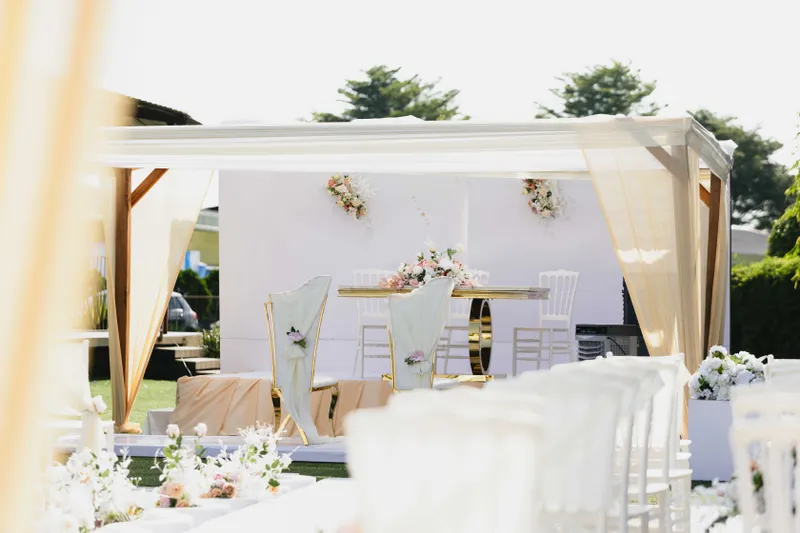
The four models compared
| Beach | Private villa | Hotel or resort | Garden or private property | |
|---|---|---|---|---|
| What sets capacity | Usable sand and decking area | Flat outdoor ground and access road | Function space and room inventory | Flat usable ground and access |
| Privacy | Often partial or shared | Strongest | Weakest without a buy-out | Usually good, site dependent |
| Accommodation on site | None | Inner circle only | Full party possible | Rarely, or very limited |
| Ceremony to reception flow | Usually one area, limited separation | Good if grounds allow | Strong, purpose-built routes | Good, but needs designing in |
| Guest transport | Short runs, parking often tight | Multiple minibus runs | None if guests stay in | Longest runs, narrowest roads |
| Supplier load-in | Hardest, sand and timed access | Constrained by road width | Easiest, service routes exist | Depends entirely on access |
| Sound and finishing time | Most restricted, especially in nesting season | Neighbour dependent | Usually clearest answer | Varies, confirm early |
| Catering and beverage | Usually set by the operator | Fully brought in, flexible | In-house, least flexible | Most flexible |
| Wet-weather backup | Rarely built in | Marquee required | Indoor space exists | Marquee required |
| Multi-day suitability | Single event location | Strong for a small group | Strongest overall | Single event location |
Every entry above is a general characteristic of the model, not a statement about any particular property. Individual venues differ substantially, and the only reliable version of any of these answers is the one a named venue gives you in writing.
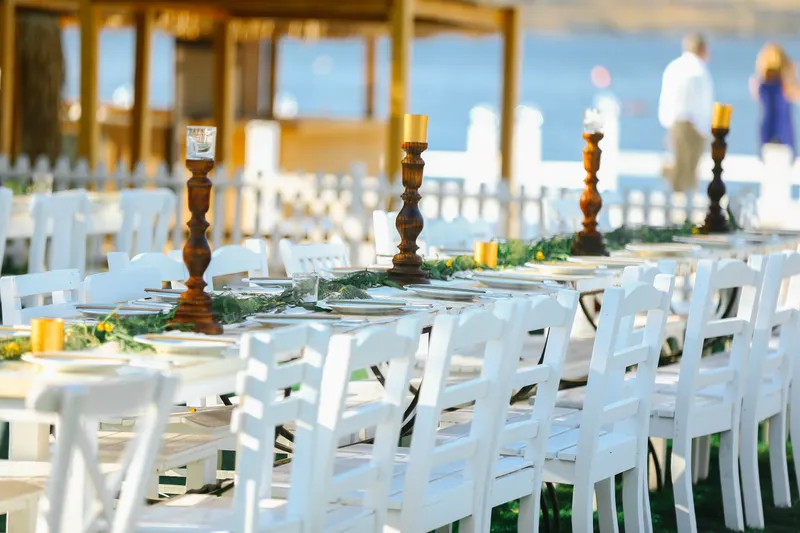
Wind, heat and rain: design the backup before you sign
Fethiye has a hot-summer Mediterranean climate. According to Fethiye Municipality’s climate report, the district’s climate is classified as Köppen Csa, August is the warmest month with an average high of around 33°C, and more rainfall falls in winter than in summer.
In practice that means heat is the design problem in high summer and rain is the design problem in the shoulder seasons. Both need answering before you sign, and the answers differ by model.
Wind is the factor couples underestimate most. The Fethiye and Göcek gulf is comparatively sheltered by the standards of the Turkish coast, and sailing operators consistently describe conditions here as gentler than further west, but an afternoon breeze in summer is normal rather than exceptional. It affects loose linens, tall floral structures, open flames, veils, hair, and, more than anything, the sound system during the ceremony. A ceremony that is inaudible from row four is the most common avoidable failure at an exposed outdoor site.
On rain, the honest question is not whether the venue has a plan but whether the plan is genuinely usable. Ask whether the alternative space seats your full guest count, whether it is a space you would be content to be photographed in, at what time the decision is taken and by whom, and who bears the cost of holding a marquee on standby. Our guide to managing unexpected weather on your wedding day covers the decision process in more detail, and the broader trade-offs are set out in our comparison of indoor and outdoor wedding venues.
Hotels answer this well because indoor space already exists. Beach venues frequently answer it poorly. Villas and gardens answer it with a marquee, which means it becomes a budget question rather than a venue question.
Sound levels and finishing times
There is no single national finishing time you can look up and apply to a Fethiye venue. Türkiye’s Environmental Noise Control Regulation sets the framework, and it works through a combination of national provisions and local decisions.
Under that framework, premises broadcasting amplified music require a music broadcast permit. The regulation’s annex sets a night-time limit for the outdoor sections of premises broadcasting music, up to 01:00 at the latest. Operating hours for such premises may be re-set by decision of the Provincial Local Environment Board, taking account of summer and winter periods, local characteristics, strategic noise maps and action plans. The same board determines which areas may host outdoor music events, the maximum number of such events per year, and how many consecutive days they may run. Separately, fireworks require permission from the local civil authority, with time and place notified in advance.
What that means for you is straightforward. The finishing time that applies to your wedding comes from the individual property’s licence and from local decisions, not from a rule that applies across Fethiye. It is property-specific and must be confirmed with the venue in writing.
Four questions are worth putting in an email rather than asking on a site visit. What is the latest time amplified music may play outdoors. Is there an indoor space where music may continue, and until when. Is a decibel limiter fitted, and at what level is it set. Has the property received noise complaints, and did they change what it now permits.
Villas and garden properties in residential areas are the most exposed to this, because the constraint comes from neighbours as much as from regulation. Hotels typically give the clearest and most reliable answer.
Guest access and transport
Dalaman Airport is the gateway for the region. It sits roughly 45 kilometres from Fethiye centre, with a road journey typically in the region of 45 minutes to an hour depending on traffic and route. Ölüdeniz lies about 14 kilometres south of Fethiye, and journey times from the airport are correspondingly longer, commonly around an hour.
The airport transfer, though, is the number people fixate on and the one that matters least. It happens twice. The journey that matters is the one between where guests sleep and where each event takes place, repeated for every event across the wedding week, including late at night.
That is where the four models separate sharply. A hotel wedding may involve no transport at all. A beach venue usually involves short runs but constrained parking and drop-off. Inland villa and garden properties involve the longest and most complex transport build, and narrow approach roads often rule out full-size coaches, which means more minibuses and more journeys rather than fewer.
The questions to ask are physical rather than logistical. Can a full-size coach reach the entrance, and where does it turn around. Where exactly is the drop-off point. How far is the walk from drop-off to the ceremony, what is the surface, and is it manageable for older guests, for anyone with limited mobility, and in heels on gravel or sand. Our guide to coordinating wedding transportation for guests covers how to build the schedule once the venue is fixed.
Multi-day celebrations
Multi-day celebrations work when guests sleep close to where the events happen. That single condition does more to determine success than any decision about décor.
Hotels are the strongest model for multi-day weddings, because a welcome event, the wedding day and a farewell breakfast can all happen where people are already staying, with different spaces for each. Villas are strong on atmosphere for a small group who are staying together and weak on accommodating everyone else. Beach and garden properties are generally single-event locations that need to be combined with a hotel base.
For celebrations spanning several days with distinct cultural events, catering control and room availability usually matter more than the appearance of any individual space. Our guide to multi-day wedding celebrations in Turkey covers how those events are sequenced. Couples drawn to the gulf itself sometimes also consider a wedding in Göcek as a base, which sits within the same protected zone and the same airport catchment.
Which model suits which wedding
A beach venue suits a ceremony-led wedding where the setting is the point, where guests are already staying nearby, and where you are content with a shared or partially exclusive setting and stronger evening restrictions, with the exact finishing time depending on the property and location. It suits smaller parties better than large ones, and it very often works best as a ceremony location with the reception moving elsewhere.
A private villa suits couples who want exclusivity and an unhurried multi-day rhythm for a smaller group, and who are comfortable building the infrastructure and solving accommodation off site. It is the right answer far more often for an intimate wedding than for a large one.
A hotel or resort suits the largest and most complex weddings, guests arriving from several countries, and couples who value certainty and wet-weather cover over exclusivity. It is also the model that copes best when you cannot visit the destination repeatedly during planning.
A garden or private outdoor property suits design-led weddings and culturally specific celebrations where catering control is the priority, and couples who accept a full production build. Resolve the sound and finishing-time question at this type of site early, before you fall in love with it.
It is also worth saying that many Fethiye weddings do not use one model. A ceremony on the water and a reception at a second property is a common and often excellent structure. It simply needs to be priced and planned as two venues with a guest movement in between, rather than treated as a detail.
Frequently asked questions
Can we get married at the Blue Lagoon in Ölüdeniz?
The lagoon sits inside Ölüdeniz Nature Park, a protected public area with an entrance fee and set opening hours, so it operates as a location rather than a private venue you can reserve for a celebration. Beach weddings in the Fethiye area normally take place at licensed beach clubs, hotel beaches or waterfront properties. What any specific property is permitted to do must be confirmed with that property in writing.
Do sea turtle protections affect a Fethiye beach wedding?
They can. Fethiye-Çalış is a designated sea turtle nesting beach under Circular 2009/10, and during the nesting season from around May to the end of September the protection and use conditions include restrictions on night-time beach access, motor vehicles on the sand, and lighting visible from the beach. Because the circular defines protected zones by coordinates, whether a particular property is affected is property-specific and should be confirmed with the venue in writing before you book.
What time does the music have to finish?
There is no single answer that applies across Fethiye. Türkiye’s Environmental Noise Control Regulation sets a framework, including a night-time limit for the outdoor sections of premises broadcasting music and a role for the Provincial Local Environment Board in setting local hours, but the time that applies to your wedding comes from the individual property’s licence and local decisions. Ask the venue for its answer in writing and ask whether music may continue indoors afterwards.
Is a villa cheaper than a hotel?
Not reliably, and the comparison is often made incorrectly. A villa fee covers the property, while a hotel figure typically covers a great deal of infrastructure that a villa does not have. Once catering, kitchen facilities, a marquee, generator, furniture, toilets, staff facilities and guest transport are added to the villa, the two can converge or reverse. Compare the two on the full cost of delivering the same celebration, not on the headline site fee.
Which model works best for a multi-day cultural celebration?
Usually a hotel base, sometimes combined with a second location for one of the events. Multi-day celebrations depend on rooms and catering flexibility more than on any single space, and a hotel resolves accommodation and capacity at the same time. Where in-house catering cannot accommodate specific cultural requirements, a garden or private property often becomes the better venue for the event where that matters most.
Should we choose the venue before or after the guest list?
Establish an approximate guest count first, and settle where those guests will sleep at the same time. Both of those constrain the venue far more tightly than the reverse, and in Fethiye the accommodation question in particular tends to eliminate options quietly rather than obviously.
If you are weighing these four models against a specific guest count and a preferred date, Ramarossi can talk through how each one would work for your celebration, and what each would realistically require. A conversation about guest numbers, dates and the venue model that fits is a sensible place to begin.