


A villa wedding in Antalya is an event built from nothing on a property that was designed to be lived in, not to host two hundred people. Four questions decide whether a particular villa will work: whether the owner has given written permission for a wedding of your size, whether suppliers and guests can physically reach the site, whether the property can carry the power, water and service load of a full event, and whether there is a genuine covered alternative when the weather turns. If any of those four is unresolved, the villa is not yet a venue.
None of this is an argument against villa weddings. The appeal is real and it is specific. You get exclusivity for several days rather than a few hours, a setting that belongs to you alone, and a celebration shaped around a place rather than around a function room. But the trade is that the property carries none of the operational load. A hotel or resort venue arrives with kitchens, licences, staff, power capacity, wet weather space and a duty manager. A villa arrives with a view.
This guide covers the practical layer only: permission and property rules, access, supplier setup, catering logistics, guest transport, sound and finishing times, weather backup, and the specific points to verify before you sign anything.
A Villa Is a Property, Not a Venue
The single most useful mental shift is to stop thinking of a villa as a small hotel and start thinking of it as an empty site with a beautiful backdrop. Most villas in the Antalya region, including the villa-heavy pockets around Kalkan, Kaş and the Kemer hinterland, are holiday rental properties. They are licensed and insured, where they are licensed and insured at all, for people to sleep in.
That has concrete consequences. Many villas do not have a commercial kitchen, so catering is usually a mobile operation. Do not assume the property has an electrical supply sized for event use, because lighting, sound and catering equipment can exceed what the house circuits were built for. Many villas do not have covered space that could seat your guest list in bad weather, so the backup plan is often a structure you hire. There is no venue coordinator, so someone has to run the site on the day. And there is no standing permission for a wedding, so permission has to be obtained specifically.
This also changes the cost structure rather than simply the cost. At a resort, a large share of what you pay is already assembled. At a villa, the property fee is the beginning of the budget, and the items that follow it, catering infrastructure, power, furniture, sanitary provision, transport, staffing and a weather structure, are where the real weight sits. Couples who compare a villa rental against a venue hire fee are not comparing the same thing.
Permission: What Has to Be in Writing Before You Book
Owner consent for an event, not just for a stay
Booking a villa for a week does not give you the right to hold a wedding in it. Those are two different permissions, and the second one has to be granted explicitly by whoever actually controls the property. Rental agents are sometimes enthusiastic on behalf of owners they have not asked. Get it in writing, from the owner or from an agent with written authority, and get it before any deposit moves.
The written permission should state the maximum number of people on site, that external suppliers may work at the property, the hours during which setup, the event itself and dismantling may take place, and what happens to the security deposit. Vague goodwill is not a permission. It is a conversation that can be withdrawn six weeks before the wedding.
A tourism rental permit is not an event permit
Since Law No. 7464 came into force at the start of 2024, letting a residential property in Turkey for one hundred days or less at a time requires a permit certificate from the Ministry of Culture and Tourism, obtained before the property is advertised or let. Applications are made by the owner or holder of comparable rights, not by a tenant or agent, and where the property sits within a building of multiple units, the unanimous consent of all unit owners in that building is required. Operating without a permit carries administrative fines.
This matters to couples in two ways. First, a villa without a valid permit is exposed, and so is your booking. Second, and less obviously, the permit is an accommodation permit. It authorises the property to be let. It says nothing about holding a wedding there. Confirm the permit exists, then treat event permission as an entirely separate question.
Villas inside managed complexes
A large number of Antalya villas sit inside gated developments with shared roads, shared pools and a management committee. Turkish flat ownership law binds owners, tenants and anyone using a unit to the complex management plan and to a general obligation not to disturb the other residents. The management plan functions as a contract between owners, and it can contain restrictions that no rental listing mentions.
In practice this means a neighbour who objects is not merely awkward. They may have a contractual basis to object. Where a villa sits in a managed complex, ask to see what the management plan says about events, guest numbers, vehicle access and music, and ask whether the management committee has been notified. A villa on its own land, with distance to the nearest neighbour, removes an entire category of risk.
Sound, Music and Finishing Times
Turkey’s Environmental Noise Control Regulation, published in the Official Gazette in November 2022, provides a framework under which outdoor activities are to take place between 10:00 and 01:00. Operating hours for music-broadcasting businesses can be adjusted regionally by the Provincial Local Environment Board, taking account of the season and local conditions, which is why practice varies between coastal resort districts and quieter residential areas. Fireworks require the time and location to be notified and permission obtained from the local civil authority.
Do not read 01:00 as a guaranteed finishing time for a private villa. That framework describes the general position for outdoor activity, not an entitlement attaching to your property. What actually applies on the night depends on local conditions and any regional decision in force, the status of the property itself, the rules the owner imposes, and the view of the relevant local authorities. Check all four for the specific villa rather than working from the headline hours.
There is a further point specific to private property. Live amplified music at licensed venues in Turkey operates under a music permit attached to the business’s operating licence, granted on the basis of an acoustic assessment. A private rental villa should not be assumed to sit within that same permission framework. That does not make a band at a villa impossible, but it does mean you should establish what permission actually covers music at the property rather than assuming it works the way a licensed venue does.
The practical planning consequences are worth taking seriously. Build the evening around an outdoor finish that sits comfortably inside whatever window is confirmed for the property rather than testing it. Hillside villas above a bay carry sound a long way, and the acoustics that make a terrace feel dramatic at dinner also make it audible in the next valley at midnight. Where couples want the celebration to continue, the usual answer is a planned move indoors, a lower-volume set, or a second location. Discuss the shape of the night with your music and entertainment supplier early, because it affects what you book, not just when they stop.

Access and the Last Kilometre
Getting suppliers in
Access is the constraint couples most consistently underestimate, because the villa photographs never show the road. Antalya’s villa districts are frequently reached by steep, narrow lanes with tight bends, low branches, informal parking and no turning circle at the end. A saloon car manages it easily. A refrigerated catering van, a marquee lorry, a generator trailer and a furniture truck are a different proposition.
The questions to answer are specific. What is the largest vehicle that can reach the gate? Where can it turn or reverse safely? How far is the gate from the event area, and is that distance flat, stepped or on a slope? Everything that cannot be driven in has to be carried in, and carrying costs time and crew. A villa that requires a hundred metres of hand carry up steps will change your supplier quotations and your build schedule.
Getting guests in
Parking at villas is usually limited to a handful of spaces, and lanes that are marginal for a delivery van become unusable when guests park along them. Assume guests are not driving themselves. Plan a drop-off point close to the property, a holding area for vehicles elsewhere, and a marshalled arrival sequence rather than forty cars converging at once.
Think about who will struggle. Unlit gravel, uneven stone, steps without handrails and long walks from the gate are ordinary features of hillside villas and a genuine problem for elderly guests, guests with mobility limitations, and anyone in heels after dark. Lighting the route is not decoration, it is access.
Airport distance is not the same as travel time
Antalya Airport serves the central and eastern parts of the province comfortably. The villa areas of the western Antalya coast are a longer journey than couples expect. Transfer operators quote the Antalya Airport to Kalkan road journey at figures ranging from roughly two and a half to four hours, and the variation across sources is wide enough that you should confirm with the operator you actually book. Dalaman Airport is considerably closer to that stretch of coast, commonly quoted at around one and a half to two hours.
This is a guest-experience decision more than a logistics one. A three-hour coach journey after a four-hour flight shapes how people feel on arrival, whether they can travel on the wedding day itself, and how early the return transfers have to leave. If a meaningful proportion of guests will fly into a different airport from the one you assumed, that needs to be settled before you commit to the property. Our guidance on coordinating guest transport covers the scheduling side in more detail.
Power, Water and the Service Backbone
Electrical load
A villa’s electrical supply was sized for a family, an air conditioning system and a pool pump. A wedding adds stage and festoon lighting, a sound system, catering equipment, warming units, refrigeration and often additional cooling. The failure mode is not usually a dramatic blackout. It is a breaker that trips during the first dance because someone plugged a fryer into the same circuit as the DJ.
Have your production supplier assess the actual load against the actual supply, and treat a silenced generator as a normal line item rather than an admission of failure. Where a generator is used, its position matters: far enough from the dinner area to be inaudible, close enough to cable safely, and accessible for refuelling without crossing the party.
Water, drainage and sanitary provision
Two or three bathrooms are ample for a household and inadequate for a hundred and fifty guests across six hours. Additional provision, whether hired units or a managed arrangement, is normal at villa weddings and is far better planned than improvised. Ask about water pressure when multiple demands run at once, where waste water goes, whether the property is on mains drainage or a septic system, and what the owner expects regarding rubbish removal after the event.
Build and derig windows
Standard rental check-in and check-out times are the enemy of a villa wedding. A marquee, a dance floor, lighting rig and full table setup are not a morning’s work, and dismantling in the dark immediately after the party is how equipment gets damaged and neighbours get annoyed.
Negotiate the build and dismantle window into the rental agreement itself: access from a stated day before the wedding, and departure of suppliers on a stated day after. If the villa is let to other guests the day after your wedding, you have a problem that no amount of coordination will solve on the night.
Catering at a Property Without a Commercial Kitchen
Villa catering is field catering. The caterer arrives with a mobile setup, prepares in a temporary kitchen area, and works without the fixed infrastructure a hotel brigade takes for granted. Done well, the food is excellent. Done without planning, it is the single most likely point of failure at a villa wedding.
The practical requirements are consistent. The caterer needs a flat, shaded, screened working area with power and water access, positioned so that service routes to the tables do not cross the guest experience. Cold chain has to be maintained from the moment food leaves the supplier’s premises, which in an Antalya summer is a real constraint rather than a formality. Staffing ratios run higher than at a hotel because there is no back of house to absorb inefficiency. And the menu itself should be built for the conditions: dishes that hold well and travel well, rather than a hotel menu transplanted onto a hillside.
Beverage arrangements vary considerably from property to property and supplier to supplier. Some owners restrict what may be served, some caterers supply beverages themselves, and some couples arrange this separately. There is no standard model, so establish the arrangement in writing early rather than assuming the resort convention applies. Our overview of catering and food options in Antalya sets out the wider menu considerations.
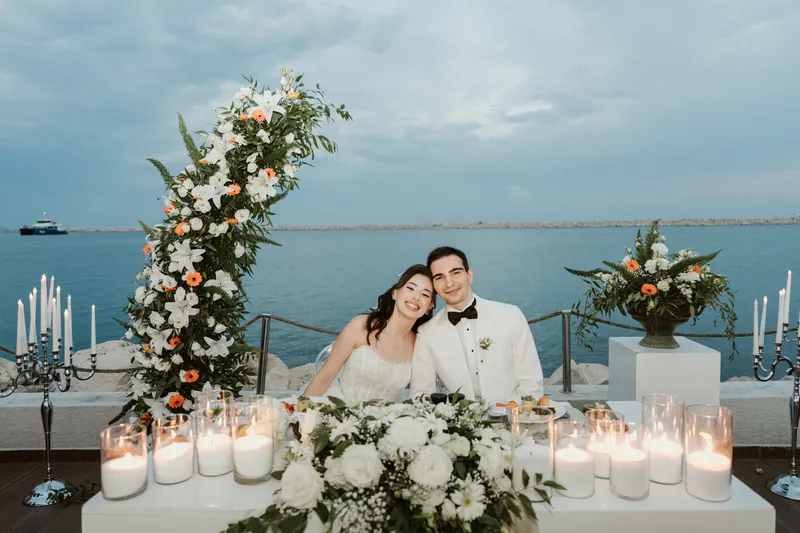
Guest Transport and the Shape of the Evening
At a resort wedding, guests walk from their room to the reception. At a villa wedding, almost everyone is arriving from somewhere else, and transport becomes part of the event design rather than a detail attached to it.
Most couples base guests in hotels and move them in shuttle waves. That works, but the waves have to be planned against the schedule: an arrival window that fills the property gradually rather than depositing everyone at once, and a return service with more than one departure so that guests who want an early night and guests who want the last song are both accommodated. A single coach at midnight forces everyone onto the same timetable.
Where a villa sleeps a portion of the party, be clear about who stays and who travels, because it changes the atmosphere of the following morning as much as the logistics of the night before. The related question of arranging guest accommodation is worth settling early, since villa locations are often not walking distance from a useful range of hotels.
Weather Backup for a Villa Wedding in Antalya
A hotel’s wet weather plan is a ballroom. At a villa the plan is usually whatever you have hired in advance, because the interior of a house will rarely seat your guest list. This is the point at which villa weddings most often become expensive late in the process, when a structure is added in the final month at short-notice rates, if it is available at all.
Decide the backup at the point of booking, not in the final month. In practice the options are a hired structure held from the outset, a covered terrace large enough to be genuinely usable, or a reserved alternative location. Note that on the Antalya coast wind is often the more disruptive factor rather than rain: it affects marquee specification, whether an open-sided structure is viable, floral and candle decisions, and sound. Heat is the other side of the same problem, and shade for the ceremony, cooling in the dining area and water for guests are part of the plan rather than an afterthought. Our guide to Antalya wedding seasons covers the timing side of this decision.
The Legal Ceremony Question
Only a civil marriage conducted before an authorised marriage officer is legally valid in Turkey. A religious or symbolic ceremony has no legal effect on its own. Turkish rules do allow for ceremonies to be held away from the marriage office, including in private buildings, and outside office hours, with the marriage officer’s agreement and payment of their transport costs. What cannot be assumed is that it will be available at your villa. The relevant district marriage office has to confirm the particular property, whether an officer is available on your date, the procedure to be followed and the fees payable, and practice varies between municipalities.
For that reason many international couples complete the legal marriage in their home country and hold a symbolic ceremony at the villa, which removes the documentary timetable from the wedding week entirely. Couples who want the legal ceremony to happen in Turkey should confirm the position directly with the district marriage office well in advance, and should read our guidance on civil weddings in Antalya alongside the current requirements for their own nationality.
What to Verify Before You Book a Villa Wedding in Antalya
The following should all be answered before a deposit is paid. Any one of them left open is a reason to keep looking.
- Written permission from the owner for a wedding, stating maximum numbers on site.
- Confirmation that external suppliers may work at the property, and on what terms.
- Setup and dismantle access windows written into the rental agreement.
- Whether the property holds a valid tourism rental permit.
- If the villa is in a managed complex, what the management plan says about events and music.
- Distance to the nearest occupied neighbouring property.
- The largest vehicle that can reach the gate, and where it can turn.
- Carry distance and gradient from the gate to the event area.
- Available electrical supply, and whether a generator is required.
- Bathroom provision against your guest count, and drainage arrangements.
- Confirmed wet weather structure or alternative location, reserved in advance.
- Parking capacity and the designated coach drop-off point.
- Realistic transfer times from the airport your guests will actually use.
- Who holds liability, and what the owner requires by way of insurance or deposit.
Most of these can only be answered properly on site. Photographs do not show gradients, road widths or how far the kitchen area sits from the dining terrace, which is why a planning visit matters more for a villa than for a hotel wedding. Where a visit is not possible, your planner should walk the property on your behalf and report against this list rather than sending photographs.
Frequently Asked Questions
Can you hold a wedding at any rental villa in Antalya?
No. Permission for an event is separate from permission to stay, and it has to come from the owner in writing. Some owners welcome weddings, some allow small gatherings only, and some prohibit events entirely. Where the villa sits in a managed complex, the complex management plan may impose further restrictions. Always confirm before booking.
What time does music have to stop at a villa wedding in Antalya?
There is no single answer, and 01:00 should not be treated as a guaranteed finishing time. Turkey’s Environmental Noise Control Regulation provides a framework under which outdoor activities take place between 10:00 and 01:00, and the Provincial Local Environment Board can adjust hours for music-broadcasting businesses according to season and local conditions. For a private villa, what applies depends on local conditions, the status of the property, the owner’s own rules and the relevant local authorities, so all of those need checking for the specific property. The safer approach is to plan an outdoor finish comfortably inside whatever window is confirmed, and move any later celebration indoors or to a lower volume.
Do we need a marquee for a villa wedding?
Not always, but you need a defined wet weather plan, and at most villas that means a hired structure or a covered terrace large enough to hold the full guest list. Decide this at the booking stage. Adding a structure in the final weeks is expensive and depends entirely on availability.
How many guests can a villa wedding accommodate?
It depends far more on access, power, sanitary provision and flat usable ground than on how many bedrooms the villa has. A villa that sleeps twelve may comfortably host a hundred guests, or may struggle with fifty if the terrace is terraced and the lane is narrow. Assess the site against your guest count rather than reading capacity from the listing.
Is a villa wedding cheaper than a hotel wedding in Antalya?
Not reliably. The rental figure is only the entry point, and everything a hotel includes as standard becomes a separate line: catering infrastructure, power, furniture, sanitary provision, a weather structure, transport and additional staffing. Villas are chosen for exclusivity and for the character of the setting rather than as a cost-saving measure.
Can we get legally married at the villa itself?
Possibly, but do not assume it. Only a civil ceremony before an authorised marriage officer is legally valid in Turkey, ceremonies outside the marriage office require that officer’s agreement, and practice varies by municipality. Many international couples complete the legal marriage at home and hold a symbolic ceremony at the villa.
If you are weighing a specific villa in Antalya and want a clear read on whether it will actually work for your guest count and your plans, Ramarossi is happy to talk it through. Tell us the property, the numbers and the dates you are considering, and we can tell you what the site would need.