


Kaş wedding venues are often grouped into three models: the boutique hotel, the private villa or private property, and the seafront terrace or waterfront venue. They are useful categories for organising a shortlist, because they tend to raise different questions. They are not, however, a reliable guide to what any individual venue can actually deliver.
That distinction matters more than couples expect. Usable capacity, exclusivity, supplier access, catering, power, accessibility, sound and finishing times are settled by the specific property and its contract, not by the category it sits in. Two boutique hotels a few streets apart can differ on every one of those points. This article compares what to ask of each model. The property itself confirms the answers, and it should do so in writing.
If you are still choosing the destination rather than the venue, our overview of a wedding in Kaş is the better place to begin. This article assumes you have already chosen Kaş and are now deciding what kind of place to hold it in.
Reading a Kaş Venue Before You Read the Photographs
Kaş sits at the western edge of Antalya province on a stretch of the Turkish Mediterranean coast where the ground rises quickly from the sea. The town centre is compact, and much of it can be crossed on foot, though the route between any two specific points is a separate question worth checking for yourself.
Protected-area status is one piece of context worth understanding correctly. The Kaş-Kekova Special Environmental Protection Area covers part of the wider coastline east of Kaş, so protected-area considerations may be relevant to some properties or locations. Whether they affect a specific venue depends on its exact position and status, and that is a question for the property and, where relevant, the responsible authority, rather than something to infer from the name of the town.
Access to Kaş itself shapes guest expectations and is worth settling early. Kaş has no airport of its own, and guests generally arrive through Dalaman or Antalya, both of which involve a substantial road transfer along the coast. Published estimates of that drive vary noticeably between sources and by route, season and traffic, so treat any single figure with caution and confirm current transfer timings with your planner close to the date. Neighbouring Kalkan shares much of the same approach.
Survey the route your guests and suppliers will actually take
Terrain around Kaş varies from one site to the next, and a description of the area tells you nothing reliable about a particular address. Whichever model you are looking at, walk the site and establish the same set of facts each time.
- Where the largest vehicle in your supply chain can stop, and where guest cars and any coach can stop, turn and depart.
- The number of steps and the steepness of any slope between that stopping point and the ceremony, dinner and dancing areas.
- The route guests take between arrival, ceremony, dinner, dancing and the lavatories, including after dark.
- The carry distance for suppliers from the unloading point to where equipment is needed, and what that route crosses.
- Whether an accessible route exists for guests who cannot manage steps, however indirect it may be.
Answer those five questions at every property on your list and you will have a comparison that means something. Answer them for the category rather than the address and you will have very little.
The Boutique Hotel Model
Rooms, exclusivity and the shape of the day
The reason many couples look at a hotel first is the possibility of holding accommodation and celebration in one place. Whether that possibility exists at a given property is a matter of fact to establish rather than assume. Ask how many of your guests the hotel can house on your dates, what happens to the remainder, and whether exclusive use of the property is available at all, on what terms and what it covers.
Where exclusive use is not taken, the wedding runs alongside other guests and the hotel’s normal operation. That is workable, and it is common, but it should be a decision rather than a discovery. Room availability, block arrangements, minimum commitments and exclusive-use terms are commercial matters for each hotel to confirm in writing.
Usable event layout
Boutique properties in Kaş vary in how they are laid out, and some are built across more than one level, with a restaurant terrace and one or more smaller outdoor areas. The figure that matters is not the property’s overall capacity but the number it can seat for dinner while also holding a ceremony space, a dance floor, service routes and technical positions.
Ask each property for a layout at your actual guest numbers showing all of those elements together, rather than a single capacity figure. Where the day depends on turning one space between stages, ask where guests will be while that happens.
Catering, kitchen and supplier policy
A hotel with its own kitchen may be able to cater your wedding comfortably, or may be sized for its restaurant service rather than for a wedding at your guest count. Establish which, at your numbers, with the menu style you have in mind and the service format you want.
Then establish the policy position. Some hotels restrict or price external catering, and some limit which outside suppliers may work on site. If you intend to bring a specialist caterer, a particular cake supplier or an external bar or entertainment team, raise it before you commit and get the answer recorded in the contract.
Power, load-in and technical provision
Ask what electrical supply is available at the point where it will be needed, what a band, DJ, lighting design and catering equipment would draw, and whether the property has run an event of comparable technical scale before. Ask where a supplier vehicle can stop, how far the carry is from there, what the route crosses, when the earliest setup access is and when everything must be removed.
Sound, neighbours and finishing times
Central Kaş is a lived-in town, and residential neighbours may be close to a hotel’s outdoor spaces. What any individual property is permitted to do with amplified music, outdoors and indoors, is specific to that property. Ask for its outdoor and indoor finishing times separately, and record them in writing rather than relying on a conversation.
What to establish before shortlisting a boutique hotel
- Room availability on your dates, and where any remaining guests would stay.
- Whether exclusive use is available, on what terms and what it covers.
- A layout at your guest numbers showing ceremony, dinner, dancing, service and technical areas together.
- Kitchen capability at your guest count and in your service format.
- External caterer and supplier policy, including any charges.
- Available power at the point of use, and load-in and dismantling arrangements.
- Accessible routes for guests with limited mobility.
- Music position, and contractual outdoor and indoor finishing times.
The Private Villa or Private Property Model
Status comes before everything else
One principle governs this model and should be applied before any other consideration. A private or residential property should not be assumed to have the operating status, permissions or infrastructure of a licensed wedding or event venue. Some private properties are set up and permitted to host events. Others are homes that are let for holidays. The two can look similar in photographs and behave very differently in practice.
Establish the property’s status first, because the answer determines whether the remaining questions are worth asking. A property owner’s willingness to host your wedding is not the same thing as the property being in a position to do so.
Exclusivity, accommodation and guest movement
If a private property appeals for the sense of having the place to yourselves, confirm what that means at the specific address: whether the let is exclusive for the whole period you need, whether any part of the property or grounds remains in other use, and whether neighbouring properties sit close enough to affect how the evening runs.
Then establish how many of your guests the property sleeps, where any remainder would stay, and what transfers that implies at the start and the end of the night. Where the approach is narrow, the departure plan deserves as much attention as the arrival.
Catering, power and infrastructure
What a private property already provides varies widely. Some have kitchens and service infrastructure suited to catering at scale; some do not. Rather than assuming either, put the question to your caterer and your production supplier directly, and have them survey the property rather than work from a description of it.
- What kitchen, preparation, refrigeration, water and waste provision exists, and what a caterer would need to bring.
- What electrical supply is available, where the supply points are, what the event would draw, and whether additional power provision is needed.
- Where any additional plant would be positioned so that its noise does not sit behind the ceremony or the speeches.
- What covered or enclosed space exists for a weather alternative, and what would have to be brought in.
- Which suppliers are permitted to work on site, and any restriction on external catering.
- Vehicle access, turning, stopping points and supplier carry distance.
Events and amplified music at a private property
Whether events are permitted at the property, and what amplified music is permitted in which space and until when, are questions to settle in writing before you plan an evening around them. A private or residential villa should not be assumed to hold the same permissions as a licensed hotel or event business, and the arrangements available at one property tell you nothing about another.
The Seafront Terrace or Waterfront Venue Model
Position, exposure and usable footprint
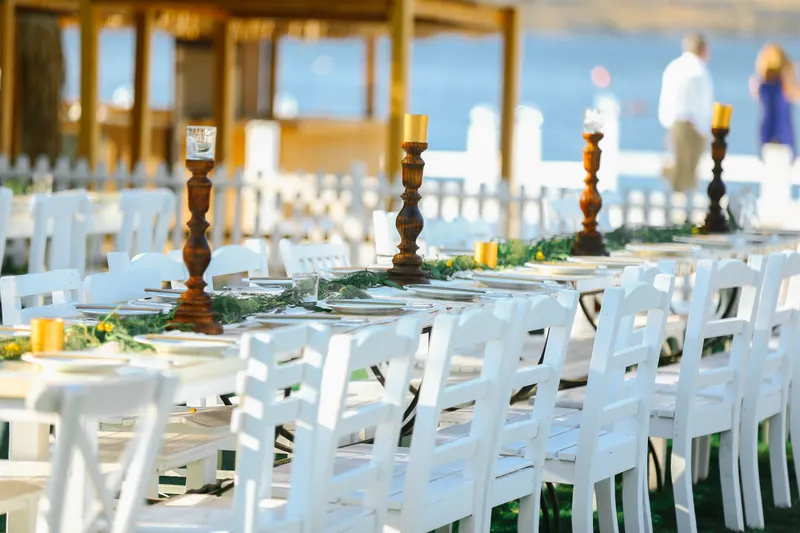
A waterfront venue puts the sea directly behind your ceremony and holds it there through the evening. The consideration that comes with that position is exposure, and exposure is easy to underestimate on a calm morning site visit.
Establish the usable footprint at your guest numbers, and how the shape of the space accommodates a ceremony, a seated dinner, a dance floor and service routes. Some waterfront spaces handle all of that comfortably; others require the space to be turned between stages, in which case ask where guests will be during the interval and whether there is shade or shelter for them.
Wind and weather at the specific site
Wind exposure is highly site-specific on the Kaş coast. An open waterfront terrace may behave very differently from a sheltered courtyard, so assess the specific space at the time of day the event will operate and ask the venue how it manages wind-sensitive setups.
Wind affects light fabrics, floral installations, table settings, stationery, candles and any structure with a surface for it to push against. Sea conditions matter too at a space close to the waterline, both for spray and for wave noise competing with an unamplified ceremony or with speeches. Ask at what point the venue would move or modify a setup, who makes that decision and when.
Load-in and technical constraints
Access to waterfront positions varies. Some are reached directly by vehicle; some are reached through pedestrian streets, down steps, or along a route no vehicle can take. That answer determines setup time, labour and what can realistically be installed, so establish the load-in route, the earliest access time and the dismantling window before committing to a design. A concept that cannot be carried to the site is not a concept.
Sound and neighbouring sensitivity
Waterfront venues in Kaş may sit within or beside residential and commercial areas, and sound travels efficiently over water. What a venue is permitted to do with amplified music, outdoors and indoors, is specific to that venue. Treat any assurance about music and finishing times as something to record in the contract.
What to establish before shortlisting a waterfront venue
- Usable footprint at your guest numbers, with ceremony, dinner, dancing and service shown together.
- How the space behaves in wind at your intended time of day, and how the venue manages wind-sensitive setups.
- The weather alternative, where it is, and who decides when to use it.
- Load-in route, vehicle access, setup access time and dismantling window.
- Shade and shelter for guests, including during any changeover between stages.
- Music position, and contractual outdoor and indoor finishing times.
Comparing the Three Models: What to Verify
The table below sets out the questions each model tends to raise. The questions are the useful part. No row describes a characteristic you can rely on by venue category, and every one of them is answered by the individual property.
| Consideration | Boutique hotel: verify | Private villa: verify | Waterfront venue: verify |
|---|---|---|---|
| Exclusivity | Is exclusive use available, on what terms, and what does it cover? | Is the let exclusive for the whole period, and what adjoins it? | Is the space exclusively yours, and what else operates nearby? |
| Accommodation | How many guests can stay, and where do any others stay? | How many does the property sleep, and where do any others stay? | Where will guests stay, and how far is it? |
| Guest movement | What is the route between spaces, including level changes? | What is the approach, and the route once on site? | How do guests reach and move around the space? |
| Catering | Can the kitchen deliver your format at your numbers? | What provision exists, and what must a caterer bring? | What kitchen or service provision is available on site? |
| Power and technical | What supply exists at the point of use? | What supply exists, and is more provision needed? | What supply exists, and what do access limits allow? |
| Weather backup | What alternative space exists, and does it fit your numbers? | What alternative exists, and what would be brought in? | What alternative exists, and how quickly can it be used? |
| Accessibility | Is there a step-free route from arrival to each area? | Is there a step-free route from arrival to each area? | Is there a step-free route from arrival to each area? |
| Multi-day use | Are the rooms and spaces available across your dates? | Is more than one event permitted, and over what period? | Is more than one event possible, and on which dates? |
Factors Worth Settling Early at Any Kaş Venue
Heat, rain, wind and ceremony timing
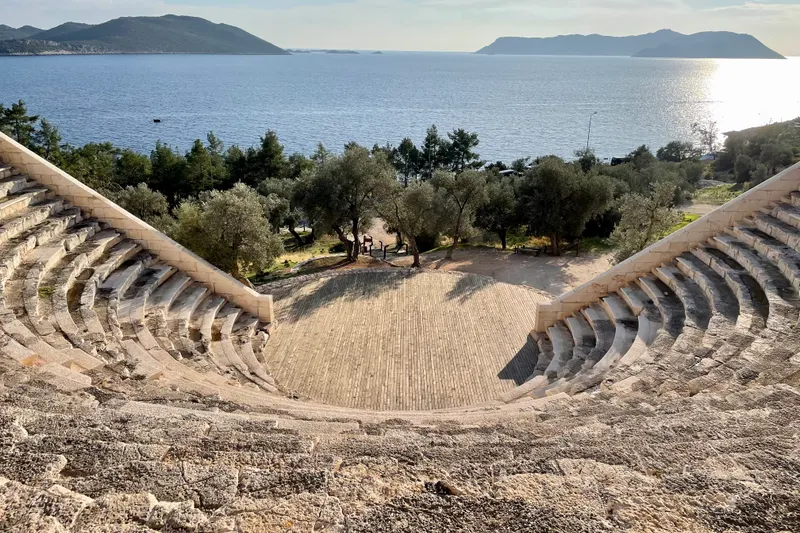
Heat, rain and wind exposure vary by date and site. Confirm the actual weather-backup space, wind plan, shade and ceremony timing for the specific property, and agree the decision point for invoking any alternative in advance rather than on the day. Our comparison of indoor and outdoor wedding venues covers the general trade-off in more depth.
Mobility and older guests
If your guest list includes older relatives, anyone using a stick or a wheelchair, or anyone who will struggle with repeated stairs at night, make this an explicit criterion at shortlisting stage rather than a detail to resolve later. Ask every property directly whether a step-free route exists from arrival to ceremony to dinner to the lavatories, and ask to walk it.
Photography and movement on the day
Decide early whether photographs happen within the venue or at a separate location, because moving a wedding party costs time and the schedule needs to reflect that decision rather than discover it. Where a separate location is planned, establish the journey time on the roads you would actually use, at the time of day you would use them.
Multi-day celebrations
For a multi-day celebration, compare accommodation, exclusive-use period, whether more than one event is permitted, available spaces on each day and transport requirements. Our guide to a multi-day wedding experience in Turkey covers how those days tend to be shaped.
Wedding Timing and After-Party Arrangements
In Ramarossi’s operational experience of Turkish wedding-venue practice, the main wedding and reception programme is normally structured to finish at approximately 00:00, with any continuation after that treated as an after-party. An after-party may continue later, commonly to around 02:00, only where the specific venue and specific event space are permitted and contractually able to operate. If outdoor amplified music is permitted after 00:00, the after-party may continue outdoors within that permission; otherwise authorised indoor or enclosed continuation may be possible. Exact outdoor, indoor and after-party times must be confirmed with the property in writing.
These are conventions of wedding-venue practice and property-specific arrangements, not universal statutory finishing times, and they should not be planned as though they were. A private or residential villa should not be assumed to hold the same permissions as a licensed hotel or event business.
If you want to understand how the later part of the evening is structured as an event in its own right, our article on the after-party, or post-wedding reception covers it separately.
What to Confirm in Writing Before You Commit
Whichever model you choose, the following items are property-specific and belong in your contract rather than in a conversation. Nothing in this article can substitute for confirmation from the venue itself.
- Usable capacity for ceremony, dinner and dancing simultaneously, and any minimum numbers.
- Whether exclusive use is available, what it covers and on what terms.
- Which suppliers may work on site, and any restriction on external catering.
- Kitchen and service facilities available, and what a caterer would need to bring.
- Electrical supply, distribution points and any additional power provision required.
- Load-in route, vehicle access, earliest setup access and dismantling window.
- The property’s legal and operating status, any relevant music permissions or conditions, and what amplified music is permitted in each space.
- The contractual outdoor finishing time.
- The contractual indoor finishing time.
- Whether an after-party is possible, in which space, and until when.
- The weather alternative, and who decides when to invoke it.
- Accommodation availability, room blocks and any commitment attached to them.
- Accessible routes for guests with limited mobility.
Frequently Asked Questions
Which Kaş venue model works for a larger guest list?
Venue type alone does not determine whether a larger guest list works. Ask for a layout at your actual numbers showing dinner, dance floor, ceremony, service routes and technical space, and verify vehicle access and backup capacity. A property in any of the three categories may handle your numbers well or poorly, and the layout is what tells you which.
Can we hold a wedding at a private villa in Kaş?
Private property weddings do take place in the area, but what is possible at any particular property depends on that property’s status, its permissions and its position relative to neighbours. A private or residential property should not be assumed to have the operating status, permissions or infrastructure of a licensed wedding or event venue. Establish the position for the specific property before building plans around it.
How late can music continue at a Kaş wedding?
There is no single answer that applies across venues. In Turkish wedding-venue practice the main programme is normally structured to finish at approximately 00:00, with any later continuation treated as an after-party, and whether that is possible depends on the individual venue’s permissions and its contract. Ask each venue to state its outdoor and indoor finishing times separately, in writing.
Is Kaş suitable for guests with limited mobility?
That depends on the specific venue rather than on the town. Properties differ in how much of the guest journey can be completed on the level. If this matters for your group, raise it at shortlisting stage, ask each property directly about a step-free route from arrival through to the lavatories, and walk that route yourself where you can.
Do we need a weather backup for a summer wedding in Kaş?
Plan one, and plan it for wind as well as rain. Exposure varies between sites, so agree with the property what the alternative arrangement is, where it would take place, whether it accommodates your guest numbers, and at what point the decision to use it would be taken.
Choosing Between Them
These three models are a way of organising a shortlist, not a ranking. What separates a venue that will work for your wedding from one that will not is not its category. It is the layout at your numbers, the access, the catering position, the power, the permissions, the weather alternative and the finishing times, all confirmed in writing by the property itself.
Ramarossi plans international weddings along this coast, and much of that work consists of putting exactly these questions to properties and getting the answers documented before couples commit. If you would like help comparing a shortlist in Kaş against your guest list, your dates and how you want the days to run, we are glad to have that conversation. Availability, access, permissions, terms and pricing always remain matters for the individual property to confirm, and we would always want you to see the shortlist for yourselves. Our note on how a planning trip is structured explains how couples do that.