

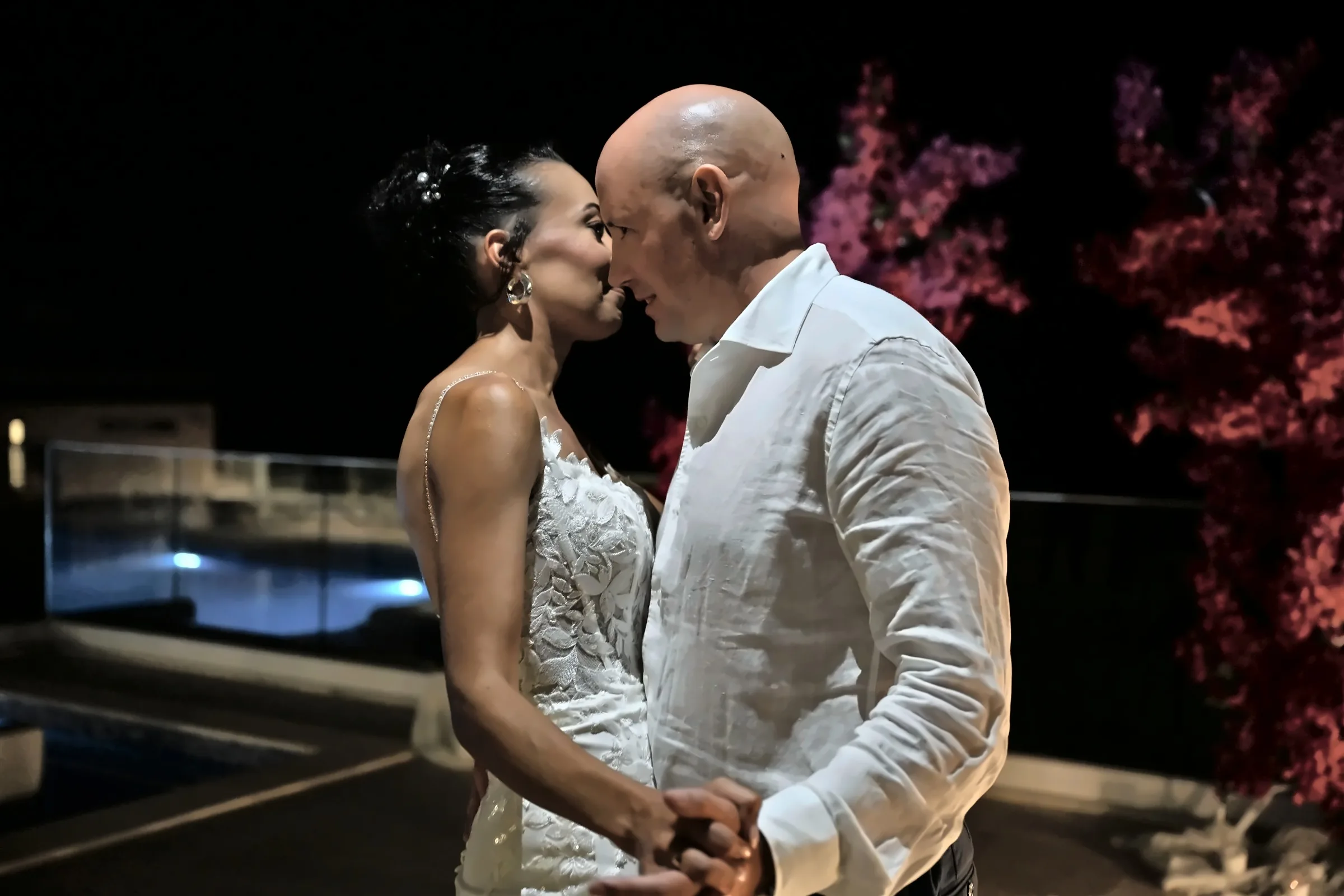
Romantic First Dance: How to Plan Yours for a Destination Wedding
Choosing the song, easy steps for couples who do not dance, practice before you fly, and how the floor, the light and the timing shape the moment in Antalya.
A romantic first dance does not need years of lessons. It needs a song that means something to you both, a few simple steps you trust, and a floor, a light and a moment that suit the evening you are planning.
This guide from Ramarossi is written for couples planning a wedding in Antalya flying in from Lebanon, the Gulf, North America, Europe or the UK, who may see their dance floor for the first time only days before the wedding. It covers the song, easy styles for beginners, practice at home, outfits, timing, lighting, outdoor floors, photos and the cultural dances that can follow.
Why a Romantic First Dance Feels Different Abroad
At a destination wedding the setting does much of the work: a warm night, a terrace or garden, the sound of the sea, and guests who have travelled to be with you. The romance comes less from flawless footwork and more from two people at ease with each other in a place their guests will remember.
The planning changes too. You rehearse in a living room far from Antalya, then dance on a floor you may only know from photos. The sections below close that gap, so the dance you practised at home is the one you enjoy on the night.
Choosing the Song: Meaning, Tempo and Length
Start with meaning. A track from your first trip together, a song from a long-distance year or a record a parent loved can all carry the moment. Write a shortlist each, swap lists and listen together before you decide.
Then test the tempo: if you can step comfortably on every beat, or every other beat, the song works for beginners. A very slow ballad can feel endless in front of a crowd. Read the words of the whole song too, because a verse about leaving or heartbreak can surprise your guests.
Finally, think about length. Two and a half to three minutes is plenty for a couple dancing alone. Ask your DJ to edit a shorter version or fade it at a natural point, or play the full track and invite guests to join halfway. If a band will play it live, send them the recording you practise with, since a live arrangement can change the tempo. For choosing between a DJ and live musicians, read about wedding music in Antalya.
Two Cultures, Two Songs
Bicultural couples have two musical traditions and one dance. One answer is a song from each side: a Persian and British couple might open with an English ballad and blend into a Persian love song, while a Pakistani and Canadian couple might pair a Western track with an Urdu favourite. Rehearse the changeover, where beginners lose count, and let the MC explain the choice so both families feel the music is theirs.
A Few Song Ideas, for Example
Treat these as starting points rather than a list to copy. For a slow sway, you might start with classics such as “At Last” by Etta James, “Can’t Help Falling in Love” by Elvis Presley or “Perfect” by Ed Sheeran. If you would rather open with energy, “Marry You” by Bruno Mars or “Shut Up and Dance” by Walk the Moon can turn a first dance into the start of the party.
Dance Styles for Couples With No Experience
No dance background is needed. These four approaches suit beginners.
None; a few practice runs to the song
Slow ballads and emotional songs, couples who want to talk and laugh as they dance
A little; a few weeks of short practice
Songs with a steady count of three, classic and elegant moods
None to a little; practise the spin and dip until they feel safe
Mid-tempo love songs, relaxed couples who want one or two photo moments
Some; a handful of lessons or regular practice at home
Couples who enjoy a surprise, a slow start that cuts to an upbeat party track
| Style | Experience needed | Suits |
|---|---|---|
| Slow sway | None; a few practice runs to the song | Slow ballads and emotional songs, couples who want to talk and laugh as they dance |
| Simple waltz (box step) | A little; a few weeks of short practice | Songs with a steady count of three, classic and elegant moods |
| Sway with highlight moves | None to a little; practise the spin and dip until they feel safe | Mid-tempo love songs, relaxed couples who want one or two photo moments |
| Short choreographed opening | Some; a handful of lessons or regular practice at home | Couples who enjoy a surprise, a slow start that cuts to an upbeat party track |
The Slow Sway, Done Well
Stand close, one hand held and the other on your partner’s back or waist. Shift your weight from foot to foot with the beat and turn slowly in a small circle, so every side of the room sees your faces. A gentle spin under the arm as a chorus begins gives the dance shape. If you add a dip, the leader supports the partner’s upper back firmly, the partner keeps their weight over their own feet, and you lower only as far as feels steady.
A Waltz Box Step in Plain Words
Waltz music counts in threes. The leader steps forward with the left foot, steps to the side with the right, and brings the left foot to meet it. Then the leader steps back with the right foot, to the side with the left, and brings the right foot to meet it. Those six steps trace a small square while the partner mirrors them, starting with the right foot moving back. Count “one, two, three” under your breath; once the square feels automatic, turn it slightly each time round to travel across the floor.
An Opening That Becomes a Party
Begin with a minute of slow song, then let the music cut to an upbeat track while you break into a short routine or wave everyone onto the floor. Nervous couples like it because attention moves to the celebration quickly. Rehearse with the DJ’s edited file, not the original.
Practise at Home Before You Travel
Since you may land in Antalya only a few days before the wedding, the learning happens at home. A local teacher can turn your song into simple steps in a handful of sessions. In the UK, the Imperial Society of Teachers of Dancing explains how to find a qualified dance teacher near you; elsewhere, look for a teacher who works with beginners and wedding couples. Film the final routine on your phone so you can practise from it anywhere.
- Settle the song early. Fix the edited version a few months ahead, so every practice uses the same file.
- Learn the basics. Short sessions a few times a week build memory without tiring you.
- Add highlights last. Bring in a spin or a gentle dip only once the basic steps feel easy.
- Rehearse in your shoes. Closer to the day, practise in your wedding shoes and in a long skirt or jacket similar to your outfit.
- Pack the essentials. Bring the music file and your practice video, and run through the dance once or twice in your room after you arrive.
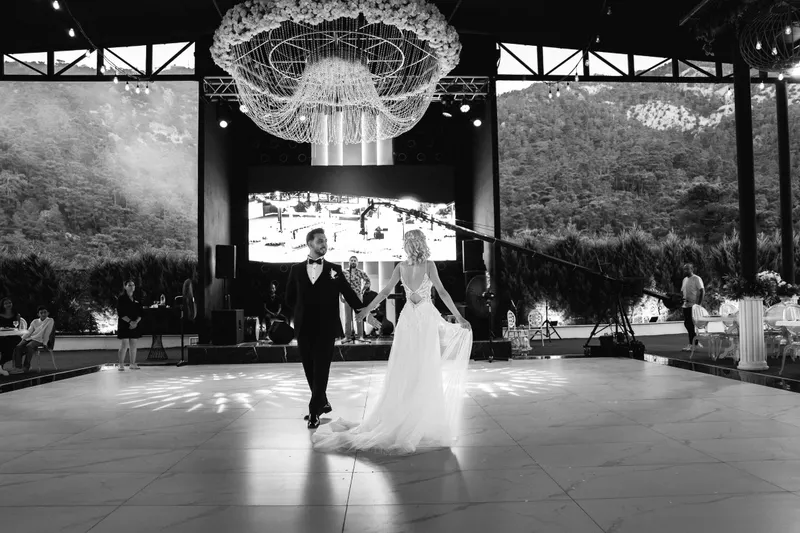
If the venue allows, ask for a short practice on the real floor the day before or on the morning of the wedding, while the space is being set up. Even five minutes shows you how the surface feels, where the edges are and which way to face for the photographer.
Shoes, Dress and Bustle
Check your outfit before you leave home.
- Shoes. Wear them in around the house, lightly scuff smooth soles so they grip, and pack a lower pair if your wedding heels are high.
- The train. Decide whether you will bustle it, hold a wrist loop or change into a shorter second look, and practise moving with it.
- Bustle practice. Show a bridesmaid or relative how the bustle fastens before the wedding day.
- Veil and hair. A long veil can catch on a spin or lift in a breeze, so consider removing it before the dance or securing it firmly.
- Jacket and sleeves. Raise your arms as if for a spin; if the jacket pulls across the back, practise without it or plan to take it off.
Our destination wedding dress guide covers fabrics that move well on warm evenings.
When to Have Your First Dance
There is no single right moment. Choose the one that suits your evening and your nerves.
Straight after your entrance. You go directly onto the floor while the energy of the entrance is high, then relax over dinner.
After dinner. Guests have eaten, the speeches are done and everyone turns to face the floor, with cake cutting just before or after.
As the floor opens. Your dance becomes the signal for the party, with the DJ or band moving straight into an upbeat track as guests join you.
Whichever you choose, place the dance well before the music has to end, so the party that follows has room to build. Music finishing times differ from venue to venue; see Antalya wedding venue curfews before you fix the order of the evening.
Lighting, Cold Sparks and Low Fog
Light changes how a first dance feels and how it looks on camera. A soft spotlight, warm string lights above the floor or candles around its edge draw every eye to the two of you. Confirm with the venue what is possible in your space.
Spotlight. Ask whether the room can be dimmed and the floor lit on its own for the length of the song, by the venue or your lighting supplier.
Cold sparks. Spark machines at the edge of the floor can add a burst at a key moment in the music. Ask whether they are permitted in your space and how far from guests they need to stand.
Low fog. A low-lying fog can make the floor look like a cloud around your feet. Ask whether it may set off smoke detectors indoors, and how it holds outdoors in a breeze.
Tell your photographer about any effects, as sparks and fog change the exposure. Our guide to wedding venue lighting explains the options in more detail.

Dancing Outdoors: Breeze, Ground and Floor Panels
An open-air first dance under the stars is one of the pleasures of a summer wedding on the Mediterranean coast of Antalya, Turkey. Outdoors, three things deserve a check.
The breeze. Evenings by the sea can bring a breeze that lifts veils, hair and long skirts and carries sound away. Secure hair and veil, and check where the speakers will face so the music reaches you clearly.
The ground. Lawns, sand, stone terraces and old paving can be uneven. Walk the exact spot in the shoes you will dance in, or ask the venue for photos of the surface.
Dance floor panels. Interlocking panels laid on grass, sand or a terrace give a level, smooth surface. Ask whether a floor can be laid in your space, what size suits your guest count, and how it will be levelled and lit. Planning to dance on the sand? Read about a beach wedding in Antalya as well.
Photos and Video of the Dance
Tell your photographer and videographer the song, when the highlight moves happen (the spin, the dip, the moment the music changes) and which way you will face at the start.
Ask guests to form a loose circle around the floor, leaving the side facing the photographer clear. A word from the MC asking guests to put their phones away lets the cameras capture your faces rather than a row of screens. For family who cannot travel, ask your videographer whether a livestream or a quickly shared clip is possible. More on photo and video teams is in our article on wedding photography in Antalya.
Inviting Parents and Guests to Join
A romantic first dance can open gently into a family moment. Halfway through, the DJ can invite parents onto the floor, then the wedding party, then every couple in the room. For bicultural families it is a graceful way to bring both sides together. A parent dance can also be folded in, with partners switching as the song changes; tell everyone beforehand when to join, so no one hesitates at the edge of the floor.
Cultural First Dances: Persian, Lebanese and Turkish
At Persian weddings, dancing is a joyful centrepiece, with graceful hand and wrist movements and guests circling the couple. A slow couple’s dance can flow into Persian dance music that brings everyone in; read more in our article on Persian wedding dance.
At Lebanese and wider Arab weddings, the zaffe, a lively procession with drums and dancers, can lead the couple into the reception and straight onto the floor for their first dance. Our cultural guide to Lebanese weddings explains the zaffe and what follows it.
The Turkish halay, danced in a line or circle with linked hands, works as a party dance after your first dance rather than in place of it. Once the romantic moment has passed, a halay can pull every generation onto the floor, and Turkish guests may happily lead the line.
Feeling Relaxed on the Night
Nerves before a first dance are natural. Eat properly at dinner, go easy on drinks before the dance and take a moment alone together before you walk onto the floor. A simple breathing routine, such as the one the NHS sets out in its breathing exercises for stress, can steady you in the minutes before.
Talk while you dance: whisper, laugh, count the steps if it helps. If you miss a step, keep moving and smile; guests see two people enjoying themselves, not the counting.
If the nerves are about more than the dance, our article on how to beat pre-wedding anxiety has further ideas.
Plan an evening built around your first dance
Send us your dates, guest numbers and the kind of setting you picture, and Ramarossi will reply with ideas for a reception, music and dance floor that fit your celebration.
Prefer another email service? Write to info@ramarossi.com using Antalya Wedding Enquiry as the subject.
Follow our celebrations
Discover beautiful weddings, private events, styling ideas and behind-the-scenes moments from Ramarossi in Turkey.
Frequently Asked Questions
How long should a romantic first dance be?
Two and a half to three minutes is plenty for a couple dancing alone. Ask the DJ or band to edit or fade the song, or invite guests to join halfway through.
What is the easiest first dance for couples who cannot dance?
A slow sway. Hold each other close, shift your weight from foot to foot in time with the beat and turn slowly in a small circle, then add one spin as a highlight.
Should we take dance lessons before a destination wedding?
Lessons at home help if you want a waltz or a short routine. A few sessions with a teacher who works with beginners can be enough, and filming the routine lets you keep practising while you travel.
When should the first dance happen at the reception?
Straight after your entrance, after dinner, or as the moment that opens the dance floor. Choose what suits your evening, and place it well before the venue’s music finishing time.
Can we have cold sparks or low fog for our first dance?
They can be options at some venues. Ask what is permitted in your exact space, how far from guests spark machines need to stand, and whether fog may affect smoke detectors indoors.
Can we include Persian or Lebanese traditions in the first dance?
Yes. Persian dance music or a Lebanese zaffe can lead into or follow your first dance, and a Turkish halay can open the party once the romantic moment has passed.