
Sofreh Aghd Arch: How to Frame Your Persian Ceremony with Flowers
Arch shapes, placement, proportions, sea light, wind and summer flowers: a practical design guide to setting your Sofreh Aghd inside a ceremony frame in Antalya, then giving those florals a second life at dinner.
A Sofreh Aghd arch puts the mirror, the candles and the whole spread inside one clear frame. Plan its shape, size and position around the light, the breeze and your guests’ view, and the same flowers can serve a Persian ceremony and Western vows alike.
This Ramarossi Journal guide deals only with the frame: the shapes on offer, where it can stand, how big it should be, sun and sea air on the coast, flowers that cope with heat, and reusing the florals once the ceremony is over. For what goes on the spread itself and what each piece means, turn to our complete Sofreh Aghd guide.
Why a Sofreh Aghd Arch Works
Out on a terrace, a lawn or the end of a pier, a ceremony spread can look small against a wide sky and open water. A frame gives it height and edges, shows guests where to look as they arrive, and turns the mirror and candlelight into the centre of a picture instead of one table in a broad view.
When one family is Persian and the other comes from Britain, Europe or North America, the frame does a quieter job too. Persian relatives see their tradition placed at the heart of the setting, while the other side recognises the arch from the weddings they grew up with. Each heritage is visible, and neither has to step back. Couples weighing up locations along this coast can start with our overview of a Persian wedding in Antalya.
Arch Shapes and Frames Compared
The outline you choose sets the mood of the ceremony as much as the flowers do. Compare the main options against your spread and your setting:
A low, wide spread with open sea or sky behind it
Dress the circle more lightly at the top so the horizon still shows through above your heads
Long, symmetrical spreads with a candelabra at each end
Line the two uprights up with the candelabras so the mirror sits dead centre in the opening
Smaller spreads, intimate guest numbers and a pared-back look
Turn the open side towards the view, and let the sky finish the shape
Modern, sculptural spreads on lawns and garden terraces
Balance the heavy side with a taller flower stand or candelabra on the light side
Ceremonies held while the sun is still strong, or couples who want a sheltered, enclosed feel
Measure the inside height: the cloth must still be raised comfortably above the seated couple
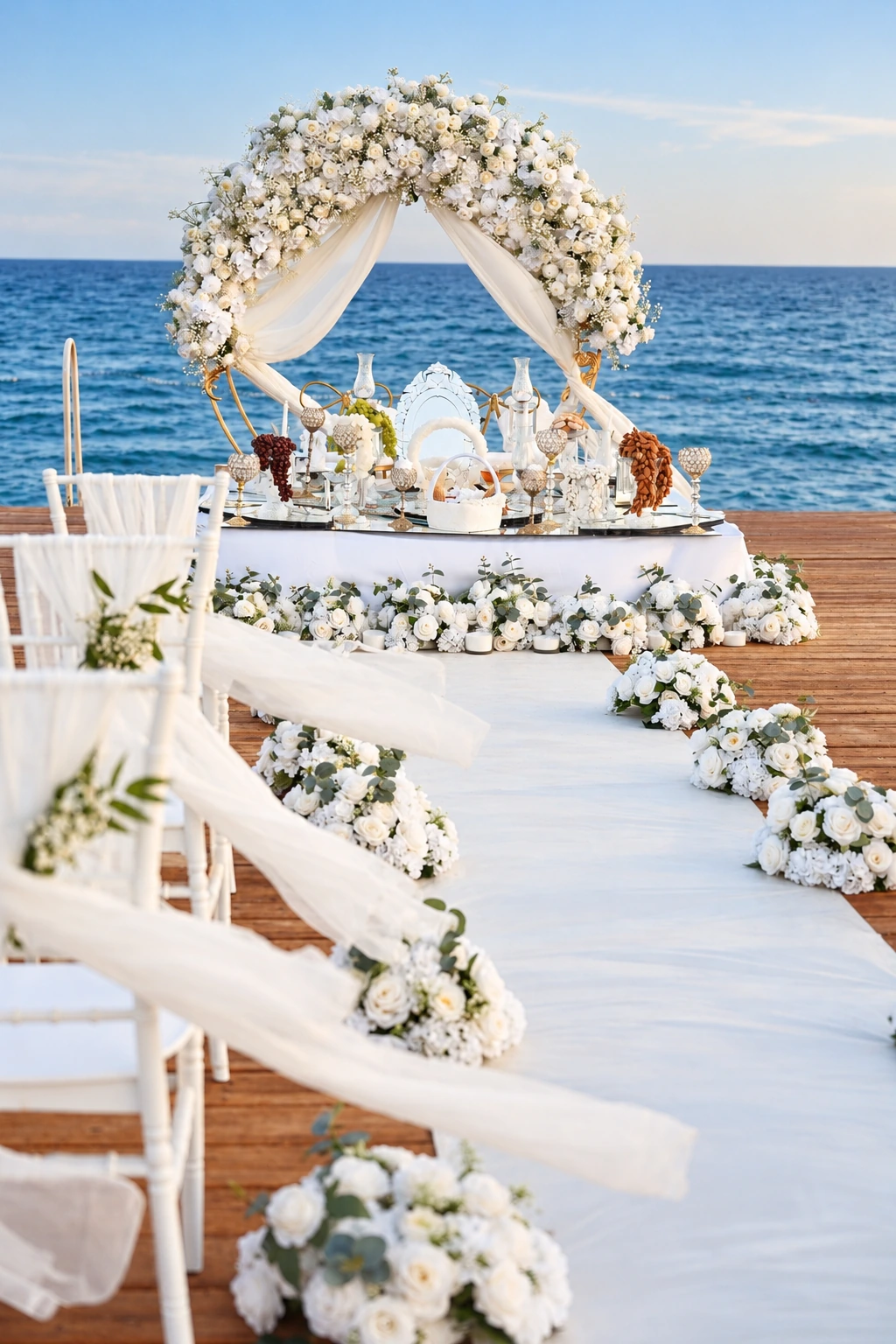
Piers and beaches, where soft fabric moving in the air suits the setting
Tie the fabric at several points and keep a generous gap between chiffon and every flame
| Arch style | Works best with | Tip |
|---|---|---|
| Round hoop | A low, wide spread with open sea or sky behind it | Dress the circle more lightly at the top so the horizon still shows through above your heads |
| Square or rectangular frame | Long, symmetrical spreads with a candelabra at each end | Line the two uprights up with the candelabras so the mirror sits dead centre in the opening |
| Half-moon or crescent | Smaller spreads, intimate guest numbers and a pared-back look | Turn the open side towards the view, and let the sky finish the shape |
| Asymmetric installation | Modern, sculptural spreads on lawns and garden terraces | Balance the heavy side with a taller flower stand or candelabra on the light side |
| Canopy or gazebo | Ceremonies held while the sun is still strong, or couples who want a sheltered, enclosed feel | Measure the inside height: the cloth must still be raised comfortably above the seated couple |
| Draped two-post or chiffon frame | Piers and beaches, where soft fabric moving in the air suits the setting | Tie the fabric at several points and keep a generous gap between chiffon and every flame |
Material changes the feel too: slim metal carries heavy floral work, timber suits a lawn or olive grove, and acrylic or mirrored panels echo a glass spread. Ask your stylist which frames are available locally before falling for a shape seen online.
Where the Arch Stands: Behind, Over or at the Aisle
A frame can sit in three positions, and each one creates a different picture for your guests and your photographer.
- Behind the couple’s seats. The spread sits in front, you sit with your backs to the flowers, and guests take in faces, mirror and blooms in a single view. It keeps foliage well clear of candle flames and is the simplest arrangement to light and photograph.
- Over the couple and the spread. A deeper structure, such as a canopy, encloses everything. It feels intimate and gives welcome shade, but the inside needs enough headroom for relatives to stand and lift the cloth above you, and for the camera to see in.
- At the start of the aisle. The arch becomes an entrance you walk through, and the Sofreh Aghd waits at the far end on its own. This suits a long, low spread, or a day where the vows and the Persian ceremony take place in two separate spots.
Whatever you choose, keep a clear strip of floor behind the seats. That is where relatives stand to raise the cloth while sugar is rubbed above you, and they need space without brushing the flowers; our article on the sugar-rubbing ceremony describes that moment in full.

Sizes and Proportions
A narrow frame squeezes the spread, while an oversized one makes a seated couple look tiny. Three relationships decide whether it looks right: width against the spread, height against the two of you standing, and depth against the space behind your chairs.
As a working guide, the inside opening should be wider than the spread together with its candelabras, so the uprights never slice through them in photographs. While you are seated, your heads should sit in the lower part of the opening with flowers rising above; when you stand for vows or a kiss, there should still be air between your heads and the top of the frame. Before anything is built, send your florist these details:
- The spread. Length and depth of the table or floor cloth, candelabras included.
- Your seats. Width of the two chairs or the bench, and their distance from the spread.
- The ground. Stone, timber decking, grass or sand, since each takes a different base and fixing.
- Overhead limits. Branches, string lights, sunshades or beams above the spot.
- The way in. Width of doors, lifts and paths the frame must travel along to arrive.
- A second role. Whether the arch moves after the ceremony, and where it goes.
Facing the Sea and the Sun
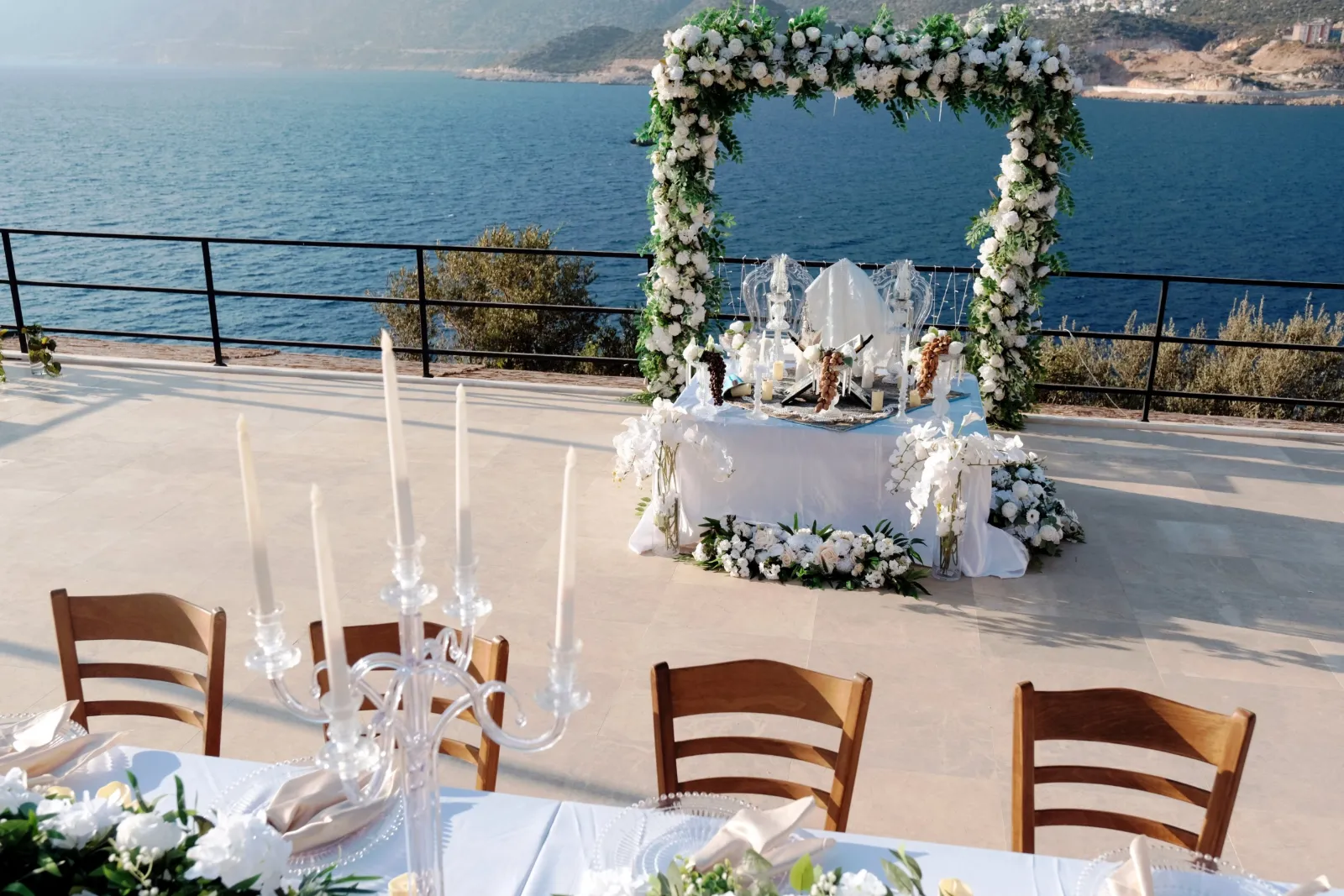
On the coast of Antalya, Turkey, setting the water behind the couple gives guests the view and the frame together, as in the photographs in this guide. Facing the sea instead hands the view to the two of you and puts your guests behind you in pictures, which can suit a venue whose land side is the prettier one.
Then check the sun at your exact spot and hour. Low sun behind you darkens faces and can flash off the mirror straight into the lens, while sun in front makes you squint through the vows. Visit at the same time of day if you can, or ask the venue for a photo taken then. For ceremony hours shaped around the evening light, see our guide to Antalya venue curfews and evening timings; if the date is still open, the month-by-month look at the Antalya wedding season helps you choose.
Heat affects the frame too. Official long-term records for Antalya, kept by Turkey’s state weather service, put July and August as the hottest months, so a midsummer arch in full sun needs flowers that can take it and a way to keep you cool while seated. A canopy, or a start time when the terrace has already fallen into shade, helps on both counts.
Wind on Piers and Terraces
Open water and raised terraces catch the wind, and a tall frame loaded with flowers behaves a little like a sail. Ask how the structure will be held down on your particular surface: weighted bases on decking or stone where drilling is not possible, ground anchors on a lawn, and sandbags hidden under fabric or flowers on a beach.
Fabric needs the same care. Tie drapes at several points rather than letting them hang loose, or choose an undraped frame for an exposed spot. Put every candle on the spread and around the arch inside glass chimneys or hurricane vases, and keep chiffon well away from flames; the London Fire Brigade’s candle safety advice to keep candles away from anything that can catch fire, curtains and fabrics included, applies just as much outdoors. Finally, ask the venue where the arch could move if the wind rises on the day. Our questions for a cliffside wedding in Antalya cover exposed settings in more depth.
Indoors, for a ballroom ceremony or a move inside on a gusty day, the questions change. Measure the ceiling height, note chandeliers and low beams, and ask whether a freestanding flower wall or a draped frame would suit the room better than an arch designed for open sky.
Flowers That Cope with Heat and Sea Air
Judge each bloom by how it will look at the end of the ceremony, not at the moment the florist steps back. Ask which stems your florist trusts on the coast in summer: sturdy flowers such as roses, carnations and chrysanthemums can hold up better in heat than delicate, thirsty blooms, and leaning more on greenery and foliage helps in the hottest months. Sun and salty air dry petals quickly, so ask for the arch to be finished as close to the ceremony as the set-up allows, with someone from the florist’s team staying until guests are seated.
Colour works with the setting. White and green read as calm and fresh against blue water, as in the Kaş terrace above; orange, pink and red glow against the sea and sky as the light softens, while blush and white roses suit a garden canopy, as in the pergola photo. Repeat the arch palette in the flowers on the spread so that frame and table read as one design. Our advice on matching flowers to a venue goes further.
How the Arch Helps Your Photographs
A frame hands the photographer strong lines to work with. From the centre of the aisle, arch, mirror and couple line up in one symmetrical shot; from the side, the flowers layer in front of the sea or garden. Agree beforehand where your photographer will stand for the key moments, so that the frame is centred on that position, and keep tall arrangements on the spread low enough not to hide your faces. Once the spread is set, ask the stylist to look at it from the camera position before guests arrive. Our page on wedding photography in Antalya covers photo and video planning more widely.
One Arch for the Persian Ceremony and Western Vows
For a mixed couple, a single frame can hold both ceremonies without rebuilding the set. Once the Sofreh Aghd is complete, you can rise and step in front of the spread, or the spread table can be lifted a little to one side, so that vows, rings or the first kiss take place beneath the same flowers. Agree in advance who moves the table and how long it takes, so the pause feels intentional rather than awkward.
Either ceremony can come first. What matters is that the person reading in Persian and the celebrant speaking in English know where each will stand, so neither blocks the mirror or the camera, and that a short change of music tells guests the second part is beginning.
Moving the Arch Florals to the Reception
An arch built for half an hour of ceremony can go on working all evening. Plan its second life early:
- Pick the new role. Behind the head or sweetheart table, at the entrance to dinner, or as a photo spot beside the dance floor.
- Walk the route. Doors, steps and the distance between the two spaces decide whether the frame travels whole or in sections.
- Use the drinks hour. Ask the venue and florist how long the move needs and who carries it out while guests are busy elsewhere.
- Refresh it. Swap tired stems and re-tie any drapes before guests sit down.
- Or split it. If the frame stays put, garlands from its uprights can become table runners or flowers for the cake.
If shipping a frame and heirloom pieces from home feels like too much, read about Sofreh Aghd rental in Antalya.
Bringing the Design Together in Antalya
Settle the shape, the spot, the measurements and a wind plan early, leave the final flowers for the last possible hour, and keep room for every family ritual to unfold comfortably beneath the frame.
If you are looking for a wedding planner in Antalya who works in Persian, English and Turkish, Ramarossi would be glad to hear how you picture your ceremony.
Tell us about your Sofreh Aghd and arch
Share your date, guest count and the setting you have in mind, and Ramarossi will come back with ideas for a frame that suits your spread, the light and the view.
Prefer another email service? Write to info@ramarossi.com using Antalya Wedding Enquiry as the subject.
Follow our celebrations
Discover beautiful weddings, private events, styling ideas and behind-the-scenes moments from Ramarossi in Turkey.
Frequently Asked Questions
What is a Sofreh Aghd arch?
It is a floral frame, arch or canopy placed around a Sofreh Aghd so that the mirror, candles and spread sit inside a clear outline. It gives the ceremony height, marks the space for guests and frames the couple in photographs.
Should the arch stand behind the couple or over the spread?
Behind the couple’s seats is the simplest choice: guests see faces, mirror and flowers in one view and the frame stays away from the candles. A canopy over both feels more enclosed and gives shade, but it must be tall enough for relatives to raise the cloth above you.
How wide should a Sofreh Aghd arch be?
The inside opening should be wider than the spread together with its candelabras, so the uprights do not cut across them in photographs. Send your florist the length and depth of the spread, the width of the seats and the ground surface before anything is built.
Can we use the same arch for the Sofreh Aghd and Western vows?
Yes. After the Persian ceremony the couple can stand in front of the spread, or the spread table can be moved aside, so vows, rings or the first kiss take place beneath the same flowers. Agree in advance who moves the table and how long it takes.
Will a floral arch stay up in the wind on a pier?
It can, when it is secured for the surface: weighted bases on decking or stone, anchors on grass, dressed sandbags on a beach. Tie any drapes at several points, put candles in glass, and ask the venue for a sheltered second spot.
Which flowers last in the summer heat in Antalya?
Ask your florist which stems they trust on the coast in summer. Sturdy flowers such as roses, carnations and chrysanthemums can hold up better than delicate, thirsty blooms, and more greenery helps in the hottest months.
Can the arch flowers be reused at the reception?
Yes. The frame can move behind the head table, to the dinner entrance or beside the dance floor, or its garlands can dress tables and the cake. Check the route between the spaces and plan the move during the drinks.