


A Cappadocia wedding venue shortlist almost always narrows to three models: a cave hotel, an open valley or landscape site, and a hotel or restaurant terrace. Each solves a different problem. A cave hotel keeps the celebration and most of your guests in one place and offers the only reliable indoor fallback of the three. A valley gives you the landscape at its most complete, but has to be built from nothing, with no shelter and no services. A terrace gives you a fixed view, level ground and predictable service, but its capacity cannot be extended and it is usually the most exposed to sound limits and wind.
The right answer follows four things: how many guests you have, how mobile they are, how much of the wedding week you want in a single location, and how much weather risk you are willing to carry outdoors.
One caveat runs through everything below. Capacity, finishing times, permitted sound levels, exclusivity terms, decoration rules and supplier access in Cappadocia are set property by property, and in some cases by conservation authorities rather than by the venue. Nothing here should be read as a rule that applies to a specific site. Treat each point as a question to put to the individual venue in writing.
Why Cappadocia Constrains Venues Differently
Cappadocia sits on a plateau in central Anatolia, broadly between 1,000 and 1,300 metres above sea level. Göreme is at roughly 1,100 metres and Uçhisar at roughly 1,270 metres. That altitude is the single most useful fact for anyone planning an outdoor evening here, and we return to it under weather below.
The second constraint is legal, and it is frequently misdescribed. The area between Nevşehir, Ürgüp and Avanos has been inscribed on the UNESCO World Heritage List since 1985, under the official property name Göreme National Park and the Rock Sites of Cappadocia. That World Heritage listing remains in force. The Turkish designation, however, has changed. Under Law No. 7174 of 2019 the region is governed as the Cappadocia Area, within boundaries set by that law, and the Cappadocia Area Directorate was established to handle its protection, planning, management and supervision. The 1986 decision that had made Göreme Valley and its surroundings a Turkish national park was repealed by Presidential Decision No. 1673 in October 2019. The historical UNESCO property name should not be read as current Turkish national-park status. Conservation site designations, registered-building status and the Cappadocia Area planning rules continue to apply, and it is those, rather than a park designation, that govern what may happen on a given site.
Two practical consequences follow. A cave property may itself be a registered building, so what can be fixed to a wall, cut into rock or added to a courtyard is not purely a commercial decision by the owner. And open valley land is not simply private ground that someone can rent to you. Permission for a private event on a protected site cannot be assumed. Restrictions and permission requirements vary by site and by the works involved, and depending on both they may sit with the Cappadocia Area Directorate, a conservation council or the municipality. Verify the position for the specific site with the relevant current authority, obtain anything required in the venue’s or organiser’s name, and do not promise a location to guests before that is in hand.
What Each Cappadocia Wedding Venue Model Actually Is
A cave hotel is a village property, usually a mixture of rock-cut rooms and masonry buildings, converted into accommodation. The wedding itself normally happens in the courtyards and terraces rather than inside the caves, which serve as bedrooms, getting-ready spaces and photographic settings. Some properties also have a vaulted interior room large enough for dinner or dancing.
A valley or landscape site is open ground with a direct view of the rock formations and no built infrastructure at all. Everything, including power, water, kitchen, toilets, seating and lighting, arrives on the day and leaves that night.
A terrace is a built, serviced deck belonging to a hotel or a restaurant, usually facing a valley or a castle rock. It comes with kitchen, power, toilets and staff, and it is the model closest to a conventional wedding venue anywhere else.
Guest Count and Usable Capacity
In all three models, the number that matters is the usable capacity of the largest single flat area, not the capacity of the site as a whole. This is where shortlists most often go wrong.
In a cave hotel, rock-cut rooms are carved out of soft volcanic tuff. They cannot be enlarged, so the seated dinner almost always lands in a courtyard or on a terrace, and the courtyard’s dimensions cap the wedding. A property with plenty of rooms may still have a modest courtyard. Ask for the seated figure and the plan behind it, not the total footprint.
Terraces are often long and narrow, because they follow a cliff edge or a building line. A long narrow terrace seats fewer people comfortably than its area suggests, and it makes a central dance floor, a single long table or a clear sightline to the ceremony harder to achieve. Ask for a drawn seating plan at your exact guest number, including the service routes.
A valley is nominally the largest of the three and in practice the most constrained, because capacity is limited by how much infrastructure can be moved onto the site and by whatever the permission allows.
Privacy, Exclusivity and Who Else Is on Site
A cave hotel taken on exclusive use gives genuine privacy: no other guests on the terraces, no strangers in your photographs, and control over the whole property for the wedding week. Without exclusive use, small properties feel shared very quickly, because the same terraces serve everybody.
Terraces vary most. A restaurant terrace may still be trading that evening unless you take it exclusively. A hotel terrace may be overlooked by guest rooms. In dense villages, neighbouring terraces frequently look straight across at each other, which affects both privacy and photography.
A valley is visually private and legally public. Walking routes run through much of the landscape, and other visitors, photographers and, at dawn, balloon crews may be present. Visual isolation is not the same as exclusivity. If exclusivity matters, ask specifically whether the permission includes controlling access to the area, and for how long.
Accommodation and When a Hotel Buyout Makes Sense
Cappadocia properties are typically small by resort standards. That is partly geological and partly regulatory: UNESCO records that the area’s conservation planning provides for hotel developments to take account of set limits on room capacities. The result is that a full buyout is realistic here at guest numbers that would be impossible at a coastal resort.
A buyout does several useful things at once. It gives exclusivity, removes almost all guest transport, allows the celebration to spread across several days rather than a single evening, and gives you more influence over setup times and the running of the night. It is often the reason couples choose the cave hotel model in the first place.
The limit is the same room count that makes the buyout affordable. If your guest list is larger than the property can sleep, you have a split party and a shuttle plan regardless, and the exclusivity argument weakens. Count beds before you count seats.
A hotel terrace gives you rooms on site without exclusivity unless you buy the property out. A valley gives you no accommodation at all, so every guest movement is a transfer. This also shapes where the money goes: a buyout moves cost into accommodation and minimum-night commitments, a valley moves it into infrastructure and logistics, and a terrace behaves most like a conventional catering and venue-hire structure. Where a property applies a minimum guest number, a minimum spend or a minimum-night stay, get it in writing with the cancellation terms attached.
Ceremony and Reception Flow
A cave hotel gives you several small spaces rather than one large one, which suits a wedding that moves: a courtyard ceremony, drinks on a terrace, dinner in a second courtyard or a vaulted room, dancing inside. Distances are short and nobody needs transport between moments. The risk is that every one of those moves involves a change of level.
A terrace usually gives you one footprint, which often means a turnaround between the ceremony and dinner on the same deck. That is entirely workable, but it needs somewhere to hold guests for thirty to forty-five minutes and enough staff to reset. Ask where the holding space is, whether it is under cover, and what happens if it rains during the changeover.
A valley handles a ceremony very well and a full seated reception much less easily. In practice the strongest answer for many couples is a hybrid: the ceremony and the portrait session in the landscape, then a short transfer to a cave hotel or terrace for dinner and the party. It keeps the setting that made you choose Cappadocia and removes most of the infrastructure risk from the part of the evening that runs longest.
Access, Stairs and Slopes
This is the axis that most often decides a Cappadocia shortlist once the guest list is real, and the one most often assessed too late.
Cave hotels are built into hillsides. Expect steps cut into rock, uneven flagstones, changes of level between adjoining rooms, and narrow passages. Lifts are frequently impossible rather than merely absent, because new shafts cannot be cut through protected fabric. Do not judge a property by its entrance. Map the whole guest route: vehicle drop-off to reception, reception to ceremony, ceremony to dinner, dinner to the toilets, and toilets to bedrooms. Any one of those legs can involve a flight of steps with no handrail.
A terrace is usually the most level of the three once you are on it, but the approach can still involve a village lane, a kerb and a staircase from wherever the vehicle can stop.
A valley is unpaved. Soft ground, dust, loose surfaces and slope are normal. Heels sink, and a wheelchair will not cross open ground without matting laid in advance. If your guest list includes older relatives, anyone with reduced mobility, wheelchair users or anyone in late pregnancy, this consideration outranks aesthetics. Ask the venue for photographs or video of the route rather than of the view.
Supplier Setup, Load-In and What the Rock Will Not Allow
Village lanes are narrow and access is often restricted to small vehicles. Load-in may mean hand-carrying equipment up steps, which changes both what production is realistic and how long setup takes. Heavy staging, large lighting rigs and oversized furniture are frequently impractical rather than merely expensive.
On a registered building, drilling, anchoring, rigging from rock faces and attaching structures may be restricted or prohibited. The usual alternative is free-standing structures with ballast, which are heavier, slower to install and more affected by wind. Confirm what may be fixed to what before a designer draws anything.
A valley setup is a full temporary build: generators and fuel, water, refrigeration, a catering tent, portable toilets, lighting for the site and the access route, and matting where guests walk. Everything arrives across rough ground and leaves the same night, and leave-no-trace conditions are normal in protected areas.
A terrace is the simplest, but setup still has to work around the property’s other guests and its own service. Ask what time suppliers may begin, what vehicle sizes reach the door, whether a service lift exists and what its dimensions are, and who is responsible for clearing the site at the end of the night.
Getting Guests There and Back
Two airports serve the region. Nevşehir Kapadokya (NAV) is the closer, at roughly 40 kilometres and about 40 minutes from Göreme, and handles mainly domestic connections. Kayseri Erkilet (ASR) is roughly 75 kilometres away, commonly quoted at around 60 to 90 minutes depending on your village, and generally offers a wider schedule. Many international guests connect through Istanbul, although Kayseri also has seasonal direct international services, so check the live schedule for your dates.
On the ground, full-size coaches often cannot reach village properties. Plan for minibuses and repeated runs, and give as much thought to the return journey as to the arrival, because guests leave in waves across the last two hours rather than together. A valley compounds this: the return is a convoy on an unlit track, so lighting the route and the parking area is a genuine line item rather than a detail.
A cave hotel taken on buyout removes most of this, which is its most underrated advantage. Our guide to coordinating wedding transportation for guests covers the scheduling side in more detail.
Sound Levels and Finishing Times
Cappadocia villages are residential. Cave hotels, terraces and restaurants sit among houses and other hotels, frequently within a few metres. Permitted sound levels and finishing times are set by the individual property and by local rules, and they vary between properties in the same village. Do not infer anything from another wedding you have seen photographed.
Terraces are the most exposed of the three, because they are open, elevated and facing a valley that carries sound. An enclosed courtyard contains sound better, and an interior vaulted room contains it best. Where a late party matters to you, the availability of an indoor room to move into is often what makes the finishing time workable at all.
In an open valley, sound travels a long way and the whole system runs on generators, so both output and duration may be capped by the conditions attached to the permission. Ask for the finishing time in the contract, what an extension would involve, and whether an indoor continuation is permitted.
Wind, Rain and Cold Evenings
Long-period averages recorded at the Nevşehir station by the Turkish State Meteorological Service, over a measurement period from 1959 to 2025, give a clear picture of what an outdoor evening here involves.
Rain is genuinely uncommon in high summer. The averages show about 2.3 rainy days in July and about 1.7 in August, with monthly totals near 9 mm and 8 mm respectively, and about 3.4 rainy days in September. May is a different proposition, at about 12.9 rainy days and around 58 mm. That summer dryness is the main reason an unsheltered valley wedding is viable at all.
Cold is the risk couples underestimate. The same records show a mean daily maximum of about 28.5 degrees Celsius in July and 28.7 in August, against a mean daily minimum of about 13.7 and 13.6. By September the mean daily minimum is around 10.5. On a plateau at this altitude the temperature falls quickly once the sun drops behind the rock, which is usually well before dinner ends. Blankets, heaters and a wrap for the bride are practical items here, not styling.
Wind is the risk couples plan for last. The plateau is open and the valleys funnel air; the fastest daily wind recorded at the Nevşehir station over that measurement period is 34.8 metres per second. You will not be marrying in that, but ordinary afternoon wind is more than enough to lift drapes, extinguish open flames, tip tall florals and make a fabric structure unsafe. Design for wind from the start: weighted bases, lower arrangements, glass hurricanes, secured signage and no unballasted structures.
Backup capability separates the three models more sharply than anything else. A cave hotel usually has real interiors that can take a reception. A terrace depends entirely on whether the property has an indoor room of comparable capacity, and often it does not, so ask the question directly and ask to see the room laid out. An open valley has no backup unless you build one, and a temporary structure that is genuinely safe in wind is an engineering exercise rather than a decorative one. Whichever model you choose, agree a decision time for switching to the alternative plan and agree who makes that call. Our guide to managing unexpected weather on your wedding day covers how that decision usually works in practice.
Photography, Sunset and the Balloon Question
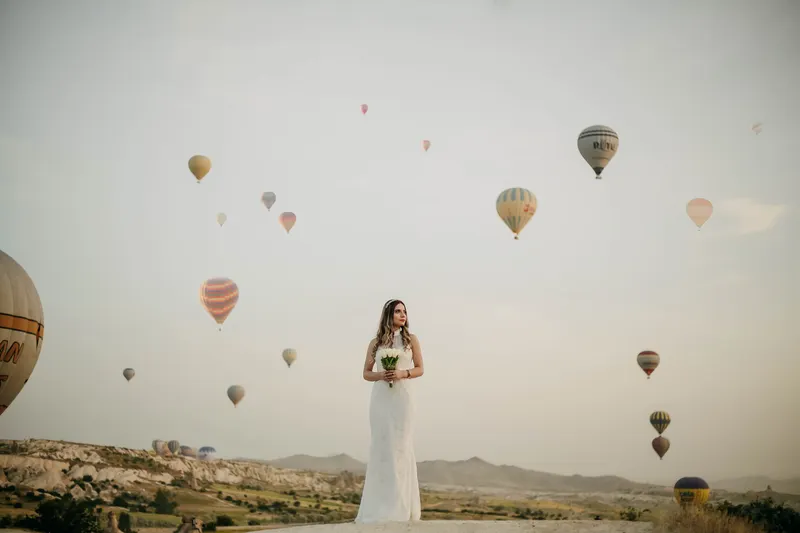
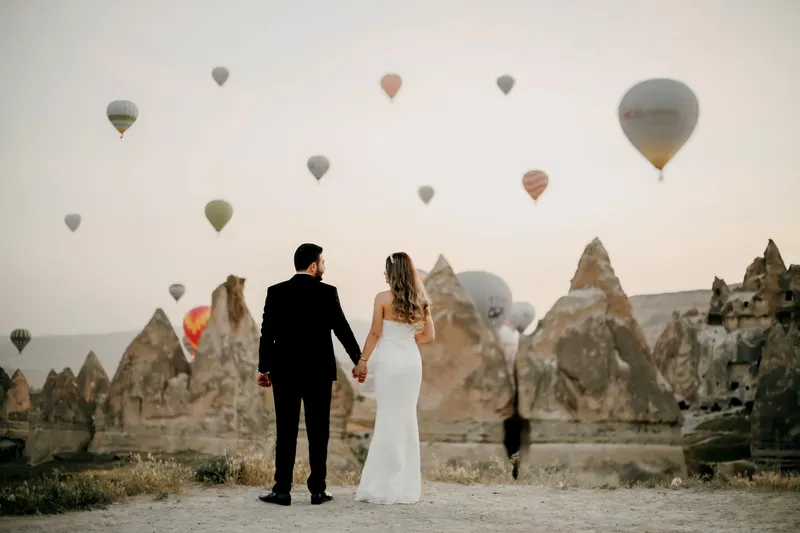
Balloon flights operate at or close to sunrise under authorisation from Turkey’s Directorate General of Civil Aviation, with the daily decision based on weather conditions, and flights are grounded when those conditions are not met. Two things follow. Balloons are a morning subject, not an evening one, so a balloon photography session belongs to the day before or the day after the wedding. And no part of the wedding day should depend on a flight taking place, because any given morning may be cancelled. If balloon photographs matter to you, build in more than one morning.
For the wedding itself, valleys give the strongest light and the cleanest backgrounds, with nothing modern in frame. Terraces give a fixed panorama, which is reliable but unchangeable, so establish which way the terrace faces and where the sun will sit on your date. Cave hotels give texture, candlelight and intimate frames, but enclosed courtyards can lose direct sun early because of the surrounding rock.
The practical question to ask at every site visit is simple: at what time does the light leave this exact spot on our date, and does that leave enough time between the ceremony and dinner for portraits? Walk each shortlisted site at the hour you intend to marry, not at midday. Choosing a photographer who has worked in this landscape before is worth more here than in most destinations, and our guidance on selecting a destination wedding photographer sets out what to look for.
Which Model Suits Which Wedding
| Cave hotel | Valley or landscape site | Hotel or restaurant terrace | |
|---|---|---|---|
| Best suited to | Multi-day celebrations where the whole party stays together | Ceremony-led and design-led weddings, or a ceremony before dinner elsewhere | Predictable evening receptions with a fixed panorama |
| Usable capacity | Set by the largest courtyard, not the room count | Set by permission and by what can be built on site | Set by the deck, and cannot be extended |
| Accommodation | On site, and often available for full buyout | None; every movement is a transfer | On site at a hotel, none at a restaurant |
| Mobility | Most demanding: steps, slopes and level changes | Difficult without matting and a made-up route | Usually the easiest once guests are on the terrace |
| Weather backup | Strongest: genuine interior space | None unless a wind-rated structure is built | Depends on an indoor room of matching capacity |
| Main trade-off | Access and load-in against exclusivity and backup | Setting against cost, logistics and risk | Reliability against exclusivity and flexibility |
Read those rows against your own list rather than against a preference. A guest list with several people over seventy makes the valley model expensive and difficult regardless of how it photographs. A guest list of confident travellers who all want to stay together for three days makes a cave hotel buyout the obvious answer. A larger, mostly local-in-timing evening reception with mixed mobility points at a terrace. And if you cannot choose, the hybrid, with the ceremony in the landscape and the dinner under a roof or in a courtyard, resolves most of the tension.
What to Confirm With Every Venue in Writing
- Seated capacity at your exact guest number, supported by a drawn plan rather than a headline figure.
- Exclusive-use terms, and whether other hotel guests or restaurant diners will be present.
- Finishing time, permitted sound levels, and whether an indoor continuation is allowed.
- The wet-weather and high-wind plan, its capacity, who makes the call and by what time.
- The complete guest route from vehicle to table, described leg by leg, with photographs or video.
- Supplier access times, vehicle size limits, service lift dimensions, and what may be fixed to walls, rock or floors.
- Any minimum guest number, minimum spend or minimum-night stay, with the cancellation terms attached.
- Whether any conservation, Cappadocia Area or municipal permission is required, which authority grants it, who obtains it, in whose name, and by when.
Frequently Asked Questions
Can you hold a wedding ceremony in a Cappadocia valley?
Some open sites are used for ceremonies, but much of the landscape sits inside registered conservation sites within the Cappadocia Area, so availability is site-specific and permission has to be obtained from the relevant current authority for that site. Never treat a valley as booked until that permission is confirmed in writing, and keep a fallback location held in reserve.
How many guests fit at a Cappadocia cave hotel wedding?
There is no general figure, and any number quoted without a plan behind it should be treated with caution. Capacity is set by the largest usable courtyard or terrace at that specific property, not by its room count or total footprint. Ask for a seating plan drawn at your guest number, including service access.
Is a full hotel buyout realistic in Cappadocia?
More often than at a coastal resort. Properties here are typically small, in part because the area’s conservation planning provides for limits on hotel room capacities. A buyout gives exclusivity and removes most guest transport, but the same room count also caps how many guests can stay on site, so check beds against your list before committing.
What is the wet-weather backup for an outdoor Cappadocia wedding?
It depends entirely on the model. Cave hotels usually have vaulted interiors capable of taking a reception. Terraces depend on whether the property has an indoor room of comparable capacity, which many do not. Open valley sites have no backup unless a structure is built, and wind makes that a structural question rather than a decorative one.
Should we plan the wedding day around a hot air balloon flight?
No. Flights go at or near sunrise under civil aviation authorisation and each morning’s decision depends on the weather, so any individual flight may not operate. Treat balloons as a photography opportunity on a separate morning, and give yourself more than one morning to work with.
Choosing between a cave hotel, a valley and a terrace in Cappadocia is mostly a question of guest numbers, mobility and how much weather risk you are prepared to carry outdoors. If you would like to talk through which model fits your list, your dates and how your guests will travel, Ramarossi plans weddings in Cappadocia alongside its work on the Turkish coast and is happy to go through a shortlist with you. Our wider guide to a wedding in Cappadocia covers the destination as a whole, and our overview of wedding hotels sets out how venue and accommodation decisions tend to interact.