


Keeping your wedding guests in one cave hotel or property simplifies arrivals, communication and wedding-day transport, but only when that property has enough suitable rooms, access the group can manage and availability for every night you need. When it does not, two or three properties close together are a sound alternative. What creates real difficulty is not a divided group, but a group that scatters without a plan.
Cappadocia wedding guest accommodation is a planning decision rather than a booking detail. Where guests sleep shapes how they arrive, how they reach each event and how the weekend feels socially. If you are still deciding whether Cappadocia suits your celebration, start with our overview of planning a wedding in Cappadocia.
The Real Decision: One Guest Base or Several?
There are two broad models. In the first, all or nearly all guests stay in one main property, which may or may not be the wedding venue. In the second, the group is divided across several properties, by choice or because no single property can take everyone. Neither is correct by default. The decision depends on the guest list, the rooms actually available for your dates, the access each guest needs, guests’ budget range and where the wedding takes place.
The wedding venue and the guest hotel do not have to be the same place. A ceremony and dinner may be held at a hotel, a private event property or a terrace while guests sleep elsewhere. The planning question then becomes how many guest movements the arrangement creates, which is why venue and accommodation are best assessed together rather than one after the other.
When Keeping Everyone in One Property Works Best
A single guest base has clear practical advantages. Guests arrive at one address, updates reach everyone through one front desk, and the wedding day can run from one main pickup point. The wedding party can prepare close to each other, and guests meet naturally at breakfast and around the property.
These benefits only apply if the property genuinely fits the group. Before treating one hotel as the answer, check that it has:
- enough suitable rooms for the real guest list, not just a headline total;
- room categories and bed configurations that suit couples, families, friends sharing and single travellers;
- access that older or less mobile guests can manage, room by room;
- availability across every night you need;
- commercial terms the couple and guests can accept;
- a practical relationship to the wedding venue, if the wedding is held elsewhere.
If one of these fails, forcing everyone into one property can create more problems than it solves.
When Several Properties Make More Sense
Dividing the group is not a compromise to apologise for. It can be the better plan when:
- no single property has enough suitable rooms for your dates;
- the guest list needs a wider range of room types than one property offers;
- some guests need easier physical access, or families need configurations, that the main property cannot provide;
- guests have different budget expectations;
- the wedding venue has limited accommodation of its own;
- guests arrive and leave on different days;
- the couple wants a smaller, quieter property for themselves and close family while other guests stay nearby.
Several properties also create new work: several room lists, several addresses for arrival transfers, several pickup points on event days and more channels of guest communication. Late changes involve more parties. That is the trade-off to weigh against what dividing the group solves.
Two Nearby Properties Are Not the Same as Guests Scattered Everywhere
“Several properties” can describe very different situations. In one, the majority of guests stay in two properties close to each other, with a clear allocation of who is where. In another, guests book independently across five or six properties in different parts of Cappadocia. The logistics are not comparable.
The useful principle is clustering. Where the group has to be divided, aim for a small number of properties in the same area, chosen deliberately, rather than letting the group disperse. There is no correct number, but every additional address adds a pickup, a drop-off and another line of communication.
Dividing guests between different towns or villages creates more transport than dividing them between properties in the same place. If you have not yet settled the general area, choosing between Uçhisar, Göreme and Ürgüp as a wedding base is the earlier decision. This article assumes the area is known.
Allocate Guests Intentionally
Where the group is divided, decide who stays where. Useful considerations include keeping immediate family together, placing the wedding party near the couple’s preparation location, grouping families with children, giving older guests the property with the easiest access, and housing together guests on the same flights. These are not fixed rules; the aim is to reduce unnecessary movement.
Room Count Is Not the Same as Guest Capacity
A headline room count says little about whether a property can accommodate your group. What matters is its rooming capacity for your actual guest list.
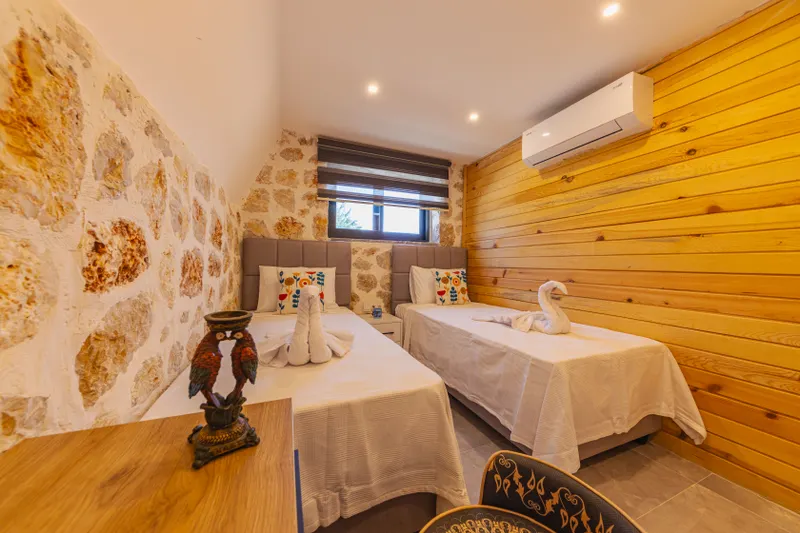
Some cave-style properties have individually shaped rooms, so two rooms in the same hotel may differ in size, bed layout and maximum occupancy. A hotel with an apparently suitable number of rooms may still fall short once twin requests, family rooms, single travellers and accessibility needs are matched against what is free for your dates. The answer only becomes clear when each room’s configuration is set against the guest list.
Formal room holds, minimum commitments and release dates are a separate commercial question, covered in detail in our guide to Cappadocia cave hotel room blocks and buyout terms.
Build the Rooming List Before Finalising the Accommodation Plan
A working rooming list turns a guest count into an accommodation plan. Useful fields include:
- guest or party name and number of occupants;
- room requirement, such as double, twin or family;
- arrival and departure dates;
- assigned property;
- access or mobility notes, where guests choose to share them and they are relevant to room allocation;
- child requirements, such as a cot or extra bed, where relevant;
- arrival and transfer details, where transfers form part of the agreed planning scope.
Collect only what the accommodation and transport plan needs, and keep one master version so that every property and the transport plan work from the same information.
Do Not Assume Nearby Properties Are Walkable
Two properties that look close on a map are not necessarily easy to walk between. In Cappadocia, a short distance can involve slopes, steps, uneven surfaces, narrow roads, changes in elevation and limited lighting after dark. A route that feels easy at midday may be uncomfortable in evening wear or in cold or wet weather.
If walking is part of the plan, check the specific route in person, ideally at the time of day guests will use it. If it is not comfortable for every guest who needs it, plan vehicle transport instead.
Planning for Older and Mobility-Limited Guests
For older guests and anyone with limited mobility, check the route from vehicle drop-off to reception, the steps along it, whether a lift exists and serves the relevant rooms, the distance from the room to breakfast and common areas, bathroom access, how luggage reaches the room, and the return route from the evening event.
Some cave-style properties involve several levels, external stairways or rooms reached by steps. That does not make every cave hotel unsuitable, and a more conventional building is not automatically accessible either. Accessibility belongs to the specific room and route, so confirm both with the property. Where one property cannot meet those needs, housing those guests in a more accessible property nearby is a good reason to use more than one.
How Accommodation Changes Wedding-Day Transport
This is where the accommodation model has its clearest effect. With one main guest property, wedding-day transport can be planned around one main pickup point. Departures run from a single location, and a late guest is in the same building as the people coordinating the departure.
With several properties, the plan needs several pickup points and a route linking them. The first pickup moves earlier to allow for the later ones, different vehicle sizes may be needed, and one late guest can hold up everyone further along the route. Vehicle access needs checking at each property: not every hotel entrance can be reached by a coach or minibus.
The same applies at the end of the evening, when guests return to several addresses. Exact timings depend on the properties, venue, vehicles and route, so the transport schedule should be built from the confirmed accommodation map rather than estimated in advance.
What Happens When Guests Book Their Own Accommodation?
Letting guests book their own accommodation is reasonable, particularly where budgets vary. The difficulty comes when booking is completely unstructured, because the transport plan cannot be built until the planning team knows where everyone is staying, whether each address falls within the transport plan, whether the guest expects group transfers, and when they arrive and leave.
A practical compromise is to recommend a small number of preferred properties or a defined area, give guests a date by which to book, and ask each guest to share their final address. Guests who stay outside the recommended area should know in advance whether group transport will reach them. This is a planning arrangement between the couple and their guests, not a contractual requirement.
Should the Couple Stay with the Guests?
There is no rule that the couple must stay with everyone else. Some couples prefer privacy, a quieter hotel, a different room category or a room at the venue itself. Where the couple stays does affect the wedding day: it determines where hair and makeup take place, where the photographer begins, how suppliers reach the preparation rooms and how the couple travels to the ceremony. A separate property works well when those movements are built into the schedule.
Accommodation for a Multi-Day Cappadocia Wedding
Over a welcome evening, wedding day and farewell event, the accommodation model is felt repeatedly. One accommodation cluster reduces repeated transport, because each organised event starts and ends from the same place. With guests across several properties, each organised event may create several pickup and return points. Not every event needs organised transport, and deciding which do is part of planning a multi-day wedding in Cappadocia.
A property housing a large share of the guests can also become an informal meeting point for breakfast, updates and transport departures. Confirm the property can support this, and do not assume common areas will be available exclusively to the wedding group.
The model also changes the social character of the weekend. Guests in one property share breakfasts and meet by chance. Guests in several properties have more privacy, more choice of room and price, and more independence. Neither is better in itself.
Arrival, Check-In and Departure Need Their Own Plan
With one main property, airport transfers share one destination. With several, there are several drop-off addresses, and guests on the same flight may not be travelling to the same property. Which airport guests should use is a separate decision, covered in our comparison of Nevşehir and Kayseri airports for Cappadocia wedding guests.
Guests may arrive before rooms are ready or check out before a farewell event, so ask where luggage can wait in both cases, and how the property handles a large group arriving together. Check-in and check-out times, luggage storage and group-arrival arrangements are set by each property and should be confirmed with each one.
One Property vs Several: Cappadocia Wedding Guest Accommodation at a Glance
| Planning factor | One main property | Several nearby properties | What to check |
|---|---|---|---|
| Room availability | One property must cover every night | Availability combined across properties | Rooms free for your exact dates |
| Room types | Limited to one property’s range | Wider choice of configurations and price | Bed layout and maximum occupancy |
| Guest communication | One front desk, one set of updates | Updates must reach every property | Who distributes information |
| Accessibility | One set of access conditions for all | Guests can be placed by access need | Specific rooms and routes |
| Wedding-day pickup | One main pickup point | Several pickups linked by a route | Vehicle access at each property |
| Airport arrivals | One main drop-off | Several drop-off addresses | Rooming list matched to arrivals |
| Breakfast and social time | Shared and informal | More privacy and independence | The weekend the couple wants |
| Multi-day events | Each event starts from one place | Several pickups and returns per event | Which events need transport |
| Couple privacy | Shared unless the couple stays apart | Couple can use a separate property | Preparation and supplier access |
| Late booking changes | One property to deal with | May involve several properties | Each property’s change terms |
Questions to Confirm Before Guests Book
Ask each property you are considering:
- How many rooms are actually available for our dates?
- What room types, bed configurations and maximum occupancies are available?
- Which rooms involve stairs or more difficult access, and are easier-access rooms available?
- Are rooms formally held for the wedding group, until when, and who is responsible for unbooked rooms, if anyone?
- Can guests book and pay individually?
- Can luggage be stored before check-in or after check-out?
- Is breakfast included, and where is it served?
- Can coaches or minibuses reach the property entrance, and where would the wedding-day pickup point be?
- Can guests gather at the property before transfers?
- What information does the property need for a group arrival?
- What happens if guests extend or shorten their stay?
How Ramarossi Coordinates Cappadocia Guest Accommodation and Wedding Logistics
Accommodation works best when it is planned alongside the venue and the programme. One sequence causes avoidable problems: the venue is chosen, guests book wherever they like, and only then does anyone ask how everyone will reach each event.
As a full destination wedding planning company, Ramarossi coordinates these moving parts within the agreed planning scope. Depending on that scope, this can include venue research, accommodation strategy, communication with properties, rooming-list coordination, guest-transfer and airport logistics planning, wedding-day transport planning, event schedules, suppliers, production and wedding-day delivery.
Ramarossi does not own or operate the hotels. Room availability, rates, room-hold terms and property policies remain for each property to confirm, and transport is coordinated with the relevant transport providers. Where hotel contract wording needs legal interpretation, that belongs with a qualified lawyer. There is no fixed accommodation package; the right plan depends on the wedding itself.
Planning a Wedding in Cappadocia?
If you are deciding how to accommodate your guests, send Ramarossi:
- your preferred wedding date or date range;
- your approximate guest count;
- the wedding venue and general Cappadocia base, if already decided;
- the number of nights you expect guests to stay;
- whether you want guests together or are open to several properties;
- any important mobility or family considerations;
- the events planned across the weekend;
- your budget direction and main priorities.
With that information, Ramarossi can assess how an accommodation strategy fits the venue, the transport plan and the wider wedding programme. Availability, rates and room terms are confirmed by each property at the time of enquiry.
Frequently Asked Questions
Is it better to keep all Cappadocia wedding guests in one hotel?
Not automatically. One hotel simplifies arrivals, communication and wedding-day transport, but only when it has enough suitable rooms, manageable access and availability for every night needed. Otherwise, two or three properties close together can work better.
What if one cave hotel does not have enough rooms for everyone?
Use a small cluster of nearby properties rather than letting guests disperse, and allocate guests deliberately so the transport plan stays simple.
How close should the hotels be to each other?
There is no fixed distance. Properties in the same area keep transport simpler than properties in different towns or villages. If guests are expected to walk between them, check the actual route in person, including at night.
Are Cappadocia cave hotels suitable for older guests?
Some rooms may be and others may not. Confirm the specific room, the route from vehicle drop-off and the route to breakfast and common areas before assigning it.
Should the couple stay in the same hotel as the guests?
Not necessarily. The couple can stay separately for privacy or preparation, provided hair and makeup, photography, supplier access and travel to the ceremony are planned around it.
Do we need transport if guests stay in several properties?
For organised events held away from the accommodation, transport planning becomes more important with every additional property, because each one adds a pickup and return point.
Can guests book their own accommodation?
Yes, but give them structure: a small number of recommended properties or a defined area, a date by which to book, and a request to share their final address.
Can Ramarossi coordinate accommodation and wedding transport together?
Within the agreed planning scope, Ramarossi can coordinate accommodation strategy, rooming lists, property communication and transfer planning alongside the venue and programme. Room availability, rates and policies are confirmed by each property, and Ramarossi does not guarantee rooms or rates.