
Afghan Wedding: Traditions, Ceremonies and Planning a Celebration in Antalya
From khastegari and the henna night to Ahesta Boro and the attan, each Afghan wedding custom explained in order, with practical advice for bringing the family together in Antalya.
An Afghan wedding is a series of family celebrations, held over several gatherings rather than a single day, that unites two families through Islamic and Afghan custom. Its main stages are khastegari (the proposal), shirini khori (the sweets ceremony), namzadi (the engagement), the henna night, the nikah (the Islamic marriage contract) and the arusi, the wedding night reception, where the couple walk in slowly to the song Ahesta Boro and see each other in a mirror beneath a shawl.
Practice varies between regions, ethnic groups and families. This guide explains each of these Afghan wedding traditions with its Dari name, and the Pashto one where sources agree, then covers food, dress and diaspora weddings, before turning to hosting the celebrations in Antalya, Turkey. Ramarossi has planned weddings across the country since 2011, and our overview of a wedding in Antalya sets out the wider choices.
The Stages of an Afghan Wedding, in Order
The sequence below follows the pattern described in studies of Afghan family law, ethnographic notes and Afghan press reports. Some families merge two stages, rename them or skip one, so read it as a map rather than a rulebook.
Women from the groom’s side raise the proposal with the bride’s parents, discreetly at first
Happens at home; nothing to book yet, but it is the moment to raise the idea of a destination wedding
The yes is sealed with sweets and a formal visit by the groom’s father and elders
A good point for both families to agree the dates, the guest list and which events will be held in Antalya
An engagement party; the groom’s family gives the bride jewellery and clothes
Hold it at home, or turn it into a welcome dinner on the first evening in Antalya
Henna on the bride’s palm and the groom’s little finger, candles, songs and sweets
A garden, terrace or private hall the evening before; book henna artists and trays in good time
The Islamic marriage contract, agreed before a mullah with witnesses and close family
A quiet room or terrace away from the party; confirm the officiant and any civil marriage early
Ahesta Boro entrance, aina masaf, malida, cake, dinner, dancing and the attan
A ballroom or large garden with a raised stage; agree the music finishing time with the venue
The bride leaves her family to begin married life with the groom
Plan a decorated car, a last song and transfers waiting for guests
A later celebration where the couple receive their wedding gifts over a festive meal
A relaxed lunch or farewell dinner with close family before guests fly home
| Stage | What happens | Planning tip in Antalya |
|---|---|---|
| Khastegari (proposal) | Women from the groom’s side raise the proposal with the bride’s parents, discreetly at first | Happens at home; nothing to book yet, but it is the moment to raise the idea of a destination wedding |
| Shirini khori (sweets) | The yes is sealed with sweets and a formal visit by the groom’s father and elders | A good point for both families to agree the dates, the guest list and which events will be held in Antalya |
| Namzadi or kozhda (engagement) | An engagement party; the groom’s family gives the bride jewellery and clothes | Hold it at home, or turn it into a welcome dinner on the first evening in Antalya |
| Henna night | Henna on the bride’s palm and the groom’s little finger, candles, songs and sweets | A garden, terrace or private hall the evening before; book henna artists and trays in good time |
| Nikah | The Islamic marriage contract, agreed before a mullah with witnesses and close family | A quiet room or terrace away from the party; confirm the officiant and any civil marriage early |
| Arusi (wedding night) | Ahesta Boro entrance, aina masaf, malida, cake, dinner, dancing and the attan | A ballroom or large garden with a raised stage; agree the music finishing time with the venue |
| Rukhsati (farewell) | The bride leaves her family to begin married life with the groom | Plan a decorated car, a last song and transfers waiting for guests |
| Takht-i-jami (after the wedding) | A later celebration where the couple receive their wedding gifts over a festive meal | A relaxed lunch or farewell dinner with close family before guests fly home |
For couples living in London, Hamburg, Toronto or Sydney, the first three stages can stay at home while the henna night, nikah and wedding night travel. Decide early which events happen where.
Khastegari and Shirini Khori: Asking and Saying Yes
Khastegari (also written khastgari) is the request for a bride’s hand. Traditionally it begins discreetly: women from the groom’s family make the first approach, so that neither side loses face if the answer is no. The bride’s parents may take time to learn about the other family before giving a reply, and more than one visit can pass before they do.
Once the answer is yes, the families mark it with shirini khori, literally “eating sweets”, written shereny khory in some English sources. The groom’s father arrives at the bride’s home with relatives and elders, bringing sweets and gifts, and states the purpose of the visit formally. In some families shirini khori and the engagement are one and the same occasion; in others the sweets come first and a larger party follows.
Where the couple already know each other, the visits become a warm formality, still worth keeping because this is where the elders give their blessing.
Namzadi: The Engagement Party
The engagement is called namzadi in Dari and kozhda in Pashto. When it is announced, the two families celebrate with a big engagement party. An engagement is a promise to marry, not the marriage itself, which is why the nikah remains its own separate moment.
Gifts carry a great deal of meaning at this stage. The groom’s family presents the bride with jewellery and clothes, and during a long engagement presents can follow at religious and seasonal holidays: eidi at Eid, nawruzi at Nawruz, the Persian new year, iftari during Ramadan, winter gifts and, in some families, presents for the night of Barat. Decorated trays, sometimes called khimcha, carry gifts between the two homes, and in Herat an Eid tray known as khvancheh can be sent to the engaged pair.
Engagements can be short or last years, depending on the families and on how quickly the wedding can be prepared. For a destination celebration, couples can hold the engagement at home and save Antalya for the later events, or bring both families together for an engagement dinner on the first evening of the trip.
The Henna Night: Shab-e Khina
The henna night, shab-e khina in Dari (written kheena or khinah in some English sources), takes place before the wedding night, in many families on the evening before. Henna marks the bride’s passage into married life, and earlier in the day her hands, and sometimes her feet, may be decorated with patterns while female relatives from both families keep her company.
The ritual itself is tender. A young relative carries in a tray holding candles, flowers and small bowls of henna. The groom’s mother places henna on the bride’s palm and the bride’s mother does the same on the groom’s little finger, and each hand is then wrapped in cloth. Guests may be offered a little henna for good luck, and songs accompany the whole ritual, sometimes sung by women to the beat of a daireh, a large frame drum. Some families repeat this moment on stage during the wedding night, and in some the bride already wears green for her henna evening, a colour more closely tied to the nikah.
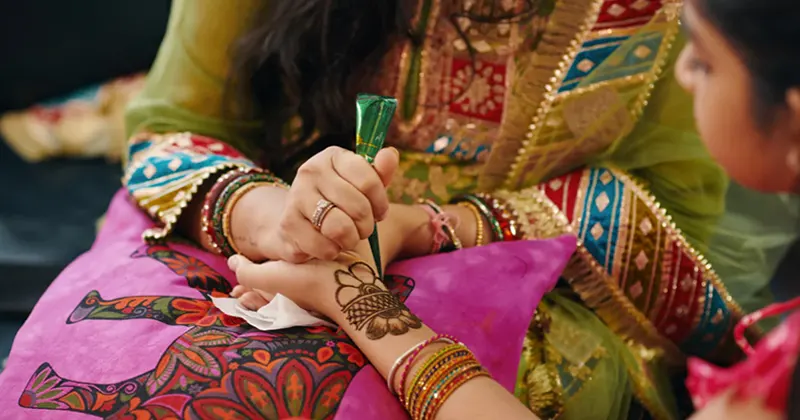
In Antalya the henna night can sit in a garden, on a terrace or in a private hall, with low seating for the bride, trays carried in by younger cousins and a separate area for older relatives. For décor and layout ideas, read about hosting a henna night in Antalya.
Nikah: The Marriage Contract and the Green Dress
The nikah is the Islamic marriage contract and the religious heart of the celebrations. Traditionally it is held privately with close family: the bride and groom may sit in separate rooms, the bride is represented by her father or a close male relative, and a mullah asks each of them for their consent before witnesses.
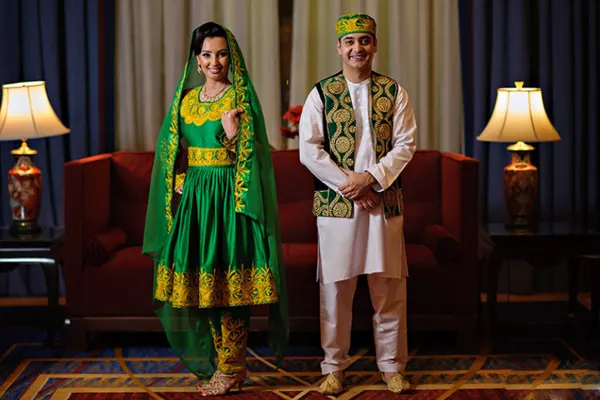
Green belongs to this moment. Afghan brides traditionally wear a green dress for the nikah, richly embroidered and sometimes worked in gold, and later change into a white gown with a veil for the reception. Some families in Afghanistan today also order a nikah dastarkhwan, a ceremonial table set with the Quran, prayer mats, sweets, a mirror and candles.
Muslim couples marrying abroad can read more about nikah arrangements and legal steps in Turkey. Legal registration in Turkey is a separate step, a civil ceremony that a municipal marriage officer conducts; the documents are explained in marrying in Turkey as foreign nationals.
Arusi: Ahesta Boro, Aina Masaf and the Wedding Night
The arusi is the wedding night reception, traditionally hosted by the groom’s family and the event that draws the full guest list. In Afghanistan it can fill a hall with several hundred people and run late into the night.
The Ahesta Boro Entrance
The signature moment comes when the couple enter to “Ahesta Boro”, a song whose title means “walk slowly” in Dari (also spelled Ahista Boro or Ahesta Bero). The newlyweds move at a gentle, almost ceremonial pace with a copy of the Quran held above their heads, and guests rise to their feet as they pass. Relatives may shower them with sweets and flower petals on the way to a raised stage.
Aina Masaf, Malida and Sharbat
Once the couple are seated, a decorative shawl is drawn over them. Beneath it they read a passage from the Quran together and look into a decorated mirror, seeing themselves for the first time as a married couple. This is aina masaf, also written aina mosaf. In earlier generations of arranged marriages, the mirror could be the first time the bride and groom saw each other’s faces.
When the shawl is lifted, the couple feed each other malida, a sweet, crumbly dessert, and offer each other a sip of sharbat or fruit juice. Later the couple cut a tiered cake, and a relative divides it into small pieces for the guests.
One order described for a modern Afghan reception runs like this, though families rearrange it freely:
- Welcome. Both families greet guests at the door.
- Entrance. Ahesta Boro, the Quran and the walk to the stage.
- Aina masaf. Shawl, Quran, mirror, then malida and sharbat.
- Henna. The candlelit tray returns, for families who keep this custom on the night.
- Dinner. The couple are served first, then guests.
- Cake and dancing. The tempo rises until the attan fills the floor.
The night closes with the rukhsati, the bride’s farewell to her family as she leaves to begin married life. It is a deeply emotional moment, so give it time rather than squeezing it into the last minutes before the hall closes.
The Attan: Afghanistan’s National Dance
The attan began as a war dance among Pashtun tribes and is now widely regarded as the national dance of Afghanistan, performed by other ethnic groups too, with local styles such as the Kabuli attan. Dancers form a circle and move to the beat of the dhol, a double-headed drum, sometimes joined by the surnai, rubab or tabla. The rhythm starts slowly and builds until the circle is spinning at speed, and groups can range from a handful of dancers to a hundred or more.
Not everyone accepts the “national” label: Ahmad Naser Sarmast, founder of the Afghanistan National Institute of Music, has called it a politicised claim for a dance whose rhythm and symbols grew from Pashtun tradition. In 2021 Afghanistan applied to UNESCO to have it recognised as intangible cultural heritage. At a wedding, it is simply the moment uncles, cousins and friends join the circle.
After the Wedding: Arrival, Breakfast and Takht-i-Jami
The celebrations carry on past the rukhsati. When the bride reaches her new home, some families sacrifice a sheep or a chicken as she steps out of the car. The morning after the wedding night, breakfast can be served to the newlyweds before they are left to rest.
In the days that follow comes takht-i-jami (also written takht jami), a further celebration at which the couple receive their wedding gifts and the families share a festive meal. Once held at home, in Kabul it now takes place in hotels too. Later the bride makes her first visit back to her father’s house, a step that draws the two families closer.
Abroad, a relaxed lunch the day after the reception can take the place of takht-i-jami, with gifts opened among close family; our article on timing a farewell brunch helps you choose the hour.
Afghan Wedding Food and Sweets
Rice is the centre of an Afghan wedding table. Kabuli palaw, the national dish, layers rice with lamb or beef, carrots, raisins and nuts such as pistachios. It sits beside plain chalaw rice with qorma, a slow-cooked onion and tomato stew, platters of kebabs, and dumplings: mantu, steamed and filled with minced beef or lamb and onion under a yoghurt and tomato sauce, and aushak, dumplings filled with leeks or chives. Bolani, a thin stuffed flatbread, can appear among the starters.
Sweets carry symbolic weight. Nuql, white sugared almonds, are served with tea, and some families scatter them over the couple much as other cultures throw confetti. Firni, a smooth milk pudding, sheer berinj, a rice pudding, and the malida shared on the stage complete the dessert table, which can also hold baklava and fresh fruit.
Turkish kitchens already cook pilaf, kebabs and their own small mantı dumplings, so Afghan dishes start from familiar ground. Share family recipes with the caterer, ask for a tasting before you confirm the menu, and look for sugared almonds sold in Turkey as badem şekeri for favours and the henna trays.
What the Bride and Groom Wear
An Afghan bride can change several times over the celebrations. An anthropologist who attended weddings in Afghanistan described brides wearing up to three outfits on one night, traditionally white first, then green, then red or blue; other families put the green dress first, for the nikah, and some choose a shade of purple for the engagement party. Formal Afghan dresses are worked in gold thread, and heavier designs carry small mirrors stitched around the chest, a style kept for weddings and other special occasions. In Kabul a bride can order her wedding dress from a dressmaker to her own design. Jewellery from the groom’s family is worn with pride.
Grooms can wear a suit for the reception and the perahan tunban for another part of the celebrations: a long, loose shirt over wide trousers, worn by men across Afghanistan. An embroidered waistcoat and cap that echo the bride’s green, like the pair the groom wears in the opening photograph, tie the couple’s looks together.
Plan around Antalya’s summer heat: wear the heaviest embroidered outfit in an air-conditioned hall, keep a changing room close to the stage, and arrange steaming and a seamstress on the day.
What to Wear to an Afghan Wedding as a Guest
Guests come in their finest clothes, and the guiding word is modest. In Afghanistan both men and women are expected to dress modestly, and women traditionally show only the face, hands and feet, so cover your shoulders and arms and choose a long hemline. Whether a headscarf is expected varies from one family to the next, so if you are unsure, ask the hosts.
- Women. A long dress or a formal tunic over trousers, with sleeves or a shawl over the shoulders; jewel tones and embellishment suit an evening reception.
- Men. A suit, or a smart jacket with a pressed shirt; relatives may also choose the perahan tunban.
- Colours. Green and white belong to the bride on the day, so pick another colour unless the family suggests otherwise.
- Separate halls. If women celebrate in their own hall, bring a wrap or long coat for arriving and leaving.
- Shoes and gifts. Wear shoes you can dance the attan in, and wrap a present in green paper, a traditional choice for wedding gifts.
- In Antalya. Light, breathable fabrics for warm evenings, plus a layer for air-conditioned halls.
For wider etiquette, read our guide for invited destination wedding guests, and the Cultural Atlas notes on Afghan etiquette explain modesty and gift-giving in more depth.
Regional and Ethnic Variations
Afghan wedding customs vary with region, ethnic group and family means, so the names and order in this guide are a common thread rather than a fixed script.
Pashtun families use Pashto terms, kozhda for the engagement among them, and may dance the attan more than once in an evening, at the start and again towards the end. Dari-speaking families, Tajik households among them, use the names given in this guide, and the attan has local forms such as the Kabuli style. Hazara families may want the dambura, the long-necked lute at the heart of Hazara folk music, alongside the keyboard and tabla. Among Uzbek and Turkmen communities in the north-west, the nikah can be arranged during the engagement party itself, and engagements there can stretch over several years.
When the couple come from different communities, or one family is not Afghan, ask each side early which moments matter to them, and share a written order of events in both families’ languages.
Afghan Weddings in the Diaspora Today
For families now settled in Germany, the UK, the Netherlands, Scandinavia, North America or Australia, the traditional days of celebration can compress into a henna night and the arusi on consecutive evenings, with the nikah held earlier in the day or at a mosque at home. Music has moved too: diaspora bands play older Afghan favourites and new songs on tabla, harmonium and electronic keyboard.
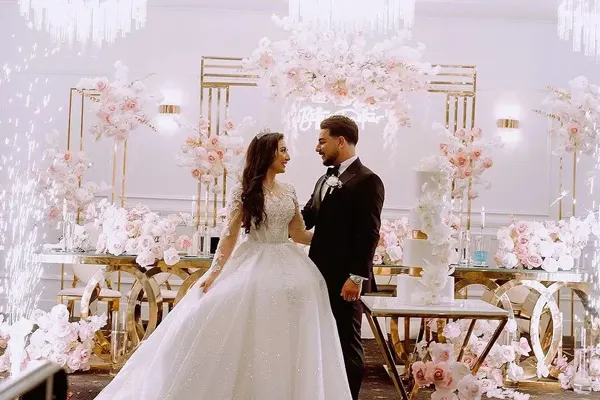
Some families seat men and women in separate halls or sections, while others celebrate together in one room. Couples with one non-Afghan family can blend customs, keeping Ahesta Boro and aina masaf while adding a first dance or speeches.
Afghan and Persian weddings share deep roots, since Dari is a form of Persian: khastegari, the mirror, sugared almonds and a strong focus on family appear in both. Couples from mixed Afghan and Iranian families can compare notes with Persian wedding planning in Antalya.
Planning an Afghan Wedding in Antalya
Turkey suits Afghan diaspora families for practical reasons. In a Muslim-majority country, a halal menu, a prayer room and a nikah are easy to discuss with venues, and Antalya is a few hours’ flight from much of Europe, with long-haul connections through Istanbul. The Antalya Airport website lists current airlines and routes. Visa rules depend on each guest’s passport, so each relative should look up their own nationality on the visa information published by Turkey’s Ministry of Foreign Affairs before booking.
Venues for a Large Guest List
Afghan guest lists can run into the hundreds, so begin with capacity. A ballroom offers a raised stage for the couple, room for a large dance floor and air conditioning for heavy outfits; a garden or terrace suits a henna night under the stars. Read how to weigh an indoor hall against an open-air setting before you shortlist, and remember the two can be combined across one weekend.
Separate Seating, if Your Family Wants It
If your families prefer men and women to celebrate apart, ask venues about two adjoining halls, a ballroom that can be divided, or a single room with separate sides and a shared stage for the entrance and aina masaf. Agree how the music and photography will reach both sides, so everyone shares the key moments.
Music, the Dhol and the Attan
Decide early between an Afghan singer flown in, a DJ or a mix, book a dhol player for the attan, and send the musicians your chosen version of Ahesta Boro well ahead. Our guide to live music and DJs for a destination wedding covers sound and set-up, and the finishing time for the dancing depends on the venue, explained in our article on Antalya venue music curfews.
A Halal Menu and Afghan Dishes
Ask the caterer to confirm halal meat in writing, cook a tasting of Kabuli palaw, mantu and firni, and plan a generous tea service with nuql and sweets for late in the evening. For ideas on styling a refined halal celebration, see our piece on a luxury halal wedding in Antalya.
Guests, Rooms and Transfers
When grandparents and small children travel, keep everyone near the main venue and plan transfers between the hotel, the henna night and the reception. Our guide to room blocks and where guests stay in Antalya explains how to organise this.
- Which events travel. Engagement at home or in Antalya; henna night, nikah and arusi on which days.
- The officiant. Who will perform the nikah, and whether a civil marriage is also needed.
- Seating. Mixed, separate halls or separate sides with a shared stage.
- The entrance. The version of Ahesta Boro, who holds the Quran and who carries the henna tray.
- The ritual items. Mirror, shawl, Quran, malida, sharbat and nuql, and who brings them from home.
- Outfit changes. How many, and where the bride changes between them.
If you are looking for an Afghan wedding planner in Antalya, Persian is one of Ramarossi’s working languages, and it sits close enough to Dari for Dari-speaking relatives to talk the details through in a language they know.
Tell us about your celebrations
Share your dates, your guest numbers and which events you would like to hold in Antalya, from the henna night to the arusi, and we will come back with ideas for venues and timing.
Prefer another email service? Write to info@ramarossi.com using Antalya Wedding Enquiry as the subject.
Follow our celebrations
Discover beautiful weddings, private events, styling ideas and behind-the-scenes moments from Ramarossi in Turkey.
Frequently Asked Questions
What happens at an Afghan wedding?
It traditionally unfolds over several gatherings: the proposal, a sweets ceremony, the engagement, a henna night, the nikah and the wedding night. On the night the couple enter to Ahesta Boro, share the mirror and Quran ritual called aina masaf, feed each other malida and dance until late, with the attan as a highlight.
What is khastegari?
Khastegari is the formal request for a bride’s hand. Traditionally women from the groom’s family approach the bride’s family discreetly, and once the answer is yes the families celebrate with shirini khori, the sweets ceremony, followed by the engagement.
What does Ahesta Boro mean?
Ahesta Boro means walk slowly in Dari. It is the song played as the couple enter the reception, walking at a gentle pace with a copy of the Quran held above them while guests stand.
What is aina masaf?
Aina masaf (also written aina mosaf) is the ritual in which the newlyweds sit under a shawl, read from the Quran and look at each other in a mirror, seeing themselves together for the first time as a married couple.
Why does an Afghan bride wear green?
Green is the traditional colour of the Afghan bridal outfit for the nikah, and some families choose it for the henna night or engagement too. A bride can change several times during the celebrations, for example into a white gown, so ask the family which moment the green dress belongs to in their tradition.
What is the attan dance?
The attan is a circle dance of Pashtun origin, now widely regarded as the national dance of Afghanistan. Dancers move in a ring to the beat of the dhol, a double-headed drum, and the rhythm speeds up as the dance goes on.
What food is served at an Afghan wedding?
Kabuli palaw, rice with lamb or beef, carrots and raisins, leads the menu, with qorma, kebabs and dumplings such as mantu and aushak. Desserts can include firni and malida, with sugared almonds called nuql served with tea.
How long does an Afghan wedding last?
The celebration can last a single night or a day, and some families spread it over three days. Couples marrying abroad can bring the henna night, nikah and wedding night together over one long weekend.
Can we hold a nikah at our wedding in Antalya?
Yes, with an officiant and witnesses. Legal registration in Turkey is a separate civil ceremony that a municipal marriage officer conducts, and its paperwork takes time to prepare.
Can men and women be seated separately at a venue in Antalya?
Yes, if your family prefers it. Ask venues about two adjoining halls, a divided ballroom or separate sides sharing one stage.
What should I wear to an Afghan wedding as a guest?
Dress formally and modestly. Women can wear a long dress or a formal tunic over trousers with the shoulders and arms covered, and men a suit or a smart jacket. Leave green and white to the bride, and ask the hosts whether a headscarf is expected, as this differs between families.
What happens after an Afghan wedding?
The bride is welcomed at her new home, and breakfast can be served to the couple the next morning. In the days that follow, families may hold takht-i-jami, a celebration where the couple receive their wedding gifts over a festive meal, and later the bride makes her first visit back to her parents’ home.