
Lebanese Wedding Traditions: A First-Time Guest’s Guide
Invited to a Lebanese wedding? Meet the zaffe, the dabke and the zalghouta, learn what to wear, and enjoy the food, the dancing and the warm welcome.
Lebanese wedding traditions fill the day with music and joy: a zaffe procession of drummers and dancers, the zalghouta, dabke on the dance floor and a cake cut with a sword.
This guide explains each tradition and what it means, how guests can take part, what to wear to each event, what to expect at dinner, and the etiquette that makes your first Lebanese wedding a pleasure, whether it takes place in Lebanon, Turkey or anywhere in the world.
What Happens at a Lebanese Wedding?
A Lebanese wedding brings families and friends together across generations, and across countries too, for a celebration full of music, food and warmth. The day can include a religious ceremony, a grand zaffe entrance into the reception, a generous dinner, dabke on the dance floor and a cake cut with a sword. White and gold flowers can dress the reception, and fireworks or cold sparklers can light up the big moments. Some families add a henna night or an engagement party in the days before.
Lebanese families are Christian, Muslim, Druze or of mixed backgrounds, and every couple shapes the day in their own way. A small family dinner and a ballroom reception for several hundred guests are both true Lebanese weddings, as is a celebration in Beirut, Sydney, London or Antalya. The invitation and the programme the couple shares are your guide to what will happen and when.
On arrival you may find a welcome desk, a seating plan or relatives greeting guests at the door. When the ceremony and the reception take place in different places, plan to arrive in time for each, as the invitation sets out.
Lebanese Wedding Traditions at a Glance
These are the Lebanese wedding traditions guests are likely to see. Each family chooses which ones to include and how.
| Tradition | What it is | How guests take part |
|---|---|---|
| Henna night | A gathering before the wedding, with music, food and henna for the bride and her closest family and friends | Join if invited and enjoy the celebration; henna is offered, not expected |
| Religious ceremony | A church wedding for Christian couples, or a Katb al-Kitab, the signing of the Islamic marriage contract, for Muslim couples | Follow the officiant and the venue on seating, dress and photography |
| Zaffe | A procession of drummers, dancers and singers that leads the couple into the reception | Clap, cheer and leave space for the procession |
| Zalghouta | A joyful ululation, led by the women of the family, to celebrate the couple | Smile, clap and enjoy the moment |
| Dabke | A Levantine line dance with linked hands and stamping steps, led by a dancer at the front | Join when invited and follow the rhythm of the line |
| Sword cake cutting | The couple cut a tall wedding cake together with a ceremonial sword | Gather round, cheer and take photos if the couple welcome them |
| Gold jewellery | Gifts of gold for the bride from both families, a long-held custom | A family custom; guests follow the couple’s gift guidance |
A gathering before the wedding, with music, food and henna for the bride and her closest family and friends
Join if invited and enjoy the celebration; henna is offered, not expected
A church wedding for Christian couples, or a Katb al-Kitab, the signing of the Islamic marriage contract, for Muslim couples
Follow the officiant and the venue on seating, dress and photography
A procession of drummers, dancers and singers that leads the couple into the reception
Clap, cheer and leave space for the procession
A joyful ululation, led by the women of the family, to celebrate the couple
Smile, clap and enjoy the moment
A Levantine line dance with linked hands and stamping steps, led by a dancer at the front
Join when invited and follow the rhythm of the line
The couple cut a tall wedding cake together with a ceremonial sword
Gather round, cheer and take photos if the couple welcome them
Gifts of gold for the bride from both families, a long-held custom
A family custom; guests follow the couple’s gift guidance
What Is the Zaffe at a Lebanese Wedding?
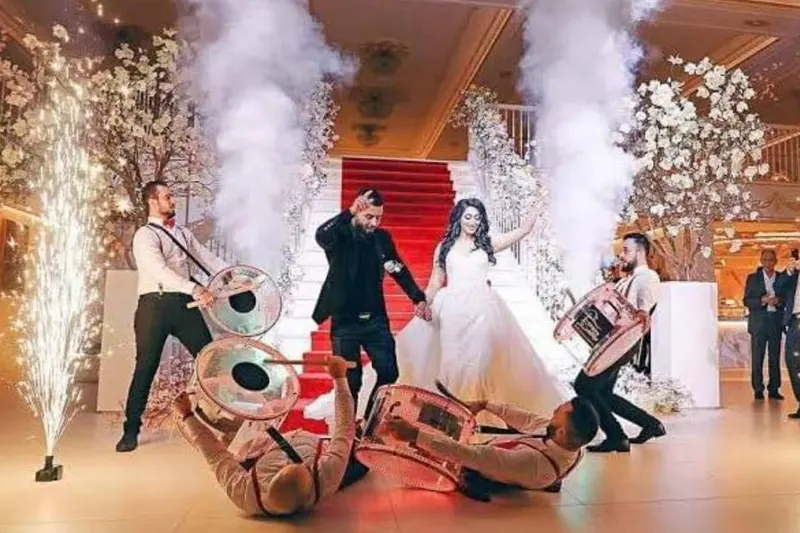
The zaffe (also written zaffeh) is the celebratory procession that announces the couple. Drummers with large tabl drums, dancers and singers lead the bride and groom into the reception, with clapping, cheering and singing from the families. Traditionally the zaffe could start at the family home and travel with the couple; today it is the grand entrance into the wedding reception. Cold sparklers, flowers and a burst of music make it a highlight for the photographers of the night.
As a guest, clap and cheer as the couple pass, make space for the drummers and dancers, and let the photographers work. In some families, guests throw rice or flower petals over the couple for good luck. You do not need to learn a routine; the joy is in welcoming the newlyweds.
The zalghouta
During the zaffe and other joyful moments you may hear the zalghouta, a high, trilling ululation led by the women of the family. It is an expression of happiness and blessing for the couple. Guests are welcome to clap along and share the excitement.
For couples planning their own entrance, our Lebanese zaffe entrance guide explains the different zaffe styles and how they fit a wedding venue in Turkey.
What Is Dabke, and Should Guests Join the Dancing?
Dabke is a Levantine folk dance performed in a line or a circle. Dancers link hands or shoulders and move together with stamping steps, while the leader at the front, the lawweeh, sets the pace and adds flourishes, such as twirling a handkerchief. At a Lebanese wedding the dabke can start after the zaffe and return through the night, alongside Arabic pop and international music.
Guests are welcome to join the line when invited. Watch the dancers beside you for a moment, then follow the rhythm; the steps repeat, so you will pick them up quickly. Joining at the end of the line is the easy way in. If you prefer to watch, clapping along from your table is part of the fun too.
The music, the dancing and the late-night energy are a big part of the celebration, and Lebanese weddings carry on well into the night. Families value guests who stay to celebrate with them, so plan to enjoy the evening to its close.
Pre-Wedding Gatherings, Engagements and Family Customs
Family is at the heart of a Lebanese wedding, and the celebrations can begin before the wedding day. An engagement party brings the two families together, and some families host a dinner for relatives arriving from abroad. Pre-wedding parties, the laylieh, can also fill the evenings before the wedding with music and dancing.
The henna night, held in the days before the wedding, is a joyful gathering with music, sweets and dancing, where henna is applied for luck and blessing. Not every family holds one, and the invitation will tell you which events you are invited to. When you are invited to more than one gathering, ask whether the dress code changes from event to event.
Gold plays a special part too: both families give the bride gold jewellery, a custom with a long history in Lebanese weddings. You will see family members honoured during the entrance, the speeches and the dancing, and close relatives taking their place in photographs, so allow a little time for family photos.
Do All Lebanese Weddings Have the Same Religious Ceremony?
Lebanon is home to several religious communities, and each brings its own ceremony. A Christian couple marries in church with the rites of their denomination, Maronite, Greek Orthodox, Greek Catholic, Armenian or Protestant. Maronite and Orthodox weddings include the crowning of the bride and groom. A Muslim couple signs the marriage contract, the Katb al-Kitab, in the presence of a religious official and witnesses, and it can take place on a separate day from the celebration. Druze couples marry under their own community’s religious law, with their own ceremony and customs.
Civil marriage cannot be performed in Lebanon, where each religious community has its own marriage law, so weddings held in Lebanon are religious. Couples can also marry in a civil ceremony in another country and celebrate with their families wherever they wish.
For guests, the invitation is the guide. A church, a mosque or a hotel ceremony room each has its own expectations about dress, seating, photography and when to stand, and the officiant and hosts will guide you through the formal part of the day.
What to Wear to a Lebanese Wedding as a Guest
Lebanese weddings are elegant, and guests dress for the occasion. For an evening reception, women wear evening gowns, dressy midi dresses or elegant jumpsuits, and men wear a dark suit or a tuxedo with a tie. Polished shoes, statement jewellery and a beautiful clutch are all at home here. When the invitation names a dress code, such as black tie, cocktail or a colour theme, follow it.
| Event | What to wear | Good to know |
|---|---|---|
| Evening reception | Evening gown, dressy midi dress or elegant jumpsuit; dark suit or tuxedo | The reception is a formal occasion, so dress up |
| Church ceremony | An elegant dress or suit with covered shoulders, or a wrap or jacket over a strapless dress | A light layer lets you move from the church to the party |
| Katb al-Kitab | Modest dress with covered shoulders and knees, or a long skirt; women may be asked to cover their hair in a mosque; men wear long trousers with a jacket or long-sleeved shirt | Bring a scarf, and ask the hosts if you are unsure |
| Henna night | A colourful dress or smart outfit; some families ask for a traditional or themed look | Check the invitation for a colour or theme |
| Daytime gathering | Smart dress, linen suit or tailored separates | Breathable fabrics suit warm afternoons |
Evening gown, dressy midi dress or elegant jumpsuit; dark suit or tuxedo
The reception is a formal occasion, so dress up
An elegant dress or suit with covered shoulders, or a wrap or jacket over a strapless dress
A light layer lets you move from the church to the party
Modest dress with covered shoulders and knees, or a long skirt; women may be asked to cover their hair in a mosque; men wear long trousers with a jacket or long-sleeved shirt
Bring a scarf, and ask the hosts if you are unsure
A colourful dress or smart outfit; some families ask for a traditional or themed look
Check the invitation for a colour or theme
Smart dress, linen suit or tailored separates
Breathable fabrics suit warm afternoons
Colours
Jewel tones, metallics, pastels and black are all popular at Lebanese weddings. Leave white and ivory to the bride, and choose a colour of your own unless the couple have asked guests to wear a theme.
Shoes for dancing
Expect to dance. Choose shoes you can wear through the dabke and late into the night, or bring a pair of flats to change into. For a destination wedding in Antalya, stone paths, terraces and lawns call for block heels or wedges rather than thin stilettos, and a light wrap is welcome for a sea breeze after dark.
What the bride and groom wear
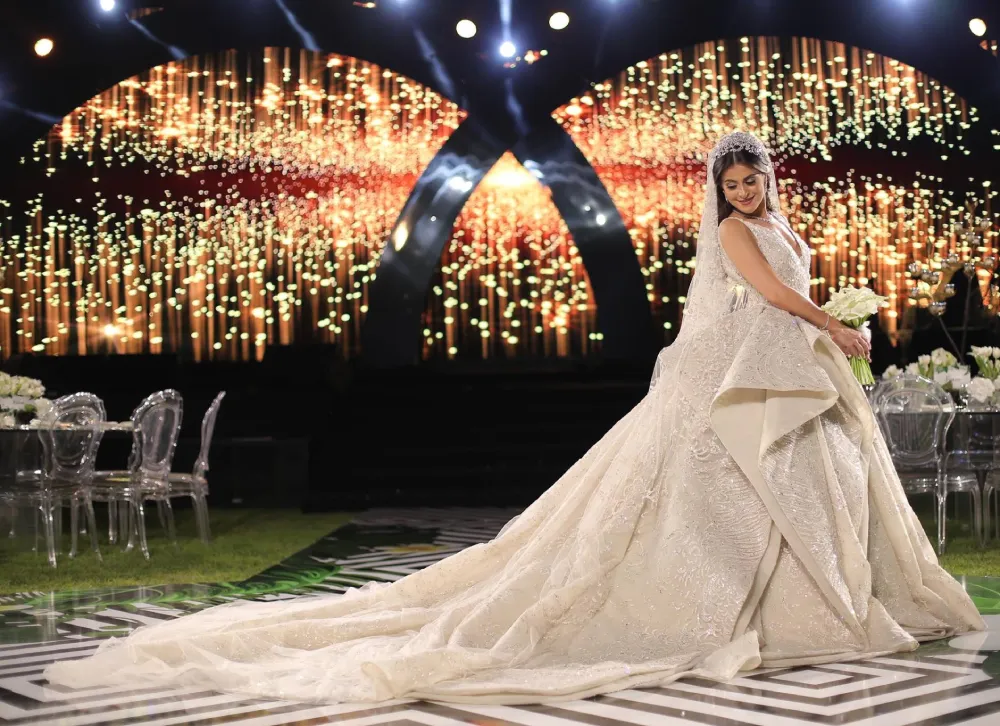
The Lebanese bride makes an entrance: a white gown with lace, embroidery or beading, gold jewellery from both families and, for some brides, a jewelled headpiece or an elegant hijab. Some brides change into a lighter second dress for the dabke and the dancing. The groom wears a tailored suit or tuxedo, in black or in white or ivory to match the bride. The families and the bridal party dress formally, and bridesmaids may wear a coordinated colour.
Brides planning a celebration abroad can read our destination wedding dress guide for fabrics and styles that suit a warm climate.
Lebanese Wedding Food, Desserts and Hospitality
Generous hospitality is a point of pride at a Lebanese wedding. Dinner can open with a mezze of shared dishes, such as hummus, moutabal, tabbouleh, fattoush, kibbeh and warm bread, followed by grilled meats, rice dishes and whole platters for the table. Some couples choose a plated menu or an international dinner, and others combine both.

The cake is a moment of its own. The couple cut a tall wedding cake together with a ceremonial sword, to cheers from the guests, a moment everyone gathers round to see. Sweets follow, such as baklava, maamoul and ashta scented with orange blossom, and sugared almonds, the dragées, may be presented to guests as wedding favours.
Share any allergies or dietary needs through the RSVP, so the couple can pass them to the venue in good time. Dinner service is timed around the entrance and the dancing, so a pause between courses is part of the rhythm of the night.
Lebanese Wedding Guest Etiquette: What to Do and What to Avoid
Good etiquette at a Lebanese wedding comes down to warmth and respect. Arrive at the time on the invitation, greet the hosts and the couple’s parents, and join in the celebration. When the zaffe begins, give the drummers, dancers and photographers room to move.
For gifts, follow the couple’s registry or wedding website. A cash gift in a card is a welcome choice at Lebanese weddings, and there is no set amount; give what feels right to you.
Enjoy the photographs, but leave the formal moments to the professionals. If the couple ask for an unplugged ceremony, keep your phone away, and ask before posting photos of the family, children or the religious ceremony online.
| Moment | Do | Avoid |
|---|---|---|
| Arrival | Arrive at the time on the invitation and greet the hosts | Arriving during the religious ceremony |
| Zaffe | Clap, cheer and make space for the procession | Stepping into the performers’ path uninvited |
| Dabke | Join when invited and follow the rhythm | Pulling other guests onto the floor |
| Ceremony | Follow the officiant and the venue on dress and photos | Taking photos during prayers |
| Gifts | Follow the registry, or give a cash gift in a card | Bringing large gifts to a destination wedding |
| Leaving | Stay and celebrate late into the night | Leaving before the cake is cut |
Arrive at the time on the invitation and greet the hosts
Arriving during the religious ceremony
Clap, cheer and make space for the procession
Stepping into the performers’ path uninvited
Join when invited and follow the rhythm
Pulling other guests onto the floor
Follow the officiant and the venue on dress and photos
Taking photos during prayers
Follow the registry, or give a cash gift in a card
Bringing large gifts to a destination wedding
Stay and celebrate late into the night
Leaving before the cake is cut
Attending a Lebanese Wedding Abroad or in Turkey
Lebanese families around the world bring their traditions to weddings far from Beirut: a terrace by the sea in Antalya, a hotel ballroom in Istanbul or a garden in Europe or Australia. The zaffe, the dabke and the generous table travel well, and each couple blends them with the setting they love. A legal marriage in Turkey is a civil ceremony performed by a municipal marriage officer, and the family celebration can follow on the same day.
If you are travelling to a wedding in Turkey, check the times of each event, the transport between the hotel and the venue, and the weather for the month; our guide to the right time to get married in Antalya shows the temperatures month by month. Wedding music in Antalya ends at 00:00 as standard, at 23:00 or 23:30 at some venues, and at a venue with permission for late music and no homes nearby the party can continue to 02:00 or 03:00.
For couples planning their own celebration, our page on planning a Lebanese wedding in Antalya shows how the zaffe, the dabke, the mezze and both families come together in one celebration by the Mediterranean.
Planning a Lebanese Wedding Celebration in Antalya?
Share your dates, guest count and the traditions you love, from the zaffe to the dabke, and we will come back with ideas for your celebration.
Prefer another email service? Write to info@ramarossi.com using Lebanese Wedding Enquiry as the subject.
Follow our celebrations
Discover beautiful weddings, private events, styling ideas and behind-the-scenes moments from Ramarossi in Turkey.
Lebanese Wedding Traditions: Frequently Asked Questions
What are the main Lebanese wedding traditions?
The zaffe entrance, the zalghouta, dabke dancing, the sword cake cutting and gold jewellery for the bride are the traditions guests are likely to see, with a henna night before the wedding in some families.
What is a zaffe at a Lebanese wedding?
It is the grand entrance: drummers, dancers and singers escort the newlyweds into the reception while guests clap and cheer, and in some families throw rice or petals.
What is dabke, and do guests have to dance?
Dabke is a Levantine line dance with linked hands and stamping steps. Guests are welcome to join when invited; watching and clapping along is fine too.
What should I wear to a Lebanese wedding?
Dress up: an evening gown, dressy midi dress or elegant jumpsuit for women, and a dark suit or tuxedo for men. Cover your shoulders for a church ceremony and dress modestly for a Katb al-Kitab.
Can I wear black to a Lebanese wedding?
Yes. Black is popular for evening receptions, as are jewel tones and metallics. Leave white and ivory to the bride.
What is the zalghouta?
A joyful ululation led by the women of the family during the zaffe and other happy moments, to celebrate and bless the couple.
How is the cake cut at a Lebanese wedding?
The sword cake cutting is a celebratory Lebanese tradition: the couple cut a tall cake together with a ceremonial sword as the guests cheer.
Do Lebanese weddings include a henna night?
Some families hold a henna night in the days before the wedding, with music, sweets and henna for the bride. Your invitation shows which events you are invited to.
What gift should I give at a Lebanese wedding?
Follow the couple’s registry or wedding website. A cash gift in a card is a welcome choice, and there is no set amount.
Can Lebanese traditions be part of a wedding in Turkey?
Yes. The zaffe, dabke, mezze and sword cake cutting all fit beautifully into a wedding in Turkey. See our page on planning a Lebanese wedding in Antalya.