
Lebanese Zaffe: Drummers, Dancers and How to Plan the Entrance in Turkey
What the zaffe is, where it comes from, how the procession runs on the night, and how to fit the drums, the dancers and the effects into a ballroom, a garden or a beach in Antalya.
A Lebanese zaffe is the procession of drummers, pipers, dancers and a lead singer that carries the newlyweds into their reception, with the women of the family answering the drums in zalghouta.
This guide stays with that one moment: what the zaffe is, how it differs from one country to the next, how it runs minute by minute, and what to agree with the troupe and the venue when the wedding is in Antalya, Turkey. Ramarossi has planned weddings on this coast since 2011, Lebanese celebrations among them. For everything around the entrance, from venue to menu, see our Lebanese wedding in Antalya page; for the meaning of the other customs, read our guide to Lebanese wedding traditions for first-time guests.
What Is a Lebanese Zaffe?
The word comes from the Arabic zaffa, a wedding march or procession, and you will see it written zaffe, zaffeh, zaffa or zaffah. Traditionally it set off from the family homes: musicians and relatives escorted the groom to his bride, then led the pair on to the ceremony and the celebration. Today the same energy is gathered into the doorway of a reception hall, and the couple’s arrival becomes the signal that the party has started.
A Lebanese troupe can bring several elements, and you choose how many of them you want:
- Tabl drummers. Large double-headed drums carried on a strap and struck with sticks; they give the zaffe its thunder.
- Derbakeh. The goblet drum, played by hand, which adds the fast, bright rhythm on top.
- Pipes. A mizmar, a shrill double-reed wind instrument, or bagpipes, which some troupes play alongside the drums.
- A lead singer. He calls out the chants and verses that name and bless the couple, and the guests shout back.
- Sword and dabke dancers. Performers with swords, sometimes with shields, or a dabke line in folk dress, opening the path ahead of the newlyweds.
- Candles or flares. Carried by dancers or relatives, depending on the family and on what the venue allows.
- Zalghouta. The high, trilling ululation of the women of the family, which comes from your guests rather than from the troupe.
Origins and Regional Variations
Processions of this kind belong to a shared tradition across the Arab world, and some trace its roots to ancient Egypt. Each country, and each family, has shaped its own version, and guests from Lebanon, Syria or Palestine will each listen for their own details. If your two families come from different places, the zaffe is a good place to blend them.
Tabl and derbakeh, sometimes bagpipes or mizmar, a singer leading call and response chants
Sword and shield dancers, a dabke line, matching costumes, the couple dancing in the middle
Songs and chants led by the troupe, with drums and handclaps
An arada troupe with swords and decorative shields, ending in ceremonial sword play
Tabl, bagpipes or reed pipes and folk songs in local dialect
A long dabkeh line with linked hands and shoulders and stamping steps
The piercing mizmar, drums and horns, with a stately, processional feel
Belly dancers, and in older versions a dancer balancing a lit candelabrum
| Style | What you may hear | What you may see |
|---|---|---|
| Lebanese zaffe | Tabl and derbakeh, sometimes bagpipes or mizmar, a singer leading call and response chants | Sword and shield dancers, a dabke line, matching costumes, the couple dancing in the middle |
| Syrian zaffe | Songs and chants led by the troupe, with drums and handclaps | An arada troupe with swords and decorative shields, ending in ceremonial sword play |
| Palestinian zaffa | Tabl, bagpipes or reed pipes and folk songs in local dialect | A long dabkeh line with linked hands and shoulders and stamping steps |
| Egyptian zaffa | The piercing mizmar, drums and horns, with a stately, processional feel | Belly dancers, and in older versions a dancer balancing a lit candelabrum |
In 2023 UNESCO added Palestinian dabkeh to its Representative List of intangible heritage, and the UNESCO entry on dabkeh describes dancers in a line or semicircle clasping hands and shoulders, striking the ground with their feet at weddings and other celebrations. Families with roots on both sides of a border can ask the troupe for a medley: Lebanese drums for the doorway, a Palestinian or Syrian verse halfway down the aisle, and everyone’s favourite dabke at the end.
How a Zaffe Entrance Runs on the Night
The zaffe works well as a planned sequence with one cue for each change. Here is a running order you can adapt and share with the troupe, the DJ and the photographer.
- Guests in place, doors closed. The host or DJ asks everyone to stand near their tables, and the house music fades.
- The first roll. Out of sight, the tabl drummers start; the sound arriving before the troupe is part of the thrill.
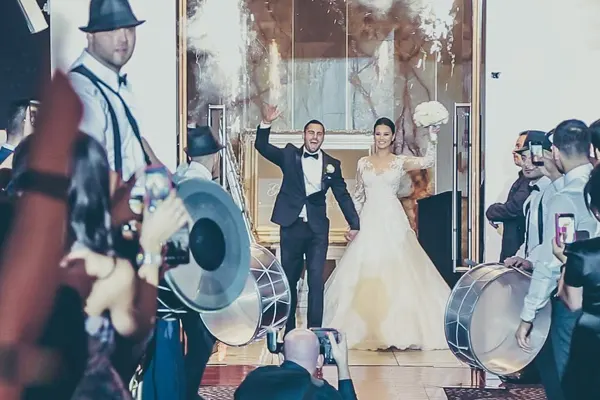
- The doors open. Drummers and pipers come in first, followed by the sword or dabke dancers and the singer.
- The couple appear. The newlyweds step in behind the troupe, pause in the doorway for the photographs, then walk slowly into the room.
- Stops along the way. The procession halts two or three times so the couple can dance with parents, siblings and friends as the zalghouta rises.
- Arrival on the dance floor. The troupe circles the couple, plays a final verse and either hands over to the first dance or leads straight into dabke.
- Handover. The DJ or band picks up on a cue agreed in advance, so the room never falls silent.
Brief your photographer and videographer on the doorway, the stopping points and the final circle, since the key frames happen in a few seconds; our page on wedding photography and film in Antalya covers how to brief a crew from abroad.
Length and Songs
A procession of 15 to 20 minutes gives the room time to stand, cheer and settle without delaying dinner. If the troupe stays on for dabke, or you want a second set later in the evening, plan a slot of 30 to 45 minutes in total and agree it in writing with the troupe.
Songs are where the families come in. A zaffe troupe sings traditional chants that bless the bride and groom, and you can ask whether they will add a modern Lebanese hit or a Western favourite for the final steps. Send the troupe your list early, with the names of the bride and groom spelt as the family says them, so the singer can weave them into the verses. Agree with your DJ or live band which track follows the last drumbeat, and at what volume. For that moment a couple may choose a song with family meaning; one Lebanese example is “Byawm Ersik”, the song Majida El Roumi sang for her own daughter’s wedding.
Choosing a Troupe and Costumes
In Turkey you can book an Arab troupe that knows the Lebanese repertoire, or fly a troupe in from Beirut. Turkish davul and zurna players are a different tradition with a sound of their own, so if you want the Lebanese zaffe, ask for it by name. Whichever route you take, these questions help you compare:
- A full video. Ask for an unedited zaffe from a recent wedding, not a highlights reel, so you hear the singer and the pipes as they really sound.
- The line-up. How many drummers, pipers, dancers and singers come, and whether that changes with the size of the room.
- Repertoire. Whether they know your family’s songs and can add your names to the chants.
- Sound needs. Whether the singer uses the venue’s system or brings a portable speaker, and how much power they need.
- Arrival and changing. When they arrive, where they change and wait out of sight, and where the drums are stored.
- Dabke. Whether they stay to lead the dabke line after the entrance.
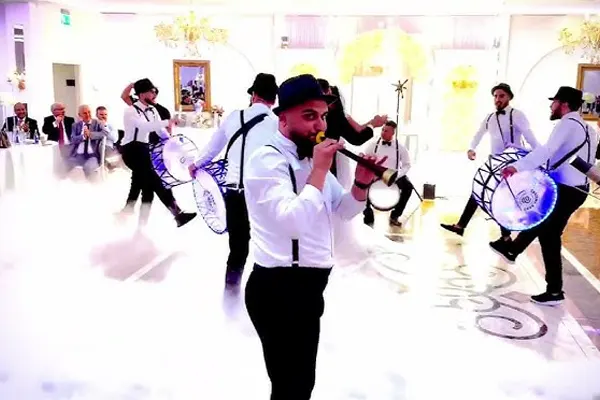
Costumes set the tone of the photographs. Some troupes wear a modern uniform of white shirts, braces, bow ties and hats, as in the photograph at the top of this page; others wear Lebanese folk dress with sherwal trousers, embroidered waistcoats and a tarboush. Ask to see both and choose the one that matches your colours and the formality of the evening.
Cold Sparklers, Smoke and Lighting
Effects can turn the zaffe into a show. Drums with lit heads, cold spark fountains either side of the doorway and a carpet of low smoke, as in the opening photograph, all look striking on camera. Each one depends on the room, so ask the venue before you book them:
- Cold spark machines. Whether they are allowed in your space, how close to guests and drapes they can stand, and who operates them.
- Low smoke or haze. How the venue’s smoke detectors and fire system are managed, and whether a technician needs to be present.
- Candles and flares. Real flames indoors, or hand flares outdoors, need the venue’s agreement for the exact spot.
- Lighting. Whether the room lights can dim on cue and a follow spot can track the couple down the aisle.
Outdoors, wind decides what works: smoke drifts away on a breezy beach, while cold sparks stay upright. Fireworks are a separate moment of the evening, covered in our article on a fireworks display at a wedding.
Space and Route at an Antalya Venue
A zaffe needs a clear route from a hidden starting point to the dance floor, wide enough for drummers carrying large drums and for the couple to dance in the middle. Look at the setting through that lens when you compare spaces.
Double doors and a wide central aisle between tables; the troupe can wait in the foyer
Ceiling height for raised drums and swords, acoustics with full drums, smoke detectors
A path or lawn aisle lit for the evening, starting behind a hedge, a wall or a building
Level ground for dancers, lighting along the path, how far the drums carry to rooms or homes
A boardwalk or matting laid across the sand to the dance floor
Firm footing for drummers and the bride’s gown, wind for smoke and candles, power for sound
| Setting | The route | What to confirm |
|---|---|---|
| Resort ballroom | Double doors and a wide central aisle between tables; the troupe can wait in the foyer | Ceiling height for raised drums and swords, acoustics with full drums, smoke detectors |
| Garden | A path or lawn aisle lit for the evening, starting behind a hedge, a wall or a building | Level ground for dancers, lighting along the path, how far the drums carry to rooms or homes |
| Beach | A boardwalk or matting laid across the sand to the dance floor | Firm footing for drummers and the bride’s gown, wind for smoke and candles, power for sound |
Drums are loud in a closed hall, so ask whether the troupe can soften the first minute indoors and let the full sound build once the doors are open. In the open air the sound travels, which is part of the joy of a beach wedding in Antalya; the zaffe opens the evening, but check that drums are welcome at that hour, and see our page on venue curfews and music times for when the music ends.
For an outdoor zaffe, keep a covered or indoor route in reserve and measure it for the drums just like the main one. Scale changes the picture too: for around 50 guests a compact troupe can fill the room, while a few hundred guests may call for more drummers and a longer route. To match a troupe to a room, browse the ballrooms, gardens and beachfront spaces in Ramarossi’s guide to Antalya wedding venues.
Timing With the First Dance and Dabke
Decide where the zaffe ends before the day, because that decision shapes the hour that follows. Three running orders suit different families:
- Zaffe into first dance. The troupe finishes on the dance floor, the lights drop and the couple’s song begins while everyone is still standing. Our article on planning the first dance has ideas for the song and the moves.
- Zaffe, dinner, then dabke. The couple reach the head table, the starters arrive, and the dabke opens the dancing after the main course, when the families are fed and ready.
- Zaffe straight into dabke. The troupe forms the first line and pulls the families in, then dinner follows. This suits a crowd that wants to dance from the first minute.
When the vows and the party take place in separate spaces, a short zaffe can lead the couple to the ceremony and a full one into the reception. Keep the two sets distinct, a few drummers for the first and the whole troupe for the second, so the bigger moment still feels bigger.
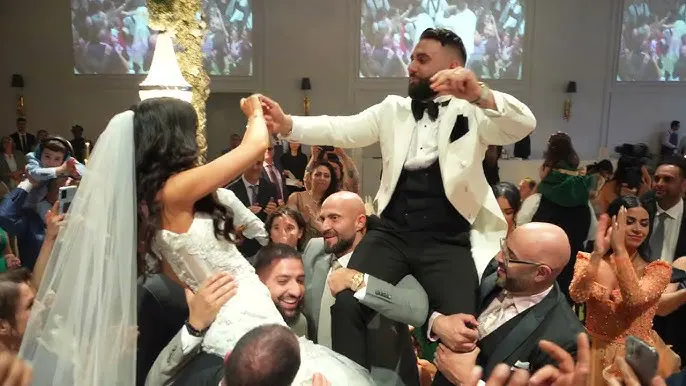
Lifting the couple onto shoulders, as in the photograph above, can happen at any point once the dancing starts. Let the troupe leader know if the bride would like to be lifted, and keep a clear circle on the dance floor for it.
Planning a Lebanese Zaffe From Abroad
Couples planning from London, Paris, Dubai, Montreal or Beirut can arrange the whole entrance on video calls. Fix the date and the venue first, then the troupe, since the route and the effects depend on the room. For dates between May and October, enquire early, as a troupe may be asked for several weddings on the same weekend.
If you fly a troupe in from Lebanon, check their flights carry the large drums as luggage, book their rooms near the venue and ask them which documents they need to perform in Turkey. A troupe based in Turkey only needs the route, the timings and your song list. A Ramarossi planner for your wedding in Antalya can help you compare troupes and agree the details with the venue.
Tell us how you want to make your entrance
Share your dates, your guest count and the troupe style you love, and Ramarossi will come back with ideas for a zaffe that suits your venue.
Prefer another email service? Write to info@ramarossi.com using Antalya Wedding Enquiry as the subject.
Follow our celebrations
Discover beautiful weddings, private events, styling ideas and behind-the-scenes moments from Ramarossi in Turkey.
Frequently Asked Questions
What is a Lebanese zaffe?
It is the musical procession that leads the newlyweds into their reception: tabl and derbakeh drummers, pipers, a singer and dancers, with the women of the family adding zalghouta.
Is it spelt zaffe or zaffa?
Both are correct. The Arabic word zaffa means a wedding procession, and Lebanese families write it zaffe or zaffeh, while Palestinian and Egyptian usage leans towards zaffa.
How long does a zaffe entrance last?
A procession of 15 to 20 minutes lets the room stand, cheer and settle. If the troupe stays on to lead dabke, allow 30 to 45 minutes in total.
Which instruments are played in a zaffe?
The large tabl drum and the derbakeh goblet drum carry the rhythm, and some troupes add bagpipes or a mizmar. A singer leads the chants over the drums.
Can we have a zaffe on the beach in Antalya?
Yes. Ask for a boardwalk or matting across the sand, check the wind for smoke and candles, and confirm that drums are welcome at that hour.
Can we use cold sparklers and smoke during the zaffe?
Ask the venue for your exact space: whether cold spark machines and low smoke are allowed, how the smoke detectors are managed and who operates the effects.
Does the zaffe come before the first dance?
It can lead straight into the first dance, open the evening before dinner with dabke after the main course, or flow directly into a dabke line. Choose one and brief the DJ.
Can we bring a zaffe troupe from Lebanon?
Yes. Check that their flights carry the large drums, book rooms near the venue and ask which documents they need to perform in Turkey. Troupes based in Turkey are another option.