


Bodrum wedding venues fall into four practical models: the beach club, the hotel or resort, the private villa, and the private estate or standalone event property. Each solves a different problem. A beach club puts you at the water with atmosphere already built in, and gives you the least control over privacy and finishing time. A hotel or resort puts beds, catering, infrastructure and a wet weather room in one place, and gives you the least freedom to change any of it. A private villa gives you a genuinely private celebration in a home rather than a venue, limited by capacity, access and neighbours. A private estate is built for events and hands you the most control, on condition that you supply everything the estate does not, accommodation included.
The right answer depends far less on how a property photographs than on how your particular wedding behaves: how many people, how late, how loud, how many days, and how far your guests are willing to travel between their bed and the party.
This article compares the venue models rather than the destination. If you are still deciding on Bodrum itself, start with our overview of planning a wedding in Bodrum.
The Four Models at a Glance
The table below is a starting point for shortlisting, not a substitute for asking each property directly. Every figure, minimum, restriction and policy referred to in this article is set by the individual venue and must be confirmed with that venue in writing.
| Beach club | Hotel or resort | Private villa | Private estate | |
|---|---|---|---|---|
| What it is | A trading beach and dining operation that also hosts weddings | A hotel with function space, gardens or a beach section | A private house rented for the wedding period | A property built or adapted specifically to host events |
| On-site accommodation | Rarely any | Its main advantage | Sleeps the immediate party only | Usually little or none |
| Exclusivity | Shared unless bought out | Shared unless bought out | Naturally private | Often exclusive use by default |
| Weather backup | Covered terrace at best | Indoor room, usually adjacent | Must be built in | Must be built in unless a covered space exists |
| Supplier and design freedom | Limited by trading hours and house style | Most restricted, often in-house only | Highest, and you build everything | High, within the property’s systems |
| Main constraint | Privacy and finishing time | Design freedom and standardisation | Capacity, access and neighbours | Accommodation and transport workload |
What Actually Sets Your Guest Ceiling
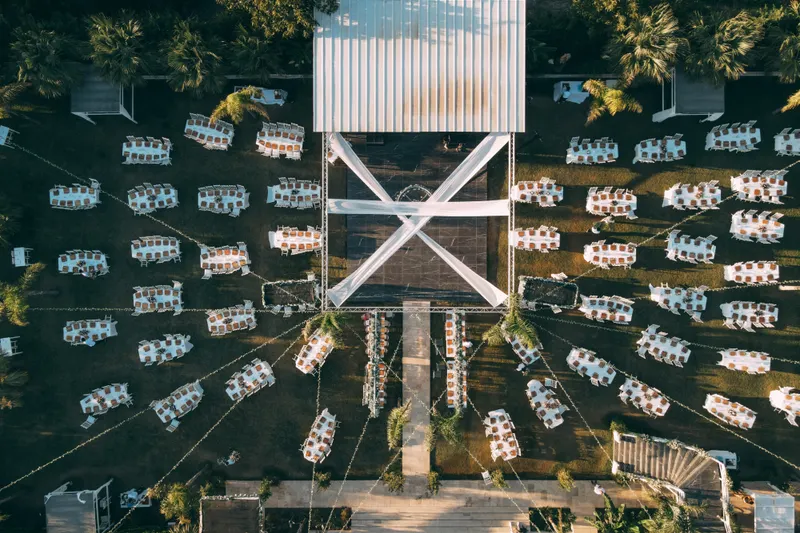
Capacity is the question couples ask first and the one venues answer least precisely. A number without a layout means nothing. Seated dinner on long tables, seated dinner on rounds, a dance floor, a live band and a buffet station all consume different amounts of the same space, and a venue quoting its maximum is usually quoting a standing reception with no band and no dance floor.
What sets the ceiling also differs by model. At a beach club, the constraint is normally the built deck and terrace footprint rather than the beach, because sand is a poor dining surface. At a hotel, the ballroom or garden footprint is rarely the real limit; kitchen throughput and room inventory are, and a hotel that can seat far more people than it can sleep will push part of your guest list off site. At a villa, capacity is governed by terrace and lawn area, by the fact that a domestic kitchen cannot produce a wedding service, and by lavatory provision, parking and the width of the access lane. At a private estate, the limit moves to power, water, back of house and transport, all of which can be engineered upwards if the budget allows.
Ask every shortlisted property for a capacity figure tied to your intended layout, in writing, and ask what that figure assumes about the dance floor and the band.
Privacy and Exclusivity, and What Private Actually Means
The four models sit on a spectrum. A private villa is private by nature. A private estate is often exclusive use by default, although you should confirm whether the owner can run a second event elsewhere on the site on the same day. A hotel and a beach club are both shared environments unless you buy them out, and a buyout in peak season is a commercial negotiation whose conditions, minimum spends and cut-off dates are entirely property-specific.
Partial exclusivity is where expectations break. A beach club may sell you its restaurant terrace while continuing to trade its sunbeds, which means day visitors in swimwear in the background of your ceremony. A hotel may give you exclusive use of a garden while its other guests walk past to reach the pool. Neither is unreasonable, and both are avoidable, but only if you ask what exclusive use covers, which areas remain in public use, and at what time the public areas close.
Where Your Guests Sleep, and How Far From the Party
This is the single most underweighted decision in Bodrum, and it follows directly from the venue model. A hotel wedding puts bed and party in the same place. Nobody drives, nobody waits for a coach, older relatives and families with young children can retire when they need to, and a late finish costs nothing in logistics. That convenience is the reason hotels remain the default for larger international guest lists.
Every other model separates the two. Beach clubs rarely have rooms. A villa sleeps the couple and the immediate family, and the rest of the guest list disperses across hotels that may be some distance away. An estate usually has little or no accommodation at all. None of that is a problem, but it does mean that choosing a villa or an estate commits you to running a hotel block, a rooming list and a coach schedule as a separate workstream from the moment you sign.
How the Day Flows: Ceremony, Drinks, Dinner, Dancing
Ask each property to walk you through the sequence and, in particular, how many times guests are moved and what happens to them during each move. A single space that hosts the ceremony and then has to be reset for dinner requires a flip, and during a flip your guests are standing somewhere else. At a hotel that somewhere else is usually a bar or a second garden. At a small villa it may be a driveway.
Beach clubs tend to run a linear, water-facing day built around sunset, which is a genuine strength and also a scheduling constraint, because the ceremony time is fixed by the light rather than by preference. Hotels offer several distinct spaces and easy transitions. Villas usually offer one continuous outdoor space, which reads beautifully and often requires a flip. Estates are generally designed around the sequence, with a separate ceremony area, drinks terrace and dining area, which is what you are paying for.
The venue model does not change Turkey’s legal marriage requirements, which run on a separate track from the celebration itself. British couples can read our guide to legally marrying in Turkey for that side of the process.
Moving Guests Around the Bodrum Peninsula
Milas-Bodrum Airport sits inland to the north east of the peninsula, roughly 36 kilometres from Bodrum town, and transfer times commonly quoted are in the region of 45 minutes to the town itself and appreciably longer to the western and northern bays such as Yalikavak, Gundogan and Turkbuku. Peak summer traffic lengthens all of it. Treat any published transfer time as an off-season figure and add to it for July and August.
The more important number is the one nobody checks: the journey between where your guests sleep and where they celebrate. The peninsula is compact on a map and slower in reality, because much of the traffic funnels through a limited road network and because a hotel on the southern coast and a venue on the northern coast are not neighbours in any practical sense. Access matters as much as distance. Steep hillside lanes and narrow village roads decide what size of vehicle can reach the gate, and a venue that cannot take a full-size coach forces you into multiple minibuses, which multiplies drivers, staggers arrivals and complicates the departure.
Decide your accommodation area and your venue together rather than in sequence. Our guide to coordinating guest transport covers the scheduling side in more detail.
Supplier Access, Load-In and Build Time
How much time your suppliers get on site, and what they are allowed to bring, varies more between these four models than almost anything else. A beach club is a trading business, so load-in is often restricted to the hours before it opens or after it closes, which can leave a florist and a production team a few hours rather than a day. A hotel typically supplies tables, linen, basic lighting and audio in house, which removes work, and frequently operates a preferred supplier list, an external supplier fee, or both.
A villa is usually a blank site. A mobile kitchen, additional power or a generator, lavatories, lighting, furniture and often a structure all arrive by lorry, and the access road governs the size of that lorry. A private estate normally has the power, back of house, staff facilities and turning space already in place, along with a longer build window, which is precisely what distinguishes it from a villa.
Where a property restricts external suppliers, charges an entry fee, or limits build and de-rig hours, get the detail in writing before you sign rather than after.
Sound Limits and Finishing Times
There is no single Bodrum curfew, and any source that quotes one should be treated with caution. Turkey regulates environmental noise nationally through the Environmental Noise Control Regulation, published in the Official Gazette on 30 November 2022. Within that framework, businesses broadcasting music require a music broadcast permit granted on the basis of an acoustic report, outdoor events are framed within the hours of 10:00 to 01:00, and the operating hours of music-playing businesses may be re-set locally by the Provincial Local Environment Board, taking into account the season, the characteristics of the area and strategic noise mapping. Fireworks require prior permission from the local civil authority, with the time and place notified in advance. The procedures governing music broadcast permits were themselves revised in August 2026.
What this means in practice is that the limit applying to your wedding depends on the individual property: whether it holds a live music permit, what its acoustic report says, how close it sits to residential use, and what the current provincial decision is for that area and season. Licensed beach clubs and hotels usually have the clearest position, because operating late with amplified music is their normal business.
Villas are where couples are most often caught out. A rented house is a home, not a licensed entertainment venue, and amplified music late at night in a quiet residential bay is the most common reason a celebration is curtailed. If a villa or estate is on your shortlist, the sound question is not a detail to settle later, it is a qualifying question. Ask for the latest permitted time for amplified music, whether it differs between indoor and outdoor areas, whether the property holds the relevant permit, and what the venue does if the limit is enforced on the night.
Catering and Beverage Flexibility
Hotels almost always cater in house. That gives you volume, consistency and a kitchen accustomed to serving several hundred covers simultaneously, and it gives you the least flexibility if you need a specific cuisine or a certified requirement. Where a wedding calls for kosher catering, halal certification, or a properly executed Indian, Persian, Lebanese or Pakistani menu, the first question is whether an external caterer is permitted at all and on what terms.
Beach clubs also cater in house, but their kitchens are built for a la carte covers across an evening rather than for one simultaneous seated service, so ask specifically how a service of your size is executed and whether it has been done before at that scale. Villas are the most flexible, because an external caterer arrives with a mobile kitchen and you choose the cuisine and the standard outright, and you are also buying the infrastructure that makes it possible. Estates commonly work from a nominated caterer list or allow external caterers subject to a fee.
Beverage arrangements differ fundamentally from property to property. Some supply exclusively in house, some permit corkage, some apply a bar minimum, and some operate a bottle allocation. Whether the celebration includes alcoholic service at all is a decision for you rather than an assumption anyone should make on your behalf, and it materially changes what a quotation represents. Never compare two venues’ proposals until you know each one’s beverage basis, because two apparently similar packages can be describing entirely different things.
Beach and Waterfront Access
Under Turkish coastal legislation, shores are under the control of the state and open to everyone equally and freely, and no structures, walls, fences, railings or similar barriers may be erected on the shore itself. In practice that means no venue in Bodrum owns the sand. A private beach is a managed operation adjoining a public shore, and the exclusivity you are buying is a commercial and operational arrangement rather than ownership.
This has two consequences worth planning around. Ceremony setups on sand are temporary, and what a specific property may place, where it may place it, and for how long, depends on its own permissions, which should be confirmed in writing. Second, sand is a difficult surface: chairs sink, heels sink, sound scatters, and catering cannot easily be served across it. A great many waterfront ceremonies work better on a deck or terrace at the water’s edge than on the beach proper.
For villas and estates, distinguish carefully between sea view and sea access. A property may sit above a bay with an outstanding outlook and no usable shorefront, or may have a private jetty and a short, steep path that older guests will struggle with. Walk the route yourself.
Wind, Heat and the Backup You Will Probably Need
The Aegean’s prevailing summer wind, known meteorologically as the Etesians and in Turkish as the meltem, is the dominant northerly airflow of the eastern Mediterranean in summer. It is most frequent from the middle of July to the middle of August, strengthens during the day as the Anatolian thermal low deepens, and generally eases overnight. Near the south west Turkish coast it tends to blow from a northerly to north westerly direction. It brings dry, clear and comparatively cool air, which is genuinely pleasant, and it also lifts drapery, destabilises tall floral installations, extinguishes candles and makes outdoor sound harder to control.
A bay open to the north takes that airflow more directly than one lying in the lee of the peninsula’s higher ground, but shelter is site-specific rather than coast-specific. The angle of the bay, the surrounding topography and the exact orientation of a terrace matter more than which side of the peninsula a venue sits on. Visit a shortlisted property at the same time of day you intend to marry, in as close to the same season as you can manage, and stand where the ceremony will actually take place.
Heat is the other constraint. High summer afternoons in Bodrum are not a sensible ceremony slot, which is one reason sunset ceremonies dominate. Shade, water and timing solve most of it.
Every model needs a defined backup, and the models differ in how much of it already exists. A hotel usually has an indoor room. A beach club may have a covered terrace. A villa or an estate normally needs a marquee or sailcloth structure, which has to be planned and costed at contract stage rather than decided in the final week. Ask each venue in writing what its wet weather and high wind plan is, at what time the decision is taken, who takes it, and whether it carries an additional cost. Our guide to managing unexpected weather covers the decision process itself.
Suitability for Multi-Day Celebrations
If your celebration runs across several days, the ranking changes. Hotels are the strongest, because guests are already in residence, several spaces can host different events, and nobody is transported anywhere. Estates work well when paired with a hotel block nearby, since a single site can usually accommodate several distinct setups across consecutive days. Villas suit intimate multi-day celebrations and struggle with large ones. Beach clubs are generally built for a single event rather than a programme, because they need to trade the following day.
Cultural celebrations that unfold over several days, whether that is a mehndi and sangeet, an aroosi, or a hafleh, place more weight on accommodation proximity and on whether one property can host visually distinct events on consecutive days without the second looking like the first. Our guide to multi-day wedding celebrations in Turkey goes further into the structure.
Which Model Suits Which Wedding
A beach club suits a single-day celebration built around sunset and the water, for couples who value atmosphere over control, whose guests are staying nearby anyway, and who are comfortable with a shared setting or can fund a buyout.
A hotel or resort suits larger and more international guest lists, families travelling with children or older relatives, multi-day programmes, and couples who want the fewest moving parts. It is the right answer far more often than design-led wedding content suggests, because it removes transport, accommodation and weather risk in one decision.
A private villa suits smaller, private, design-led weddings, and couples who are willing to build a wedding rather than book one. The result can be more personal than anything a hotel will produce, provided the guest list is genuinely within the property’s capacity and the sound position has been established before signing.
A private estate suits larger or design-led weddings that want something close to a hotel’s operational capability with a villa’s privacy, and whose couples accept the accommodation and transport workload that comes with it. If you are still weighing the Aegean against the Mediterranean coast, our comparison of Bodrum and Antalya looks at the wider difference between the two.
What to Confirm in Writing Before You Sign
Minimums, buyout conditions, sound limits, supplier policies and beverage arrangements are set by each individual property and they change. Treat the following as a written checklist to put to every venue on your shortlist, and re-confirm it at contract stage.
- Seated capacity for your actual layout, stating what it assumes about the dance floor, band and service style.
- What exclusive use covers, which areas remain in public use, and the conditions and cut-off date for a full buyout.
- The latest permitted time for amplified music, whether it differs indoors and outdoors, and whether the property holds the relevant permit.
- The external supplier policy, including any entry fee or preferred supplier requirement.
- The load-in and de-rig window, and the largest vehicle that can reach the site.
- Whether catering is in house only, and if external catering is permitted, on what terms.
- The beverage basis, including supply arrangement, corkage position and any bar minimum.
- The wet weather and high wind plan, the decision time, the decision maker and any additional cost.
- For waterfront ceremonies, what may be set up on or beside the shore, and under whose permission.
- Rooms held, the release date, and the basis on which accommodation rates are quoted.
- The payment schedule and the cancellation terms.
Frequently Asked Questions
What is the real difference between a beach club wedding and a hotel wedding in Bodrum?
A beach club gives you the water, the light and an existing atmosphere, and normally no accommodation and less control over privacy and finishing time. A hotel gives you beds, catering, infrastructure and an indoor backup in one place, and normally less design freedom. The choice usually comes down to whether your priority is the setting or the logistics.
Can we have a completely private wedding at a Bodrum beach club?
Only by buying out the venue, and the conditions attached to a buyout vary by property and by season. Partial hire is common and often means the club continues trading around your event. Ask specifically which areas remain open to the public and until what time, and get the answer in writing.
Is there a curfew for wedding music in Bodrum?
There is no single local curfew. Turkey’s national environmental noise framework requires a music broadcast permit based on an acoustic report, frames outdoor events within set hours, and allows the provincial environment board to adjust operating hours locally by season and area. What applies to a particular wedding therefore depends on that property’s permit and location, and must be confirmed with the venue directly.
Is a villa wedding cheaper than a hotel wedding in Bodrum?
Not reliably, because the two are not the same purchase. A hotel price generally absorbs kitchen, service, furniture, basic lighting and a wet weather space. A villa hire buys the setting, and the mobile kitchen, power, lavatories, furniture, lighting, staff and any structure are added on top. Villas can be excellent value at the right guest count and can become the more expensive option once the full build is priced.
Which side of the Bodrum peninsula is better if we are worried about wind?
Bays open to the north are more exposed to the prevailing summer northerlies than those sheltered by higher ground, but this is not a reliable rule for choosing a venue, because local topography and the orientation of the specific terrace matter more than the coast. The dependable approach is to visit the property at your intended ceremony hour and ask the venue how it manages wind on that particular terrace.
If you are comparing venue models for a wedding in Bodrum and want a second view on which of them fits your guest count, your dates and the way you want the day to run, Ramarossi is happy to talk it through with you.