


Destination Wedding Invitation Suite: What to Include
Save-the-dates, invitation wording, RSVPs, event cards, accommodation and travel notes: what each piece should tell guests travelling to your wedding abroad, and what to leave until it is confirmed.
An invitation to a wedding abroad does more than announce a date. It helps guests decide whether they can travel, tells them which celebrations they are invited to, and shows them where to find reliable travel and accommodation information.
This guide covers each piece of a destination wedding invitation suite, how to word the main invitation, and how to keep every detail accurate when guests are flying in from different countries.
The Pieces of a Destination Wedding Invitation Suite
A wedding abroad involves two kinds of information: the celebration itself, and what guests need to decide whether and how to travel. Splitting them across a few clear pieces is easier for guests than one crowded card. Not every wedding needs every piece.
| Piece | What it tells guests | When to send or confirm |
|---|---|---|
| Save-the-date | Your names, the destination and the date | As soon as the date and destination are certain |
| Main invitation | Hosts, celebration, date, local time, venue and how to reply | Once the venue and programme are agreed |
| RSVP card or form | How and by when to reply, event by event | With the invitation, with a deadline set by venue and supplier dates |
| Event card | Who is invited to a welcome dinner, cultural event or farewell | Once guest groups and events are clear |
| Accommodation and travel note | Verified rooms, arrival and transfer information | Only after the hotel or transport provider confirms |
| Wedding website | Current addresses, timings, updates and the RSVP link | Live from the save-the-date, updated as plans develop |
Your names, the destination and the date, as soon as the date and destination are certain.
Hosts, celebration, date, local time, venue and how to reply, once the venue and programme are agreed.
How and by when to reply, event by event, with a deadline set by venue and supplier dates.
Who is invited to a welcome dinner, cultural event or farewell, once guest groups and events are clear.
Verified rooms, arrival and transfer information, only after the provider confirms.
Current addresses, timings, updates and the RSVP link, live from the save-the-date and updated as plans develop.
Save-the-Dates: Share What You Know
A save-the-date gives guests early notice that an overseas trip may be involved. Include your names, the destination and the date, or the dates for a celebration over several days, once these are certain. Guests with school holidays, annual leave or visa applications to plan may need longer to decide than guests at a wedding at home.
If the venue is not yet booked, a destination such as Antalya or Istanbul is enough at this stage. Do not present an unconfirmed hotel as the venue, and say clearly if flight bookings should wait for the main invitation.
Some couples add a soft RSVP to the save-the-date, asking guests to say early whether they are likely to come. It helps with room and venue planning before the main invitation goes out.
The Main Invitation: What It Must Tell Guests
Before any design details, the main invitation should answer the questions every guest has:
- Who is inviting: the couple, or the couple with their families or hosts.
- What the celebration is: the wedding ceremony, the reception, or both.
- The date and local start time: in the destination’s time, so travellers do not have to work it out.
- The confirmed venue: its name and the town or district. In Antalya, guests may not know whether a resort is in Lara, Belek, Kemer or Side.
- How to reply: the RSVP method and deadline.
If the ceremony and reception are in different places, say so clearly. A resort’s public address may not be the entrance to the event space, so give the gathering point once it is agreed. Dress code, children, transfers and other events can go on a separate card or the wedding website.
Invitation Wording Examples
Wording can be formal, modern or warm. Choose the voice that suits you and your families rather than a template that assumes a particular host, tradition or type of ceremony. Fill in the bracketed details only once they are confirmed.
- Simple: “Together with our families, we invite you to celebrate our wedding on [date] at [venue], [destination]. Please join us for the ceremony and reception. Kindly reply by [RSVP date].”
- Hosted by parents: “[Parents’ names] request the pleasure of your company at the marriage of [name] and [name] on [date] at [venue], [destination].”
- After a legal marriage at home: “Join us for our wedding celebration on [date] at [venue], [destination].”
If you marry legally at home and hold a symbolic ceremony abroad, the wording should not suggest that the ceremony in Turkey is the legal marriage. In Turkey, only a civil marriage before an authorised marriage officer is legally binding; our guide to marriage in Turkey for foreigners explains the difference.

Design and Proofreading
A clear hierarchy helps guests find what matters: names first, then the date and celebration, then the venue and reply details. Choose legible type, comfortable spacing and enough contrast, especially for guests reading on a phone. A fine script that looks elegant on a printed proof can be hard to read in a messaging app.
Proofreading goes beyond spelling. Check how each person wants their name to appear, the date and the day of the week, the local start time, the venue name and every link. For printed cards, check the final proof at actual size and allow the printer’s production and delivery time, and international postage time for guests abroad.
RSVPs: Ask for the Decisions You Need
A destination wedding RSVP may need more than yes or no. If guests are invited to several events, ask for attendance at each one, and state your plus-one and children policy clearly. Set the deadline from your venue and supplier dates, and keep all replies in one list.
Ask only for the personal details you need, such as dietary or access requirements, and share them only with the people who need them. Our guide to managing destination wedding RSVPs covers follow-ups and final numbers.
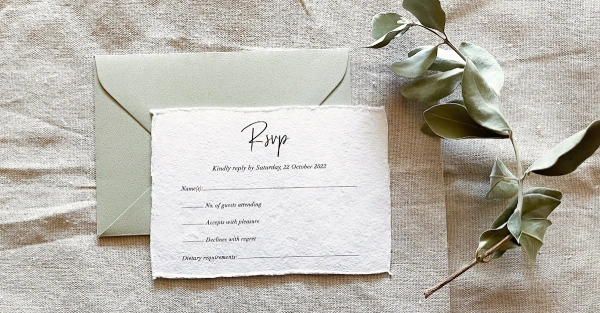
Event Cards for Multi-Day and Cultural Celebrations
A wedding abroad can include a welcome dinner, a henna or mehndi night, a Sofreh Aghd or nikah, the main reception and a farewell brunch. Not every guest attends every event, so a single list can lead guests to think they are invited to everything.
A separate card or a personalised page for each event, with its date, time, place, dress code and who is invited, is clearer than one long programme on every invitation.
Accommodation Notes: Only What Is Confirmed
Guests will want to know where to stay. A wedding at a resort does not mean rooms are held for every guest or offered at a group rate. Publish rates, deadlines or booking codes only when the hotel has confirmed them; if there is no room block, do not word the note as if there were one.
When the room options are complex, a short accommodation card pointing guests to the wedding website works better than a printed card that may go out of date. Our guide to resort room blocks in Antalya explains what to confirm before guests book.
Travel Details: Be Specific
Guests may need the arrival airport, the district, the venue address and how to reach the event. Even within Antalya, the airport journey to Lara, Belek or Kemer differs, so name the district. If transfers are arranged, say who they are for, where to meet and how changes will be shared.
Do not print travel times, fares or entry rules as fixed facts; ask guests to check entry requirements with official sources. Our guide to wedding guest transport in Antalya covers airports and drive times.
A Wedding Website as the Source of Truth
A wedding website or private information page brings together the schedule, addresses, the RSVP link, accommodation, transfers and dress code. Keep it short, easy to use on a phone and up to date, and mark anything provisional. Do not publish guest lists, passport details or other private information on an open page.
A useful wedding website includes:
- The schedule, event by event, with who is invited to each.
- Venue addresses and the gathering point for each event.
- Dress code for each event.
- The RSVP link and deadline.
- Accommodation: confirmed options only.
- Arrival airports and any arranged transfers.
- A contact for questions.
- A note on anything still to be confirmed.
When several relatives help to invite guests, ask everyone to point back to the website, so only one version of the details circulates.
Printed, Digital or Both?
Printed invitations feel personal and suit families who value a card they can keep. Digital invitations arrive quickly, link straight to maps and the RSVP form, and are easy to update. A combination, a printed invitation with a link to the website, suits weddings where some relatives prefer paper and other guests want everything on their phone.
For digital invitations, test links on a phone and check how the image looks in messaging apps. An image should never be the only place the address and RSVP details appear.
Invitations in More Than One Language
For a wedding with Persian, Arab, Pakistani, Turkish, British or other families, a bilingual or multilingual invitation helps everyone understand the details. Keep dates, times, place names and RSVP instructions identical in every version, and have each translation checked by a fluent speaker. Persian and Arabic read right to left, so check the layout of each version, not only the wording. Agree on names, titles and family wording with the people concerned rather than following one etiquette rule for every tradition.
A Final Check Before Invitations Go Out
- Names spelled as each person wants them.
- Dates, days of the week and local start times.
- The venue name, district and gathering point.
- Which guests are invited to which events.
- The RSVP method and deadline.
- Accommodation and transfer wording that matches what is confirmed.
- Every link, tested on a phone.
- Each language version against the same final details.
Planning a wedding in Turkey?
Tell Ramarossi your date or season, guest count, where guests are flying from and the events you are planning. We can then arrange a free video call to talk through your plans.
Prefer another email service? Write to info@ramarossi.com using Wedding in Turkey Enquiry - Guest Planning as the subject.
Follow our celebrations
Discover beautiful weddings, private events, styling ideas and behind-the-scenes moments from Ramarossi in Turkey.
Frequently Asked Questions
What should a destination wedding invitation suite include?
Depending on your wedding, a save-the-date, the main invitation, an RSVP card or form, event cards, an accommodation and travel note, and a link to your wedding website. Not every wedding needs every piece.
What should be on a wedding invitation?
Who is inviting, the celebration, the date and local start time, the confirmed venue and how and when to reply. Dress code, transfers and other events can go on a separate card or the wedding website.
When should we send save-the-dates for a wedding abroad?
As soon as the date and destination are certain, giving guests time to book leave, plan around school holidays and apply for any visas. Make clear if flight bookings should wait for the main invitation.
How do we word an invitation for a symbolic ceremony?
Use wording such as “join us for our wedding celebration”, which describes the event without suggesting the ceremony abroad is the legal marriage.
How do we invite guests to several events over a wedding weekend?
Give each event its own card or page with its date, time, place and who is invited, and ask for replies event by event.
Should hotel room rates appear on an invitation?
Only when the hotel has confirmed the rate and booking conditions. A wedding at a resort does not by itself guarantee rooms or a group rate.
Do we need a wedding website as well as printed invitations?
It is optional, but a website gives guests one place to find current addresses, travel details and the RSVP link as plans develop.
Can our invitations be in more than one language?
Yes. Keep dates, times, place names and RSVP details identical in every version, and have each translation checked by a fluent speaker.