


A venue sends photographs of a terrace above the sea, a lawn behind the main building, or a pool deck lit for the evening, and the dance floor places itself in the couple’s mind before anything has been agreed. The space looks large enough, and the decision feels made.
Physical room is only one part of it. An outdoor dance floor in Antalya is an operational setup rather than an empty area. It works where the venue permits amplified music in that exact space, where nearby residences or occupied hotel areas do not create an unresolved conflict, where a suitable electrical supply can reach the production position, and where speakers, lighting and cables can be installed safely.
Those conditions are property-specific, and two spaces inside one property can differ. Couples planning a wedding in Antalya from abroad have the least opportunity to discover that on site, which is why these questions belong at shortlist stage rather than after a deposit.
Outdoor Dance Floor in Antalya: The Short Answer
Before booking a venue around an outdoor dance-floor concept, confirm the sound conditions, the exposure to neighbouring properties, the electrical supply, the cable route and the technical setup for the exact space. Ask the venue to set out its operating conditions for that area in writing rather than assuming that an outdoor reception area supports amplified dancing.
An empty terrace, lawn or poolside area shows that there is room. It does not show whether amplified music is permitted there, for which part of the programme, from which position, with what electrical supply, or with what setup access. Those answers belong to the venue and, on the technical side, to a qualified supplier.
Why the Dance Floor Must Be Checked Before the Layout Is Final
The dance floor sits at the head of a chain. Guest tables are placed in relation to it, the DJ or band position follows from it, speaker placement follows the music position, lighting follows both, and power and signal cables follow all of them. The venue’s operating conditions for that area govern the whole arrangement.
So when the dance-floor location changes, the rest moves with it. A layout agreed on a floor plan and revised on site, because the intended position cannot be supplied with power or used for amplified music, costs design time and can change the reception the couple thought they had agreed. The same revision made early costs a few questions.
Outdoor Dance-Floor Feasibility at a Glance
Each point below is answered by a specific party, and none can be settled from a photograph or a site plan.
| Question | Why It Matters | Who Should Confirm It |
|---|---|---|
| Is amplified music permitted in this exact outdoor space? | Conditions can differ between areas of one property. | The venue, in writing |
| What operating conditions apply to that area? | Conditions attach to the space and the contract, not to the destination. | The venue, in writing |
| Are nearby residences or occupied hotel areas relevant? | Sound carries beyond the event area, and a distant position is not automatically a discreet one. | The venue, in writing |
| Where can speakers be positioned, and facing which way? | Position affects coverage, guest comfort and exposure to neighbouring areas. | The venue with the sound supplier |
| What approved electrical supply is available to that location? | The nearest socket is not evidence of a suitable supply. | The venue, in writing |
| Can the technical supplier use that supply for the planned equipment? | Only the supplier can assess the equipment against what the venue approves. | The technical supplier |
| Is there a safe route for power and signal cables? | Cables must reach the production position without crossing guest movement unsafely. | The venue with the technical supplier |
| Can equipment reach the space within the available setup access? | Equipment that cannot be delivered and installed cannot be used. | The venue, in writing |
| Is the surface suitable for a dance-floor installation? | Feasibility is assessed on site rather than from an image. | The production supplier |
| Do supplier restrictions apply to this area? | The chosen DJ, band or technical team may be affected by the venue’s arrangements. | The venue, in writing |
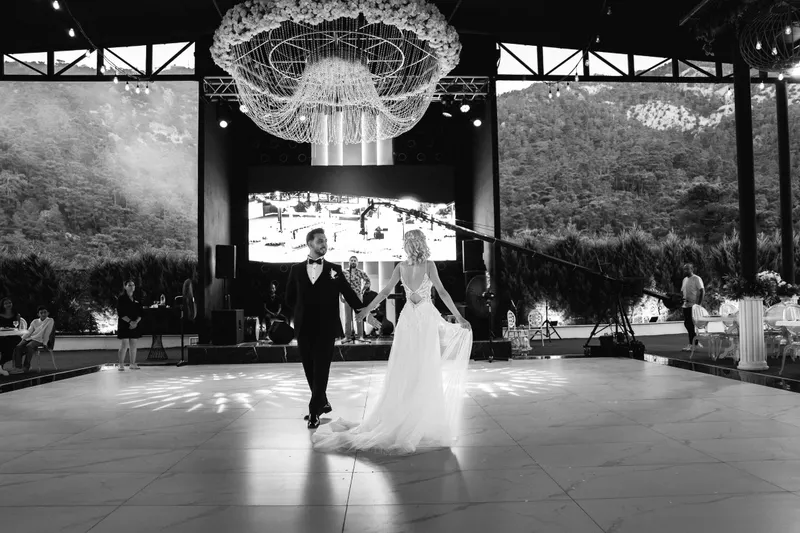
Sound: Confirm the Exact Outdoor Space, Not Just the Venue
One property can hold different conditions for different areas. An enclosed ballroom, a covered terrace, an open lawn and a pool deck are different operational environments, and a venue that hosts amplified music indoors has not thereby said what it can do outdoors. Ask what applies to the proposed location specifically:
- whether amplified music is permitted in that exact area;
- which part of the event programme it covers;
- whether volume or other operating conditions attach to the space;
- whether speaker position or direction is restricted;
- whether the venue requires sound monitoring or a particular technical arrangement;
- whether the music setup is expected to move to another space later in the evening.
The last point has design consequences: if the venue expects the music to relocate at some stage, the couple should know before the layout and lighting plan are built around one position. The useful question is not what the rules are in Antalya, but what this venue is permitted and contractually able to do in this space.
Nearby Residences and Hotel Areas Can Change the Decision
Neighbour restrictions is a practical description rather than a formal category. In planning terms it means one thing: what sits close enough to the proposed position to affect how the venue can operate it. That can be private residences, occupied guest rooms in the same hotel, another property’s grounds, shared resort areas in use by other guests, or public areas.
Distance from the main building is not the same as distance from a sensitive area. A lawn at the far edge of a property can back onto housing, a terrace chosen for its view can sit directly below occupied rooms, and sound carries differently across water, hard surfaces and open ground than a floor plan suggests.
The venue should say what it is permitted to operate in that area and what restrictions apply. One answer is not sufficient on its own: that other weddings have used the space before. Previous use establishes neither current permission nor what the couple’s own contract will allow.
Power: The Question Is Whether the Production Can Be Supplied Safely
An outdoor dance floor may require electrical supply for some combination of DJ equipment, sound, lighting and other production. At pre-booking stage the question is not how much power the setup draws. It is whether an approved supply can reach that location and whether a qualified technical supplier can work with it:
- Define the production concept, at least in outline, so there is something to assess.
- Ask the venue what approved electrical supply is available to that specific location.
- Have the qualified technical supplier confirm whether that supply suits the planned equipment.
- Confirm a cable route that does not create a hazard for guests.
- Treat any additional temporary power as a separate piece of technical planning rather than an assumption.
A socket at the edge of a terrace is not evidence that the position can carry a production. Neither a couple nor a planner should assume capacity, or specify it. That assessment belongs to the venue and a qualified technical supplier, and is worth having before the contract is signed.

Cable Routes Matter More Than Couples Expect
Power and signal cables have to reach the DJ position, the speakers, the lighting and the control equipment. On a floor plan those runs are invisible. On site they cross the ground guests walk on.
Before a position is approved, the venue and the technical supplier should confirm how cables reach the area, whether guest walkways are affected, how cables are protected where people cross them, and whether the arrangement satisfies the venue’s safety requirements. A position that looks clean on paper can require a run across an entrance or over a step, and the answer is a different position rather than a better cable.
Speaker Position Can Change Whether the Layout Works
Moving a dance floor a few metres can change speaker orientation, proximity to guest rooms or neighbouring properties, the cable route, guest circulation and the technical setup. Those are not cosmetic changes, and they can turn a workable position into one the venue will not approve, or the reverse.
Hence the sequencing rule: the venue and the technical supplier should agree that the intended location is workable before the layout is finalised. Adjusting speaker direction is a refinement within an approved arrangement, not a way of resolving a permission or neighbouring-property question, and it should not be offered as one.
Does Exclusive Use Solve the Problem?
Not automatically. A couple may hold the event space exclusively, reserve every room, or take the property on a buyout basis, and none of that by itself grants unrestricted amplified outdoor music, unrestricted volume, unrestricted operating hours, unrestricted supplier access or unrestricted electrical setup. Exclusivity governs who else is present on the property. It does not, on its own, govern what the property is permitted to do or what the contract allows in a particular space, and those remain separate points to confirm.
Private Villas Need Separate Verification
A private or residential villa should not be assumed to hold the same permissions as a licensed hotel or event business. Nor does that mean a private event sits outside all noise, event or local requirements. Both assumptions are unsafe.
Where a private property is under consideration, confirm its event-use status, what amplified music is permitted there and in which space, and what technical setup and electrical supply it can support. The legal and operating status of a property is a matter for the relevant authority and the property itself, and where a couple needs a view on it, for a qualified lawyer.
Questions to Get Answered Before Booking
A short list, aimed at the exact space rather than the venue in general:
- Is amplified music permitted in this exact outdoor area?
- Which venue conditions apply specifically to this space?
- Are there nearby residences, occupied hotel rooms or public areas that affect how it can be used?
- Where can speakers and DJ equipment be positioned?
- What electrical supply is approved for this area?
- Must the technical supplier inspect or approve the setup first?
- How will power and signal cables reach the production position?
- What setup access is available for delivering and installing the equipment?
- Are outside technical suppliers permitted in this area?
- Which of these points will the venue confirm in writing?
The final question carries the most weight. A verbal answer on a site visit is a starting point; a written answer is what the reception plan can be built on.
How Ramarossi Coordinates an Outdoor Dance-Floor Plan
An outdoor dance floor touches venue choice, layout, music, technical production, supplier access and the running order of the evening. Those are separate conversations with separate parties, and they fail at the joins. Depending on the agreed scope of wedding planning services, Ramarossi can coordinate venue shortlisting and venue communication, the reception layout, the DJ or band, the sound and lighting team, setup planning, supplier access and event sequencing on the day. The purpose is to resolve the dance-floor question before the reception design depends on it: to put the operational questions to the venue early, pass its confirmed conditions to the technical suppliers, and keep the layout and production plan aligned with them.
Ramarossi coordinates. It does not act as the venue, the property owner, an electrician, a sound engineer, a technical supplier, a licensing authority or a lawyer, and it does not certify electrical safety or sound compliance. Whether a property may operate amplified outdoor music is a matter for that property and the relevant authority. What a planner can do is make sure the right question reaches the right party early enough to change the decision.
Final Takeaway
Do not book an Antalya venue because the outdoor space looks large enough for dancing. Before the reception plan settles, confirm for the exact dance-floor position: sound conditions, power, nearby areas, technical access, cable routing and venue conditions. Each has an owner, and each can be answered in writing while the shortlist is open.
Couples considering an outdoor reception are welcome to discuss the venue, layout and production concept with Ramarossi as part of Antalya wedding planning, so the operational questions can be put to the property before the design is finalised. Permissions, availability and technical capacity remain matters for the venue and its suppliers to confirm.
Frequently Asked Questions
Can every Antalya wedding venue have an outdoor dance floor?
No. It depends on the exact space, the venue’s conditions for it, the electrical supply available and the technical setup it can accommodate. A large outdoor area is not by itself confirmation that it can be used for amplified dancing.
How do we know whether outdoor amplified music is allowed?
Ask the venue to confirm the conditions for that exact space in writing, including which part of the programme they cover. Conditions belong to the property and the contract, so a general answer about the destination is no substitute for a specific one about the space you intend to use.
Does a venue buyout mean we can play outdoor music without restrictions?
No. A buyout or exclusive use governs who else is on the property. It does not automatically remove sound, supplier, technical or operating restrictions, which remain property-specific and should be confirmed separately.
What power should an outdoor wedding dance floor have?
That is not a figure a couple should be given in advance. The technical load depends on the equipment in the production plan and must be assessed by a qualified technical supplier against the supply the venue approves for that location. The pre-booking question is whether a suitable supply can reach the position at all.
Do nearby hotel rooms or residences affect an outdoor dance floor?
They can. Nearby residences, occupied guest rooms, adjacent properties and shared or public areas may affect how the venue is able to operate a particular space. The restrictions are property-specific, so the venue is the party to confirm what applies to the area you have in mind.
Can we use an outdoor dance floor at a private villa in Antalya?
It depends on the property. A private or residential villa should not be assumed to operate under the same permissions as a licensed hotel or event venue, nor to be free of requirements. Confirm its event-use status, what amplified music is permitted and where, and what technical setup and electrical supply it can support.
Can Ramarossi coordinate the venue and technical suppliers for an outdoor dance floor?
Within the agreed planning scope, yes. Ramarossi can raise the operational questions with the venue, coordinate the DJ or band, the sound and lighting team and the reception layout, and keep the design aligned with the conditions the venue confirms. Ramarossi does not certify electrical safety or sound compliance, and does not grant or guarantee permission to operate amplified music.