

Marriage in Turkey for Foreigners: Documents, Steps and Certificate
Foreigners can marry in Turkey before a Turkish marriage officer. This guide explains who can marry, which documents marriage offices ask for, how authentication and translation work, and which certificate you receive afterwards.
Foreign couples can marry in Turkey, but there are two separate decisions to make: whether to register a legally valid marriage in Turkey, and how to plan the ceremony and celebration for family and guests. Knowing the difference early stops paperwork questions from driving venue and travel decisions.
This guide sets out how a civil marriage works for foreigners, the documents Turkish marriage offices ask for, and what you receive after the marriage. It is a planning guide, not legal advice: requirements depend on your nationality and circumstances, so confirm your own list with the marriage office where you will marry.
Can Foreigners Get Married in Turkey?
Yes. According to Turkey’s General Directorate of Population and Citizenship Affairs, the route depends on the couple’s nationalities:
- A Turkish citizen and a foreigner: can marry in Turkey only before an authorised Turkish marriage officer.
- Two foreigners of different nationalities: can also marry only before an authorised Turkish marriage officer.
- Two foreigners of the same nationality: can marry before Turkish authorities, or at their own country’s embassy or consulate in Turkey if their national law allows it.
Applications from foreigners follow the same marriage regulation that applies to Turkish citizens. The same official guidance also states that no public announcement of the marriage is needed before the ceremony can take place.
Who Marries You: The Turkish Marriage Office (Marriage Bureau)
In towns and cities, marriages are carried out by the municipality’s marriage office, known in Turkish as the evlendirme dairesi or evlendirme memurluğu, and known in English as the marriage bureau. When one partner is a foreigner, both the municipal marriage offices and the population directorates (nüfus müdürlüğü) are authorised to perform the marriage.
In practice, you apply to the marriage office of the district where you want to marry. In Antalya, Istanbul or anywhere else in Turkey the framework is the same, but each office keeps its own application procedure, appointment system and practical checklist, so ask that office directly before you book flights or a fixed date.
Civil Marriage, Religious Ceremony and Symbolic Wedding
A civil marriage is the legal event, carried out by a person authorised to perform marriages under Turkish law. A religious or cultural ceremony can express family traditions, but under Turkish law it does not replace the civil marriage.
A symbolic wedding is different again: some couples complete their legal marriage at home and then hold a personal ceremony and celebration in Turkey. The ceremony can then follow the couple’s own traditions and the venue’s setting, without any official paperwork on the day.
Decide early whether your wedding day in Turkey will be the legal marriage or a symbolic celebration. The answer changes the timeline, the documents you need and which venues and times are possible for the ceremony.
Documents Required for Marriage in Turkey
Turkish official sources list the documents below for a foreigner marrying in Turkey. Your marriage office may ask for more or fewer, depending on your nationality and situation, so treat this as the list to discuss with them, not a final checklist.
| Document | What it is | What to check |
|---|---|---|
| Marriage declaration | The application form (evlenme beyannamesi), completed in two copies. | The office supplies it; ask whether it must be signed in front of the officer. |
| Passport | The original and copies, notarised if the office asks. | How many copies the office wants and whether they need a Turkish translation. |
| Certificate of no impediment (evlenme ehliyet belgesi) | Issued by your own country’s authorities or its embassy or consulate. It shows your name, surname, parents’ names, date of birth and that nothing prevents you from marrying. | The exact name used in your country, who issues it, and how it must be authenticated. |
| Birth certificate | An international or multilingual birth certificate where your country issues one. | Whether the multilingual form is accepted or a translated, authenticated copy is needed. |
| Marriage health report | A health report for marriage from a public or private health institution in Turkey. | Which hospitals or clinics the office accepts and how long the report takes. |
| Photographs | Four recent colour photographs, taken from the front within the last six months. | The size and number the office asks for. |
| Residence | Not required. Foreign couples do not need to live in Turkey or hold a Turkish residence permit to marry. | Nothing to prepare. |
| Previous marriage records, if relevant | If divorced, a marriage record showing the divorce; if widowed, the late spouse’s death record. | That the divorce is final and the records are authenticated and translated. |
Original passport with notarised copies, and four recent colour photographs taken within six months.
From your own country’s authorities or consulate, in a form the marriage office accepts.
The health report comes from a hospital or clinic in Turkey. No Turkish residence permit is needed.
Proof that a divorce is final, or the late spouse’s death record, authenticated and translated.
Take the marriage office’s written list to your own authorities or consulate when you order certificates. A certificate prepared for another country may not include everything the Turkish office expects, such as your parents’ names.
British citizens have a nationality-specific procedure, explained in our guide for British citizens marrying in Turkey.
Apostille, Multilingual Forms and Turkish Translation
Foreign documents must reach the marriage office in a form it can accept. The Antalya Metropolitan Municipality describes three routes, depending on where your documents come from:
- Multilingual documents: citizens of member countries of the International Commission on Civil Status, such as Germany, the Netherlands, Belgium, Italy, France and Austria, can use a multilingual birth certificate and certificate of no impediment.
- Apostille: citizens of countries that are party to the Hague Convention bring the birth certificate and certificate of no impediment with an apostille. The documents are then translated by a translation office in Turkey and approved by a Turkish notary.
- Consular legalisation: for countries that are not party to these conventions, such as Iran, Iraq or Syria, documents are approved by that country’s consulate in Ankara and recognised by the Turkish Ministry of Foreign Affairs, then translated and notarised in Turkey.
If you obtain your documents from your consulate in Turkey, the same guidance says they are approved by the Ministry of Foreign Affairs when the consulate is in Ankara, or by the governor’s office when it is in another city, before translation and notarisation.
Interpreter at the application and the ceremony
If the foreign partner does not speak Turkish, an interpreter must be present both when you apply and at the marriage ceremony, according to the Turkish Ministry of Foreign Affairs consular FAQs. Ask the marriage office whether it works with sworn interpreters or expects you to bring one.
Before ordering any certificate, write down four things for each document: its exact name, who issues it, the authentication route and how recent it must be. A genuine document in the wrong format is a common cause of delay.
How the Process Works, Step by Step
- Decide on the legal route. Choose between a civil marriage in Turkey and a symbolic celebration after marrying at home.
- Contact the marriage office. Give both nationalities, any previous marriages and the district where you want to marry, and ask for the office’s current checklist.
- Order your certificates at home. Request the certificate of no impediment and birth certificate in the form the office accepts, with an apostille or legalisation where needed.
- Translate and notarise in Turkey. Where required, have documents translated by a translation office in Turkey and approved by a notary.
- Get the health report and photographs. Arrange the marriage health report and four recent colour photographs.
- Apply together. Submit the marriage declaration and documents at the office, with an interpreter if needed. The office checks the file and gives you the date and time of the ceremony.
- Marry and collect your documents. After the ceremony you receive the family book, and you can request a multilingual marriage certificate.
There is no single timetable that suits every nationality. Issuing certificates, authentication, translation and office appointments all take time, so start the legal enquiry early, especially if your wedding date or venue is hard to change.

Marrying a Turkish Citizen in Turkey
When one partner is Turkish, the couple applies to the marriage office in the same way. The office asks every Turkish citizen applicant for a population register extract (nüfus kayıt örneği). The foreign partner provides the documents listed above, with an interpreter if they do not speak Turkish.
If the marriage also needs to be recognised in the foreign partner’s country, ask that country’s authorities before the wedding which certificate, translation and authentication they will need afterwards.
Your Turkish Marriage Certificate: Family Book and Formül B
After a marriage before Turkish authorities, the couple receives a family book (aile cüzdanı) and, on request, a multilingual marriage certificate. The Ministry of Foreign Affairs explains that for the marriage to be valid in another country, the marriage record extract known as Formül B, issued by the population directorates, should be presented to that country’s authorities.
- Which document: the Ministry of Foreign Affairs names Formül B as the document to present abroad. Ask your own authorities which document and format they accept before you marry.
- Registration at home: how and whether the marriage is registered in your home country is decided by your own authorities, so confirm their process in advance.
Apostille for a Turkish marriage certificate
To use a Turkish document in a country that is party to the Apostille Convention, the Ministry of Foreign Affairs explains that a sworn translation is notarised and then apostilled by the provincial governor’s office (valilik). For countries outside the Convention, Ministry of Foreign Affairs approval follows the notary and governorship. Check with the authority that will receive the certificate which language and form it needs.
Planning the Wedding Around the Legal Steps
Turkey offers very different settings for a wedding, and the legal route shapes how you use them. A civil marriage follows the marriage office’s procedure and timing, while a symbolic ceremony can be planned freely around the venue, the light and the programme. Do not assume a venue can arrange an official ceremony simply because it hosts weddings.
Antalya
Antalya suits couples planning a destination stay with international guests, from resorts and gardens to beach and private venues. For planning support, see wedding planning in Antalya, and for settings, wedding venues in Antalya.
Istanbul and other destinations
Istanbul offers waterfront, hotel and historic venues, where travel time between ceremony, reception and hotels matters as much as the setting. Bodrum, Fethiye and Cappadocia each bring their own style of venue and accommodation. If you are still budgeting, our guide to the cost of a wedding in Turkey explains what shapes the total.
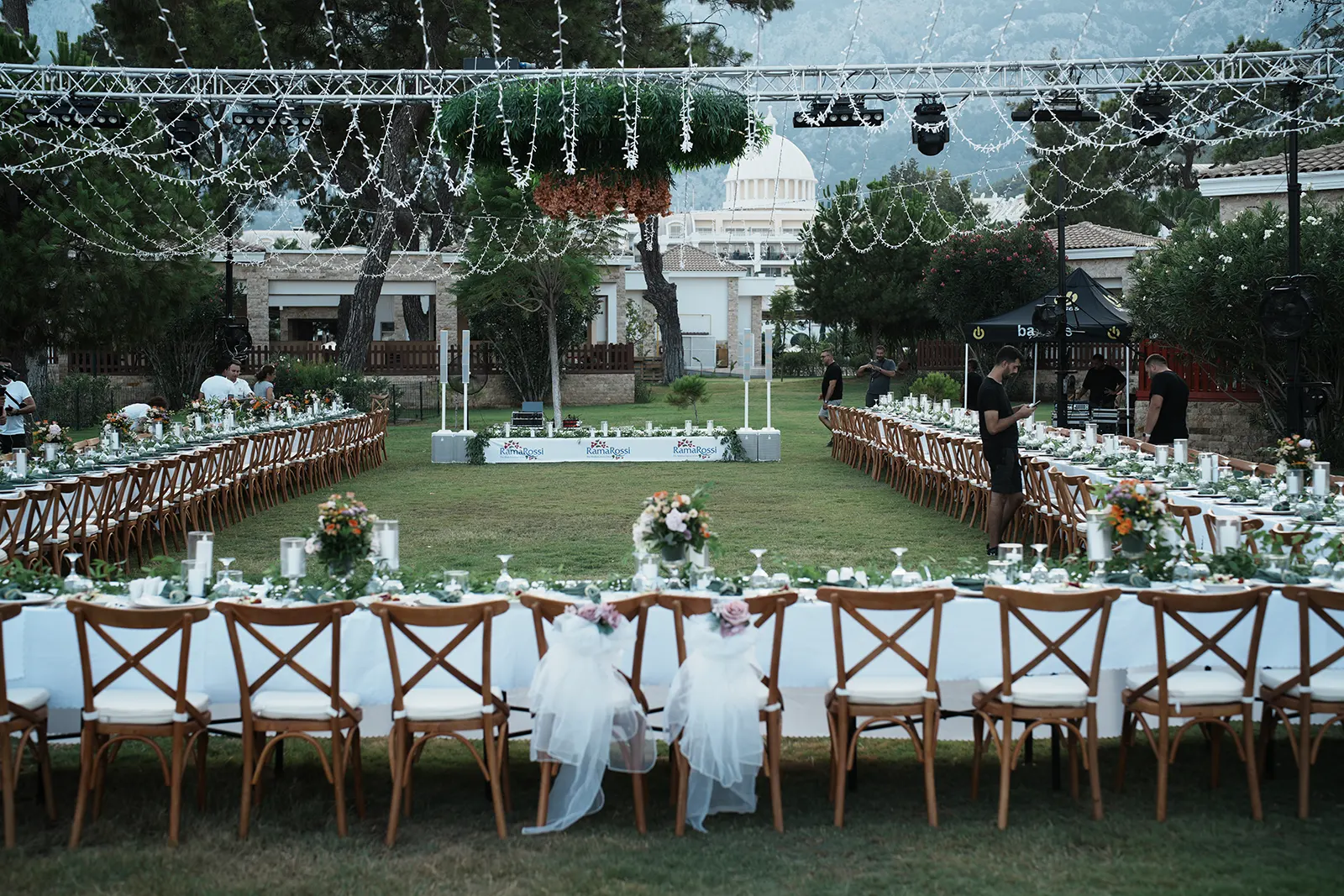
What Ramarossi coordinates
Ramarossi is a full-service wedding planner in Turkey, based in Antalya. We plan the celebration: venue selection, layout, programme, design, suppliers, guest logistics and the wedding day itself. Legal eligibility, documents and registration remain with the couple and the Turkish and home-country authorities; we are not a marriage registry or legal adviser, and we do not guarantee that an application will be approved.
- Your preferred destination and approximate date.
- Estimated guest count and where guests will travel from.
- Whether the day will be a civil marriage, a symbolic ceremony or a multi-day celebration.
- Family traditions, music or dietary needs we should plan around.
Planning a wedding in Turkey?
Tell Ramarossi your preferred destination, date, guest numbers and whether your day in Turkey will be a civil marriage or a symbolic ceremony. We will plan the celebration around your legal steps.
Prefer another email service? Write to info@ramarossi.com using Wedding in Turkey Enquiry - International Couple as the subject.
Follow our celebrations
Discover beautiful weddings, private events, styling ideas and behind-the-scenes moments from Ramarossi in Turkey.
Frequently Asked Questions
Can foreigners legally get married in Turkey?
Yes. A Turkish citizen and a foreigner, or two foreigners of different nationalities, can marry before an authorised Turkish marriage officer. Two foreigners of the same nationality can also marry at their own consulate in Turkey if their national law allows it.
Where do foreigners get married in Turkey?
At the marriage office (evlendirme dairesi) of the municipality, or at a population directorate, in the district where you want to marry. Contact that office first for its checklist and appointments.
What is a certificate of no impediment?
A document from your own country’s authorities or consulate confirming that nothing prevents you from marrying. In Turkey it must show your name, surname, parents’ names and date of birth, and be authenticated in an accepted form. Its name varies between countries.
Do all foreign documents need an apostille?
No. Countries in the International Commission on Civil Status use multilingual documents, Hague Convention countries use an apostille, and others need consular legalisation. Which applies depends on the country that issued the document.
Do we need an interpreter?
If the foreign partner does not speak Turkish, an interpreter must be present at the application and at the ceremony.
Is there a waiting period or public notice before the marriage?
Turkish official guidance states that no public announcement is needed before the marriage. The office sets the date and time once your file is complete, so timing depends on your documents and the office’s appointments.
Which marriage certificate do we receive?
A Turkish family book (aile cüzdanı) and, on request, a multilingual marriage certificate. For use abroad, the Ministry of Foreign Affairs names the Formül B marriage record extract from a population directorate.
Is there separate paperwork for Muslim and non-Muslim couples?
No. Civil marriage in Turkey is not divided by religion. Any religious or cultural ceremony is a separate part of the celebration.
Can we have a symbolic wedding in Turkey if we are already married?
Yes. A symbolic ceremony can be planned as its own event, subject to the venue’s arrangements. It does not create a second legal marriage.
Do we need to live in Turkey to get married there?
No. Foreign couples do not need to live in Turkey or hold a Turkish residence permit to marry there. This differs from some countries: for British couples marrying in Spain, for example, GOV.UK says one of you must live in Spain or be a Spanish national. See our Spain vs Turkey comparison.
Can Ramarossi handle our legal paperwork?
Ramarossi plans the wedding celebration. Issuing, authenticating and approving legal documents stays with the marriage office, notaries and the relevant authorities.
Official sources: General Directorate of Population and Citizenship Affairs · Antalya Metropolitan Municipality · Turkish Ministry of Foreign Affairs consular FAQs. Requirements can change; confirm the current list with your marriage office.