


How to Choose an Engagement Ring: Shape, Metal, Stone and Size Explained
The 4Cs, shapes, settings and metals in plain English, plus what to know about buying a ring in Turkey and keeping it safe on a Mediterranean holiday.
How to choose an engagement ring comes down to four decisions, the stone, its shape, the setting and the metal, each made around the hand that will wear it every day.
This guide takes those decisions one at a time, with gemstone and metal facts checked against GIA, the Gemological Institute of America. Because Ramarossi plans proposals and weddings on the Turkish coast, the later sections also cover what matters when you plan from abroad: buying a ring in Turkey, looking after it in sun, sand and sea, and carrying it safely to a proposal in Antalya, Turkey.
How to Choose an Engagement Ring: Start With the Wearer
Before you look at a single diamond, look at the person. The jewellery they already wear is the clearest brief you will get: white or yellow metal, fine or bold pieces, one statement ring or several stacked together.
Daily life matters as much as taste. A surgeon, a climber or a parent of small children may prefer a low setting with nothing tall to snag on gloves or knitwear, while a desk job allows a higher, more open setting that lets light in from the sides.
For a surprise, a sibling or close friend can help without giving the game away; otherwise, choosing together removes the guesswork. Either way, decide early what you care about more, whether size, sparkle, colour or one particular shape, so the budget follows that priority.
The 4Cs in Plain English
GIA developed the 4Cs in the 1950s as a shared language for describing diamonds, and explains each factor on its 4Cs of diamond quality page. In short:
- Cut. How well the proportions, symmetry and polish send light back to your eye. A well-cut stone looks bright and lively, while a poorly cut one can look flat even with fine colour and clarity. GIA grades the cut of round diamonds from Excellent to Poor.
- Colour. A scale running from D, which is colourless, to Z, which shows a light yellow or brown tint. Neighbouring grades are hard to tell apart once a stone is set.
- Clarity. How free the stone is from internal inclusions and surface blemishes, graded in eleven steps from Flawless down to Included. In the middle grades, inclusions can be hard to find without magnification.
- Carat. Weight, not size. One metric carat is 0.2 grams, split into 100 points, so a 50-point diamond weighs half a carat. Equal weights can look different in size depending on the cut.
One word trips people up. For gold, carat (spelt karat in the US) measures purity rather than weight: 18 carat gold is 75 per cent pure. And ask to see any stone in daylight and ordinary room light, not only under the jeweller’s spotlights.
Diamond Shapes Compared
Shape is the outline of the stone seen from above, and it sets the character of the whole ring. The round brilliant is the classic; fancy shapes give a more distinctive centre stone.
Classic brilliant faceting that sparkles from every angle
Any setting, and a wearer who wants a look that will not date
A softly elongated outline that can make the finger look longer
Solitaires and halos; check each stone for a darker bow-tie
A step cut with long, mirror-like facets and cut corners
Clean, architectural taste; clarity and colour show more openly
A teardrop with one rounded end and one point
A wearer who wants something different; protect the tip with a V-prong or bezel
Square or rectangular with rounded corners and a gentle glow
Vintage-inspired designs and halo settings
A crisp square with sharp corners and brilliant facets
Modern taste; the corners need prongs or a bezel
A long boat shape pointed at both ends
Statement and vintage rings; both points need protecting
| Shape | Look | Suits |
|---|---|---|
| Round | Classic brilliant faceting that sparkles from every angle | Any setting, and a wearer who wants a look that will not date |
| Oval | A softly elongated outline that can make the finger look longer | Solitaires and halos; check each stone for a darker bow-tie |
| Emerald | A step cut with long, mirror-like facets and cut corners | Clean, architectural taste; clarity and colour show more openly |
| Pear | A teardrop with one rounded end and one point | A wearer who wants something different; protect the tip with a V-prong or bezel |
| Cushion | Square or rectangular with rounded corners and a gentle glow | Vintage-inspired designs and halo settings |
| Princess | A crisp square with sharp corners and brilliant facets | Modern taste; the corners need prongs or a bezel |
| Marquise | A long boat shape pointed at both ends | Statement and vintage rings; both points need protecting |
Elongated shapes such as oval, pear and marquise can show a darker band across the middle, known as a bow-tie. It varies from stone to stone, so judge each one in person or on video. Step cuts such as the emerald shape put inclusions on display, so a higher clarity grade earns its keep there.
Settings That Hold the Stone
The setting keeps the stone secure and shields it from knocks. It also decides how high the stone sits and how easily the ring can be cleaned or resized.
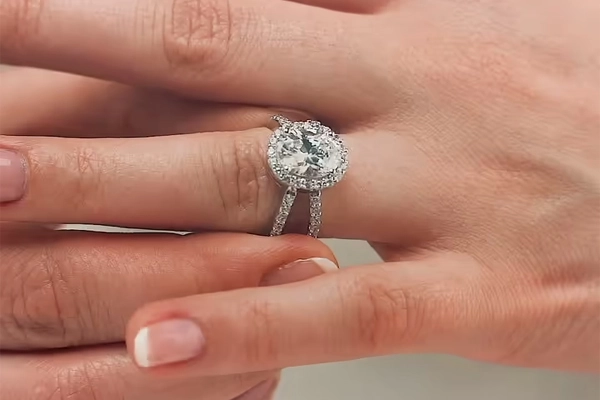
- Solitaire. A single stone on a plain band. Four prongs show more of the diamond; six hold it more securely and soften the outline.
- Halo. A circle of small stones around the centre, which makes it look larger and adds sparkle.
- Three-stone. A centre stone with a smaller one on each side, which some couples read as past, present and future.
- Pavé. Tiny diamonds set close together along the band, like a paved path. Lovely beside a solitaire, though a pavé or bead-set band is harder to resize than a plain one.
- Bezel. A thin rim of metal wrapped around the whole stone. A very protective choice for an active life and for pointed shapes such as princess and marquise, whose tips can chip.
Platinum or Gold: Choosing the Metal
Platinum is a dense, heavy white metal that stands up to decades of wear. Over time it takes on a soft patina, which some wearers love and others have polished away. In the UK, platinum is hallmarked by fineness, so 950 means 950 parts per thousand pure.
White gold is gold alloyed with white metals and finished with rhodium plating, which gives its bright white colour. That plating wears, so the ring may need re-plating now and then, and without it the metal can drift towards a warmer tone.
Yellow and rose gold need less upkeep than white gold. Their strength depends on purity: 14 and 18 carat gold are alloyed with other metals for strength and suit a ring worn daily, while 24 carat gold is soft and dents easily. GIA explains that rose gold takes its blush from copper mixed into the gold, which also makes it a little stronger than yellow gold of the same carat.
The metal also changes how the stone looks: white metals suit colourless diamonds, while yellow or rose gold can make a hint of warmth look deliberate. If a wedding band will sit beside the ring later, choose the two together so they lie flush.
Natural, Lab-Grown or a Coloured Stone
A laboratory-grown diamond is a diamond. GIA states that it has essentially the same chemical, physical and optical properties as a natural one; it is grown by one of two methods, known as HPHT and CVD. Nobody can tell the two apart by eye, and old-style diamond testers cannot either, which is why a report stating the origin matters.
The choice is personal. Some value the rarity and geological age of a mined stone; others prefer knowing exactly where their diamond was made. Both are graded on the same 4Cs.
If you would rather not have a diamond, three alternatives stand out:
- Moissanite. A separate gem made of silicon carbide. GIA rates it 9.25 on the Mohs hardness scale, just below diamond at 10. It shows more rainbow fire, and because it is doubly refractive the back facets can look doubled.
- Sapphire. Corundum, the same mineral as ruby, at 9 on the Mohs scale and hard enough for daily wear. Blue is the classic, and sapphires also come in pink, yellow, green, purple and the rare pinkish orange called padparadscha.
- Emerald. Softer, at 7.5 to 8, and inclusions are a normal part of its character; the trade calls them the jardin, French for garden. Fractures are commonly filled with oil or resin, so GIA advises against ultrasonic and steam cleaning.
Getting the Ring Size Right, Quietly
A jeweller’s ring sizer gives the surest result. For a surprise, borrow a ring your partner wears on the same finger of the same hand and have a jeweller measure it. GIA cautions that this is only an estimate, because size varies from finger to finger.
Fingers also swell in heat, which matters if you measure in a cool British autumn and propose in an Antalya summer. Sizing systems differ too: the UK uses letters, the US numbers, and other countries their own scales, so abroad give the jeweller the inner diameter in millimetres.
If in doubt, go very slightly large: rings can be resized up or down by a size or two, and a plain solitaire band is easier to alter than one set with pavé.
Grading Reports and Responsible Sourcing
For any diamond of real value, ask for an independent grading report from a recognised laboratory such as GIA or IGI. It records the 4Cs grades and confirms whether the stone is natural or laboratory-grown and whether it has been treated. Check that the report number matches the stone, which may carry it as a tiny laser inscription on its edge, and keep a copy with your receipt for valuers and insurers.
On sourcing, the Kimberley Process describes itself as an international initiative and intergovernmental forum to exclude conflict diamonds from the legitimate trade, and its certification scheme for rough diamonds came into force in 2003. It defines conflict diamonds as rough diamonds used by rebel movements or their allies to finance conflict aimed at undermining legitimate governments. Ask your jeweller how the stone was sourced and whether the invoice carries a written warranty about it.
Buying a Ring in Turkey
Istanbul’s Grand Bazaar, Kapalıçarşı in Turkish, dates back to the 15th century and is one of the oldest covered markets in the world, a network of 61 covered streets with lanes of gold and silver jewellers. It is closed on Sundays and public holidays. If you are also weighing up a wedding in Istanbul, a shopping day fits easily into a planning visit.
Gold in Turkey is sold by ayar, the Turkish word for carat. You will see 14, 18 and 22 carat pieces, stamped 585, 750 and 916 for their purity in parts per thousand. Higher-carat gold is softer, worth remembering for a band that grips a stone.
Wherever you buy, ask for a grading report for any significant diamond and an itemised receipt listing the metal, its fineness and each stone, and compare more than one shop.
Customs allowances for bringing the ring home depend on your home country, so check them before you travel and declare anything over the limit. For the UK, GOV.UK explains bringing goods into the UK for personal use; elsewhere, check with your own customs authority.
For the rest of the wedding day jewellery, for both of you, see our tips on choosing wedding jewellery and accessories.
Engagement Ring Customs: Turkish, Persian and Beyond
In Turkey, the ring at a proposal may be a solitaire, which Turkish jewellers sell as a tek taş, literally “single stone”. The engagement then has its own stages: the söz, a promise agreed between the two families, and the nişan, a formal engagement party. At the nişan, the couple’s rings are tied together with a red ribbon; a family elder slips them onto the couple’s fingers and then cuts the ribbon.
In Persian families, the engagement, or namzadi, can be celebrated with a ring, gifts and sweets ahead of the aghd and the aroosi. How those stages differ is explained in our guide to the Persian engagement and wedding.
Which hand the ring lives on varies by country and family. If it will move hands at the wedding, size it for the finger it will end up on, since fingers on the dominant hand can be slightly larger. To celebrate with both families, an engagement party in Antalya brings everyone to the coast before the wedding.
Caring for the Ring on a Beach Holiday
Sun cream, sand, salt and pool water all affect jewellery, so a few habits help.
- Take it off to swim. GIA warns that chlorine can pit and damage gold alloys, and cool sea water can shrink fingers enough to lose a ring.
- Sun cream first, ring second. Lotion leaves a film that dulls sparkle, so put the ring on once it has soaked in.
- Keep it away from sand. Sand contains quartz, which is hard enough to scratch gold and platinum, so leave the ring off for digging and beach games.
- Use the room safe. Store the ring in its own box or pouch, never loose in a bag or on a sun lounger.
- Clean it gently. Warm water, a drop of mild washing-up liquid and a soft brush suit diamonds, sapphires and emeralds.
- Check the claws. GIA suggests having jewellery checked every six months; after a holiday, ask a jeweller to look over the prongs.
If you are planning a beach wedding in Antalya, the same habits apply on the day: hand the ring to someone you trust before stepping into the sea for photos.
Bringing the Ring to an Antalya Proposal
If you will ask the question on holiday, pack the ring in your hand luggage and never in a checked bag. A box makes a telltale bulge in a pocket, so a soft pouch can be easier until the day. Check that your insurance covers the ring abroad, and carry the receipt and report for customs on the way home.

A sunset beach, a candlelit dinner or a private sunset cruise on the bay are all possible here, and our guide to planning a marriage proposal in Antalya looks at settings, timing and keeping the surprise. Ramarossi creates proposal set-ups along this coast, from rose hearts on the shingle to giant letters on the sand.
Tell us about the moment you have in mind
Share your dates, the setting you imagine and where you are travelling from, and Ramarossi will come back with ideas for a proposal or a wedding on the Antalya coast.
Prefer another email service? Write to info@ramarossi.com using Antalya Wedding Enquiry as the subject.
Follow our celebrations
Discover beautiful weddings, private events, styling ideas and behind-the-scenes moments from Ramarossi in Turkey.
Frequently Asked Questions
What engagement ring should I buy?
The right ring depends on who will wear it. Start with the metal and style they already wear and their daily routine, choose a shape they love, then balance the 4Cs within a comfortable budget.
What are the 4Cs of a diamond?
Cut, colour, clarity and carat weight. Cut is how well the stone returns light, colour is graded from D (colourless) to Z, clarity describes inclusions and blemishes, and carat is weight, with one carat equal to 0.2 grams.
How can I find out my partner’s ring size secretly?
Borrow a ring they wear on the same finger of the same hand and have a jeweller measure it, or ask a close friend to help. A plain band can be resized up or down by a size or two later.
Should we choose platinum or gold?
Platinum is a dense white metal that resists wear and develops a soft patina. White gold has a rhodium plating that may need renewing, while yellow and rose gold need less upkeep.
Are lab-grown diamonds real diamonds?
Yes. GIA states that laboratory-grown diamonds have essentially the same chemical, physical and optical properties as natural ones. Ask for a grading report that states the origin.
Can I buy an engagement ring in Turkey and take it home?
Yes. Ask for a grading report for any significant diamond and an itemised receipt showing the metal fineness and the stones. Customs allowances depend on your home country, so check them before you travel and declare anything above the limit.
Should I take my engagement ring off at the beach?
Yes, for swimming and beach games. Pool chlorine can damage gold alloys, sand can scratch metal, and cool water can loosen a ring on the finger.
What happens at a Turkish engagement?
A Turkish engagement can include the söz, a promise between the two families, and the nişan, a formal engagement party. At the nişan the couple’s rings are tied together with a red ribbon, and a family elder places the rings and cuts the ribbon.