


A cliffside or elevated sea-view venue can be an excellent setting for an Antalya wedding, but a dramatic view does not by itself confirm that a property will work for the wedding being planned. Once guests, suppliers, catering, production, lighting, sound and the evening programme are added to the picture, the site has to support the complete event safely and practically, not just photograph well.
Before booking a cliffside wedding venue in Antalya, couples should check five things: how guests will move around the site, how suppliers will get equipment and catering in and out, how the space performs once wind and weather are involved, how sound and the evening programme can actually operate there, and how the venue manages safety around edges, levels and service routes.
The right question is not whether a venue has a cliff or a sea view. It is whether that specific property can support the wedding being planned, with the guest list, catering style, entertainment and timings the couple actually wants.
What Does “Cliffside Wedding Venue” Actually Mean?
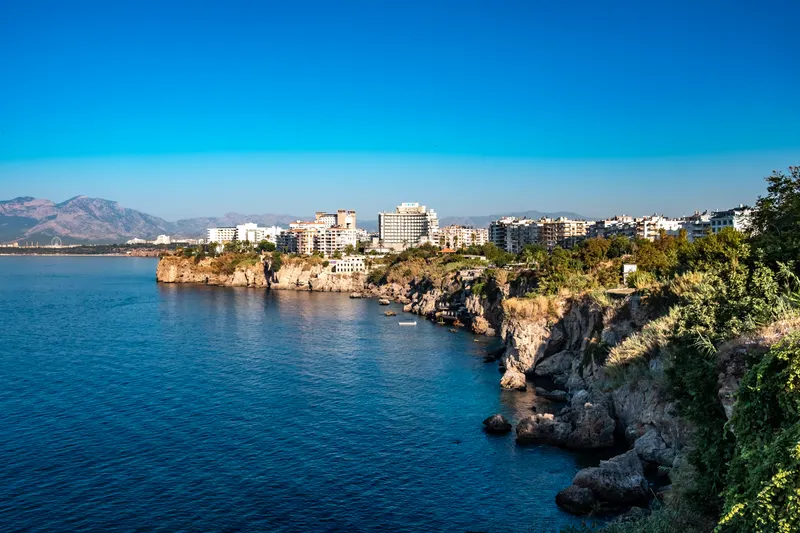
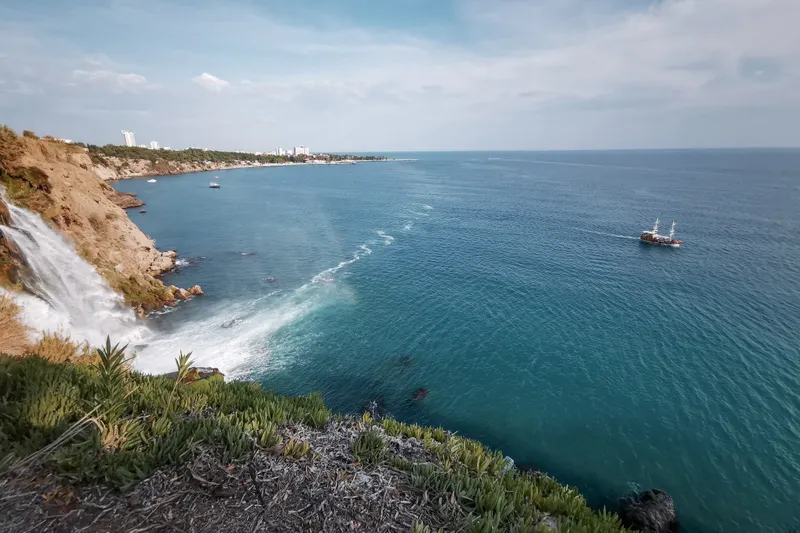
“Cliffside” is a descriptive term used for a range of Antalya properties rather than a formal category. It might refer to a hotel terrace set above the coastline, a private event property positioned on high ground, a restaurant or venue with an exposed sea-facing edge, or another elevated site marketed for its outlook.
These properties can differ considerably in layout, guest access, exposure to wind, event space and the way suppliers reach the site. A venue’s description or marketing photography says little about how it will actually function on the day. What matters is the specific property’s layout and operating arrangements, which need to be assessed individually rather than assumed from the setting.
Start With the Full Guest Route
Before considering décor or atmosphere, walk the complete guest route: arrival, ceremony, drinks, dinner, dancing, toilets and departure.
At each stage, consider:
- steps, slopes and changes in surface;
- narrow passages or pinch points;
- handrails or edge protection where the route runs close to a level change;
- lighting once it gets dark;
- the distance between spaces, and whether guests will need to move between different terraces or buildings;
- how the route works for guests who may find stairs or longer walking distances difficult.
None of this means a cliffside venue is unsuitable for older or less mobile guests. It means the actual route needs to be walked and assessed for the guest list in question, rather than judged from photographs of the view.
Guest Drop-Off and Vehicle Access
Vehicle access is worth confirming early, since it affects how the evening starts and ends. Useful questions for the venue include:
- Where do guest vehicles stop, and how far is that from the ceremony or reception space?
- Is the route from drop-off suitable for the vehicles guests will actually be using, including any larger vehicles?
- Where do taxis or private transfers wait during the event, and where do they return at the end of the night?
- Is there a practical route for guests who cannot manage stairs or a longer walk from the drop-off point?
These answers vary from property to property, so they should be confirmed directly with the venue rather than assumed from its general location.
Supplier Access Is a Different Question
Guest access and supplier access are not the same thing, and it is easy to check one and overlook the other. Catering, florals, furniture, sound and lighting suppliers often need a different route into the venue, sometimes with heavier equipment and less flexible timing.
Worth confirming with the venue:
- where suppliers unload, and how far that is from the event space;
- whether the route to the event space involves stairs, lifts or narrow passages;
- how larger items such as furniture, staging or bars are brought in;
- what the setup and breakdown access looks like, and whether it is separate from the guest route;
- whether supplier and guest routes are likely to overlap during the event.
If supplier access is difficult, this can affect setup time, the scale of production that is realistic, and how smoothly the event runs, so it is worth raising with the venue before committing to a particular layout.
Test the Real Event Layout, Not the View
A terrace or garden can look generous when it is empty and photographed without furniture. The practical test is to picture it with everything the wedding actually needs in place: ceremony seating, dinner tables, a dance floor, a DJ or band area, a bar, catering and service space, décor, technical equipment, and room for guests and photographers to move around safely.
Where the site includes changes in level or an exposed edge, guest circulation around those areas is part of the layout question, not a separate consideration. A layout that looks workable on a floor plan can feel very different once real furniture, staging and guest numbers are added, so it is worth asking the venue to talk through the layout for the actual guest count and programme rather than relying on a generic capacity figure.
Wind Changes More Than the Ceremony Décor
Exposure to wind is one of the main practical differences between an elevated or cliffside site and a more sheltered venue. It can affect more than the ceremony arch. Depending on the specific site and the day, wind can be relevant to:
- floral structures and larger installations;
- fabric, draping and signage;
- table décor and any lightweight objects;
- candles or open flame, where these are part of the plan;
- sound equipment and speaker placement;
- lighting rigs and cabling;
- any temporary structures, such as a marquee or covered area.
None of this means an exposed site cannot host these elements. It means the specific installation needs to be planned with the site’s actual conditions in mind, and that is a question for the relevant suppliers and the venue rather than a general rule that applies to every cliffside property.
Ask What the Venue’s Wind Plan Actually Is
Rather than asking whether a venue is windy, it is more useful to ask what happens when it is. Questions worth raising with the venue include:
- Which areas of the site are most exposed, and is there a more sheltered alternative on the property?
- Who decides whether to adjust or move part of the setup, and at what point in the day is that decision made?
- Which décor or production items have operating limits set by their supplier or manufacturer, and who is monitoring conditions on the day?
- Can the ceremony or dinner be moved to a different part of the property without rebuilding the whole event?
Any specific technical threshold, such as when a structure needs to be secured differently or moved, should come from the supplier or manufacturer responsible for that equipment, not from a general assumption about cliffside venues.
Edge Protection, Levels and Guest Safety
Where a route or gathering space runs close to a change in level, it is worth understanding, in practical terms, how the venue manages that area during an event. This is a planning question rather than a technical inspection, and it typically covers:
- where guests are likely to gather or pass close to an edge or level change;
- what barriers or edge protection the venue has in place;
- lighting along those routes after dark;
- how furniture is positioned so that circulation stays clear of edges and steps;
- any particular considerations for children or older guests, where relevant to the guest list.
Confirming that a property meets applicable safety or building standards is a matter for the venue and the appropriate qualified professionals, not something a wedding planning team can certify. What planning can usefully do is make sure the event layout works with the site’s edges and levels rather than against them.
Lighting Becomes an Operational Requirement After Dark
Once the sun goes down, lighting stops being a décor choice and becomes part of how safely and smoothly the evening runs. Areas worth thinking through include:
- guest routes between spaces, including steps and changes in level;
- service routes used by catering and other suppliers;
- the dinner and dance areas;
- zones where suppliers are working, such as the bar or technical area;
- entrances, exits and any area where visibility around an edge matters.
Specific technical standards for event lighting, such as required light levels, are outside the scope of wedding planning and should be addressed by the venue and its own technical requirements. What matters for the couple is confirming, with the venue, that the routes and working areas they will actually use after dark are properly lit.
Sound: Do Not Assume a Sea View Means Sound Freedom
A coastal or elevated position does not tell you anything reliable about what music arrangements a venue allows. Sound permissions and practical arrangements are specific to each property and often to each part of that property. Useful questions to ask a specific venue include:
- Is amplified music accepted in the area being considered for the ceremony, dinner or dancing?
- Does the arrangement change later in the evening, and if so, at what point?
- Are outdoor and indoor areas treated differently for sound?
- Where can speakers be positioned, and are there any restrictions on their placement or direction?
- Is there another space on the property available if the event needs to continue later than the main area allows?
- What is the contractual finishing time that applies to the space being booked?
No figure for a decibel limit should be assumed, and a coastal or elevated setting should never be treated as evidence that sound carries less or is subject to fewer restrictions. These points need to be confirmed with the specific venue, in writing, for the exact space being booked.
Main Reception and After-Party
In Ramarossi’s operational experience of Turkish wedding-venue practice, the main wedding and reception programme is normally structured to finish at approximately 00:00. Any continuation after that is treated as an after-party.
An after-party may continue later, commonly to around 02:00 in Ramarossi’s operational experience, only where the specific venue and the specific event space are permitted and contractually able to operate at that time. If outdoor amplified music is specifically permitted after 00:00 for that venue and space, the after-party may continue outdoors within that permission. Otherwise, later continuation may need to move to an authorised indoor or enclosed space.
Neither approximately 00:00 nor approximately 02:00 is a universal statutory finishing time, and the visual isolation of an elevated or cliffside property has no bearing on what a venue is permitted to do late at night. The exact finishing times, and the exact spaces they apply to, for both the main reception and any after-party, should be confirmed with the specific venue in writing.
Catering and Service Routes on an Elevated Site
Catering logistics on an elevated or multi-terrace property are worth checking in detail, since the distance and route between preparation and service areas can be longer or more complex than on a single flat site. Points to raise with the venue include:
- where food is prepared or plated, and how far that is from the dining area;
- whether the service route involves stairs or a lift;
- where the bar is positioned relative to guest areas;
- how used plates, glassware and equipment are returned during service;
- storage and any refrigeration needs on site, where relevant;
- how staff move around the site during service without crossing guest routes unnecessarily;
- how waste is removed after the event.
Not every cliffside venue requires temporary catering equipment. Some have full on-site kitchens and established service routes, while others need more planning. The only way to know is to ask the venue and, where outside caterers are involved, to walk the route with them directly.
Power, Sound and Lighting Need a Site-Specific Technical Plan
Whether a venue’s existing power supply can support catering, bar service, sound, lighting, entertainment and production on the day is a question for the venue and the relevant technical suppliers, not something to assume from the property type. If additional or backup power is needed, the requirement and the equipment used should be worked out for the specific event by the professionals responsible for it.
The planning point here is simply to raise the question early. Confirming existing infrastructure, and whether it is sufficient, well before the wedding date avoids last-minute technical surprises on an elevated site where bringing in additional equipment may take more coordination than at a more accessible venue.
Weather Backup Must Be More Than “There Is an Indoor Room”
An indoor space being available is not the same as a workable weather plan. A proper backup needs to support whatever the wedding actually involves: the ceremony if it needs to move indoors, the full dinner, dancing, the bar, catering and the equipment already planned for outdoors.
For a cliffside or elevated venue specifically, it is also worth asking whether moving indoors changes the supplier route, the service route, the sound arrangement or how guests move around the site. A backup room that works on paper can create a very different event if guests, catering and production all have to be reorganised in it at short notice, so it is worth walking through the indoor plan in the same detail as the outdoor one.
Emergency and Service Access Need to Stay Clear
The venue should be able to explain its own emergency access and event-safety arrangements, since these are set by the property and, where applicable, the relevant authorities, not by the wedding planning team.
What planning can do is make sure that furniture, décor, staging and other layout decisions do not block routes the venue needs to keep clear, including exits, service access and any area identified by the venue as required to remain open. This is a practical layout consideration to raise with the venue during planning, not a certification that Ramarossi is able to provide.
What to Check During a Cliffside Venue Visit
A site visit is more useful when it follows the actual event rather than a general tour. A practical approach:
- Arrive using the route guests would use, not a shortcut.
- Identify the actual drop-off point for guest vehicles.
- Walk the full guest route from arrival to departure.
- Walk the supplier route separately, including where deliveries and setup would happen.
- Look at steps and level changes with evening lighting conditions in mind, not just daylight.
- Stand in the proposed ceremony position and picture the seating in place.
- Mark out the dinner footprint, dance floor and bar to see how the space performs with furniture in it.
- Identify the catering and service route.
- Identify where technical equipment would be set up.
- Look at the weather backup space in the same detail as the main outdoor plan.
- Look at the proposed after-party space, if one exists.
- Ask which areas of the property are most exposed to wind.
- Ask which routes need to stay clear for emergency or service access.
- Ask where and until when sound can operate in each area being considered.
Working through this list on site, rather than relying on photographs or a general description, is the most reliable way to judge whether a specific cliffside property fits the wedding being planned.
Cliffside Wedding Venue Decision Table
| Area to Check | Why It Matters | What to Inspect | What to Confirm |
|---|---|---|---|
| Guest arrival | Sets the tone and affects mobility for all guests | Drop-off point, distance to venue, surface and lighting | Vehicle access suitable for the guest group and any mobility needs |
| Guest circulation | Determines how comfortably guests move through the event | Steps, slopes, distances between spaces | Route works for the full guest list, including older or less mobile guests |
| Supplier load-in | Affects setup time and the scale of production possible | Unloading point, route to event space, stairs or lifts | Access suitable for the equipment and catering being planned |
| Ceremony layout | Confirms the space works with real seating and structure in place | Ceremony position, seating footprint, sightlines | Layout accommodates the actual guest count and any structure |
| Dinner and dancing layout | Confirms the space performs once tables, dance floor and bar are added | Footprint for tables, dance floor, bar and service | Layout works with the intended catering and entertainment format |
| Wind exposure | Affects décor, structures, sound and comfort | Most exposed areas, availability of a sheltered alternative | Venue’s process for adjusting the setup if conditions require it |
| Décor and structures | Determines what can be safely installed and where | Planned floral structures, fabric, signage, lighting rigs | Supplier-confirmed operating limits for the specific installation |
| Edge and level safety | Affects guest safety during circulation | Barriers, edge protection, route lighting near level changes | Venue’s arrangements for managing guest movement near edges |
| Lighting | Becomes essential for safety and service after dark | Guest routes, service routes, working areas after dark | Adequate lighting confirmed for every route and area in use |
| Catering and service | Confirms food and drink service can run smoothly | Preparation area, service route, bar position, waste removal | Service route suitable for the catering style being planned |
| Power and production | Confirms technical equipment can be supported | Existing power supply, access for technical suppliers | Power and access sufficient, or backup arranged by professionals |
| Sound | Confirms the intended music programme is actually possible | Areas where amplified music is accepted, speaker placement | Written confirmation of sound permissions for each area and time |
| Main reception | Confirms the core programme fits the venue’s normal operating practice | Contractual finishing time for the reception space | Finishing time confirmed in writing for the space being booked |
| After-party | Confirms whether later continuation is realistically available | Availability of an after-party space, indoor or outdoor | Finishing time and permitted space confirmed in writing |
| Weather backup | Confirms the wedding can still run if plans change | Indoor space capacity for ceremony, dinner, dancing and bar | Backup space tested against the full event, not just guest seating |
| Emergency and service routes | Keeps the event safe and compliant with venue requirements | Routes the venue requires to remain clear | Layout plan does not block routes identified by the venue |
When a Cliffside Venue May Be a Strong Fit
A cliffside or elevated property may deserve strong consideration where:
- the guest route works comfortably for the group attending;
- supplier access supports the catering, décor and production being planned;
- the event space genuinely fits the ceremony, dinner and entertainment format;
- exposed areas can support the planned production, based on supplier and venue confirmation;
- the venue’s safety arrangements around edges and levels are clear;
- catering and service routes work for the chosen catering style;
- sound arrangements fit the intended music programme;
- the weather backup is credible for the whole event, not just part of it;
- the evening plan, including any after-party, fits what the venue can actually offer.
When Another Venue May Work Better
A different property may be the better choice where:
- guest access is impractical for the group actually attending;
- supplier load-in becomes disproportionately difficult for the planned production;
- the usable event space is too restricted for the guest count or format;
- the intended level of production cannot realistically be delivered on site;
- weather backup does not support the complete event;
- sound or evening arrangements do not fit the couple’s plans;
- the site raises safety or operational concerns that cannot be resolved for the event being planned.
This does not mean cliffside venues are a riskier category of property. It means, as with any venue, that the specific site needs to fit the specific wedding, and where it does not, another property may serve the couple better.
Put the Operational Answers Into the Booking Process
Once a cliffside property has been assessed against guest access, supplier access, wind, sound and safety, the agreed arrangements for each of these areas should be recorded clearly before the couple commits to the venue. This includes finishing times, permitted areas for amplified music, weather backup arrangements and any conditions relating to access or setup.
Our Antalya wedding venue contract checklist sets out the kind of terms worth confirming in writing before signing. Ramarossi does not provide legal review of venue contracts, and couples with specific legal questions about a contract should raise them with a qualified lawyer.
How Ramarossi Plans a Cliffside Wedding in Antalya
Choosing a cliffside or elevated venue is only the starting point. Ramarossi can coordinate the process of turning a specific property into a workable wedding plan, including defining the venue brief, shortlisting and communicating with properties, assessing sites in person, planning guest and supplier routes, and working through ceremony and dinner layouts.
This coordination extends to catering, bar and service planning, décor and floral logistics, furniture, lighting, sound, entertainment, and coordination with photography and videography teams. It also covers guest transport, weather backup planning, after-party arrangements, the setup and breakdown schedule, and coordination between suppliers and the venue on the wedding day itself.
The value of this process is not simply finding a sea-view terrace. It is converting a specific site, with its own access points, exposure and operating arrangements, into an event that works in practice for the couple’s guest list, catering style and evening plans.
Ramarossi does not certify structural safety, provide engineering approval, act as a licensing authority, offer legal review of venue contracts, or guarantee venue permissions, weather or availability. These matters remain with the venue, the relevant authorities and appropriately qualified professionals.
If you are considering a cliffside or elevated sea-view venue for your Antalya wedding, Ramarossi can help define the operational requirements, assess shortlisted properties against your actual wedding plan, and coordinate the planning process around the venue you choose. Share your preferred date, approximate guest count, any venue you are already considering, your ceremony and dinner format, entertainment plans, accessibility needs and whether an after-party matters to you, and we can help you work out whether a specific property will support the wedding you have in mind. Visit our wedding planning services page to find out more about how we work.
Frequently Asked Questions
Is a cliffside wedding venue in Antalya suitable for every guest list?
Not automatically. Suitability depends on the specific property’s access, layout and event space, and on the guest list being planned for. The route from arrival to departure should be walked and assessed for the actual guests attending, including anyone with mobility needs, rather than assumed from the setting.
What access should we check at a cliffside wedding venue?
Check both guest access and supplier access separately. Guest access covers drop-off, walking routes, steps and lighting. Supplier access covers where catering, furniture and technical equipment are delivered, and whether that route involves stairs, lifts or narrow passages.
How should wind be considered for a cliffside wedding?
Wind can affect décor, structures, sound equipment and lighting on an exposed site. Rather than assuming a general wind risk, ask the venue which areas are most exposed, whether a more sheltered alternative exists, and confirm operating limits for specific décor and equipment with the relevant suppliers.
Can amplified music be used at an Antalya cliffside venue?
This depends entirely on the specific venue and space. Sound permissions vary by property and often by area within the same property, and by time of evening. Ask the venue directly which areas allow amplified music, whether the arrangement changes later in the evening, and get the finishing time confirmed in writing.
What safety questions should we ask a cliffside venue?
Ask how the venue manages guest circulation near edges and level changes, what barriers or lighting are in place, and how furniture is positioned to keep routes clear. Confirming structural or regulatory compliance is a matter for the venue and qualified professionals, not something a wedding planning team can certify.
What weather backup should a cliffside wedding have?
A workable backup needs to support the complete event, not just seating. Check whether the indoor space can accommodate the ceremony if needed, the full dinner, dancing, the bar and catering, and whether moving indoors changes the supplier or sound arrangements.
Can a cliffside wedding have an after-party?
Sometimes, depending on the venue. In Ramarossi’s operational experience of Turkish wedding-venue practice, the main wedding and reception programme is normally structured to finish at approximately 00:00, with any continuation after that treated as an after-party. An after-party may continue later, commonly to around 02:00 in Ramarossi’s operational experience, only where the specific venue and event space are permitted and contractually able to operate at that time. Exact times and spaces must be confirmed with the venue in writing.
Can Ramarossi plan the complete wedding at a cliffside venue?
Yes. Ramarossi can coordinate the full planning process around a cliffside or elevated venue, from assessing the property against your wedding plan through to catering, décor, production and on-the-day coordination, while leaving safety certification, legal contract review and regulatory confirmation to the venue and appropriate professionals.